Facts
The four respondents were engaged as daily wage Group-D workers by the Customs Department in 1992.
Source reference: para 2They sought regularization and challenged an outsourcing tender in 2005 via an Original Application (O.A.) before the Central Administrative Tribunal (CAT).
Source reference: para 2The CAT initially dismissed the O.A. in 2006, but the High Court remanded the matter in 2017 for fresh consideration of whether the respondents were part-time workers or entitled to temporary status.
Source reference: para 2.1, 2.2On remand, the CAT, relying on internal departmental correspondence, granted the respondents "temporary status" under the Casual Labourers (Grant of Temporary Status and Regularisation) Scheme of 1993 ("Scheme of 1993") and directed the petitioners to consider them for regularization.
Source reference: para 2.4The petitioners challenged this before the High Court, contending that the respondents were merely part-time workers (3–4 hours daily) not covered by the Scheme, and that respondents No. 3 and 4 had already left service in 2009.
Source reference: para 3, 3(ix)Issues
1. Whether the respondents, despite being labeled as "part-time" casual workers, were entitled to temporary status and regularization under the Scheme of 1993 and established precedents.
Source reference: para 8, 9(i)2. Whether the direction for regularization remains valid for respondents who voluntarily left service prior to the adjudication.
Source reference: para 9, 9(ii)Law Applied
The court primarily applied the Casual Labourers (Grant of Temporary Status and Regularisation) Scheme, 1993, which mandates conferment of temporary status on casual labourers in employment as of 01.09.1993 who rendered at least one year of continuous service (206/240 days).
Source reference: para 6It relied on the landmark principle from Secretary, State of Karnataka v. Uma Devi (2006) 4 SCC 1, which allows for the one-time regularization of "irregular" (as opposed to "illegal") appointments if the employee has served for over 10 years.
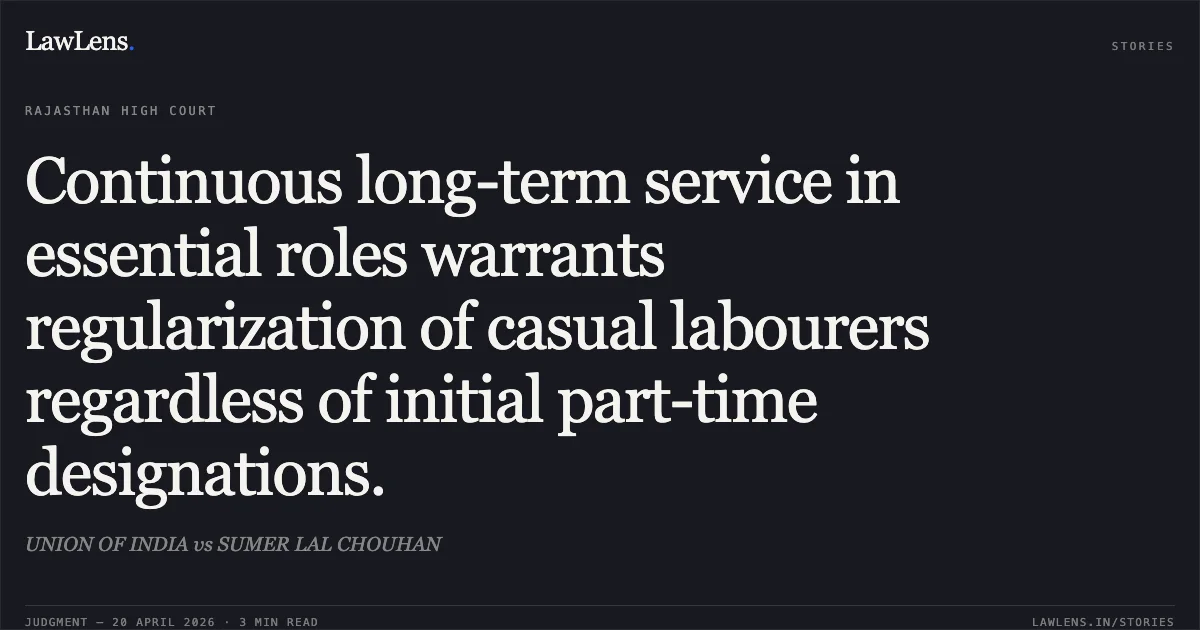
Source reference: para 9(ii)Furthermore, it applied the recent doctrine from Jaggo v. Union of India (2024 INSC 1034), which holds that "part-time" labels cannot be used to deny regularization if the workers performed essential, continuous tasks akin to regular posts for decades.
Source reference: para 9(iv)Reasoning
The Court scrutinized internal departmental communications from 2014 and 2015, which explicitly stated the respondents had been working since 1992/1993, completed the requisite service days, and in some instances, worked full 8-hour shifts.
Source reference: para 7, 7.1The Court found that for Respondents No. 1 and 2, who had completed over 30 years of service, the "part-time" label was a procedural formality that could not override the substantive reality of their indispensable, long-term service.
Source reference: para 9(iv), 9(v)Following Jaggo, the Court held that where service is continuous and the appointment is "irregular" rather than "illegal," fairness demands regularization.
Source reference: para 9(iv)However, regarding Respondents No. 3 and 4, the Court observed that regularization is inherently linked to ongoing employment. Since they left service in 2009, their claim for prospective regularization became infructuous, though they remained entitled to benefits accrued during their actual tenure.
Source reference: para 9(ii)Holding
The High Court partially upheld the CAT's order.
It dismissed the writ petition regarding Respondents No. 1 and 2, affirming their entitlement to temporary status and consideration for regularization due to their 30-year tenure.
Source reference: para 10(i)The petition regarding Respondents No. 3 and 4 was partly allowed; their entitlement to benefits under the CAT's order was restricted to the period they actually worked, terminating in 2009.
Source reference: para 10(ii)The petitioners were directed to comply with the modified directions.
Source reference: para 10Acts & Sections Cited
2 provisions across 1 statute referred to in this judgment. Linked provisions open on LawLens.
Casual Labourers (Grant of Temporary Status and Regularisation) Scheme, 19932
Original Court PDF
UNION OF INDIAvsSUMER LAL CHOUHAN
Click to open original judgment
Original judgment, available to read, download and summarize on LawLens.in