01Facts
The petitioner was appointed as a Junior Grade Typist in the Odisha Administrative Tribunal on 13 November 1997. He was subsequently permitted to perform the duties of Caretaker on an officiating/ad hoc basis from January 2007, with extensions granted from time to time and pay fixed in the higher scale applicable to the Caretaker post. Annual increments were also sanctioned up to 2012.
p. 2The petitioner applied through proper channel pursuant to an advertisement for regular recruitment to the post of Caretaker. He was selected and appointed regularly with effect from 31 August 2013.
p. 2His selection was challenged in O.A. No.3224(C) of 2014, which was dismissed, and the dismissal was affirmed in W.P.(C) No.11912 of 2016.
p. 4The Government subsequently refused to grant post facto approval for the petitioner’s officiating service from 28 February 2013 to 30 August 2013, contending that his continuance beyond six months lacked Finance Department approval and that his selection involved impermissible age relaxation.
p. 6By order dated 25 October 2019, the Government directed recovery of the financial benefits and increments paid to him. His pay was thereafter refixed at the lower scale applicable to his substantive post with effect from 31 August 2013.
p. 502Issues
i.1. Whether the petitioner’s regular appointment as Caretaker was invalid because the Chairman of the Odisha Administrative Tribunal granted age relaxation without prior concurrence of the Government or Finance Department?
p. 15ii.2. Whether the petitioner was entitled to financial benefits, including increments, for officiating as Caretaker from 28 February 2013 to 30 August 2013 under Rule 96 of the Odisha Service Code?
p. 13iii.3. Whether the Government could direct recovery of the financial benefits already paid and refix the petitioner’s pay after several years of continuous officiation and subsequent regular appointment?
p. 1203Law Applied
The Court applied Rule 96 of the Odisha Service Code, under which the pay of a Government servant officiating in a higher or additional post may be regulated with reference to the highest post held; Rule 77, relating to admissibility of annual increments after qualifying service; and Rule 52 of the Odisha Service Code, which permits relaxation of the upper age limit in special cases.
p. 13Read with Rule 5 and Item 3 of Appendix-I of the Odisha Service Code, the power to relax the maximum age limit had been delegated to the appointing authority.
p. 17Under Rules 7 and 22 of the Odisha Administrative Tribunal (Recruitment and Conditions of Service of Officers and Staff) Rules, 1999, the Chairman of the Tribunal was the appointing authority for the relevant post and could therefore exercise the delegated power of age relaxation.
p. 18Rule 10(b) of the 1999 Rules prescribed age relaxation for specified categories but did not create a bar against an eligible in-service candidate participating in direct recruitment with lawful age relaxation.
p. 1904Reasoning
The Court held that the petitioner’s regular selection had not been invalidated in the earlier challenge; both the Original Application and the subsequent writ petition had been dismissed, and he continued in service and later received promotion.
p. 15On interpreting Rule 52 with Rule 5 and Appendix-I of the Odisha Service Code, the Court concluded that the Chairman, being the appointing authority under Rule 22 of the 1999 Rules, was competent to grant the petitioner age relaxation. Consequently, the Government could not subsequently challenge the appointment on the ground that Finance Department concurrence was absent.
p. 17The Court further found that the petitioner had continuously officiated as Caretaker, with the Government’s knowledge and repeated extensions, until his regular appointment on 31 August 2013.
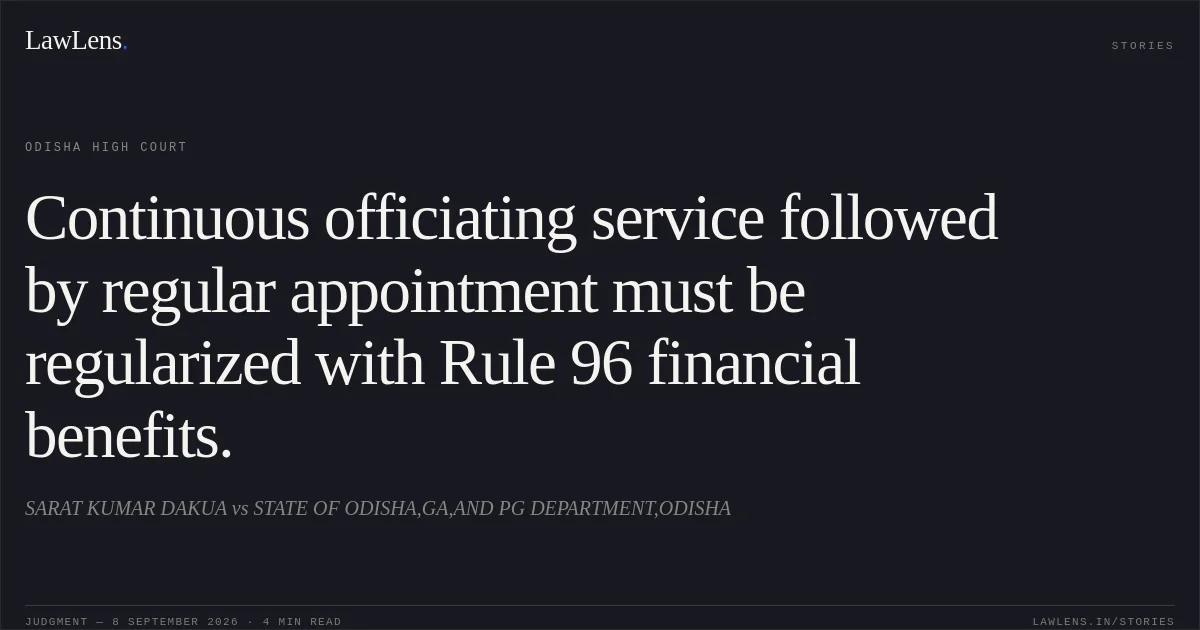
p. 12Since Rule 96 permitted regulation of pay for officiating service in the higher post, and the petitioner had actually discharged the duties and was thereafter regularly appointed to the same post, the denial of financial benefits for the period from 28 February to 30 August 2013 was unsustainable.
p. 20The condition that further continuance would not carry financial benefits could not override the entitlement arising under Rule 96 in the circumstances of the case. Accordingly, recovery of the benefits and refixation of pay were held to be unjustified.
p. 2005Holding
The writ petition was allowed.
p. 22The Court held that the petitioner’s regular appointment as Caretaker was valid, including the age relaxation granted by the Chairman of the Odisha Administrative Tribunal, and that he was entitled to the financial benefits attached to his officiating service under Rule 96 of the Odisha Service Code.
p. 19The orders dated 25 October 2019 and 13 December 2019, produced as Annexures-9 and 10, were quashed.
p. 22Opposite Party No.1 was directed to regularise the petitioner’s officiating period as Caretaker from 28 February 2013 to 30 August 2013.
p. 22There was no order as to costs.
p. 22Original Court PDF
SARAT KUMAR DAKUAvsSTATE OF ODISHA,GA,AND PG DEPARTMENT,ODISHA
Click to open original judgment
Original judgment, available to read, download and summarize on LawLens.in