Facts
The applicant was appointed as a Class-IV employee in the Health and Medical Education Department on June 19, 1998, possessing an ITI Diploma in the Electrician trade
Source reference: p. 3In view of his qualifications, he was assigned duties as a Generator Operator in 2001
Source reference: p. 3On November 5, 2009, the Director of Health Services adjusted the applicant against a vacant post of Junior Electrician (Electrical Technician) on an "own-pay-grade" (OPG) basis with a charge allowance
Source reference: p. 4, 7Although the applicant continuously performed these higher duties, the department promoted him to "Basic Health Worker" in 2011, which he declined, seeking instead to be confirmed as a Junior Electrician
Source reference: p. 4, 8Following a High Court direction in 2018 (SWP No. 1213/2011), the respondents issued an order on August 21, 2018, adjusting him as a Junior Electrician, but only on a prospective basis
Source reference: p. 4-5The applicant filed the present matter seeking retrospective confirmation and monetary benefits from the original date of his OPG adjustment (November 5, 2009)
Source reference: p. 2Issues
1. Whether the applicant is entitled to retrospective confirmation and consequential monetary benefits for the post of Junior Electrician from the date he was initially adjusted against the vacancy on an own-pay-grade basis (05.11.2009)
Source reference: p. 2, 10-112. Whether administrative delays or recruitment rule formalities can be used to deny service benefits to an employee who has continuously discharged the duties of a higher post against a clear vacancy
Source reference: p. 14-15Law Applied
The Tribunal applied the principle of equity and service jurisprudence that "no work can be taken without corresponding service benefit," emphasizing that administrative delays cannot defeat substantive rights
Source reference: p. 14-15It considered the Jammu and Kashmir Health and Medical (Subordinate) Services Recruitment Rules, 1992, and Government Order No. 743-GAD of 2007 regarding the effective dates of promotion
Source reference: p. 8-9The Tribunal also relied on the precedent of Jai Dev Gupta v. State of H.P. and Another (1997) to restrict the recovery of actual monetary arrears to a three-year period preceding the filing of the petition
Source reference: p. 15Reasoning
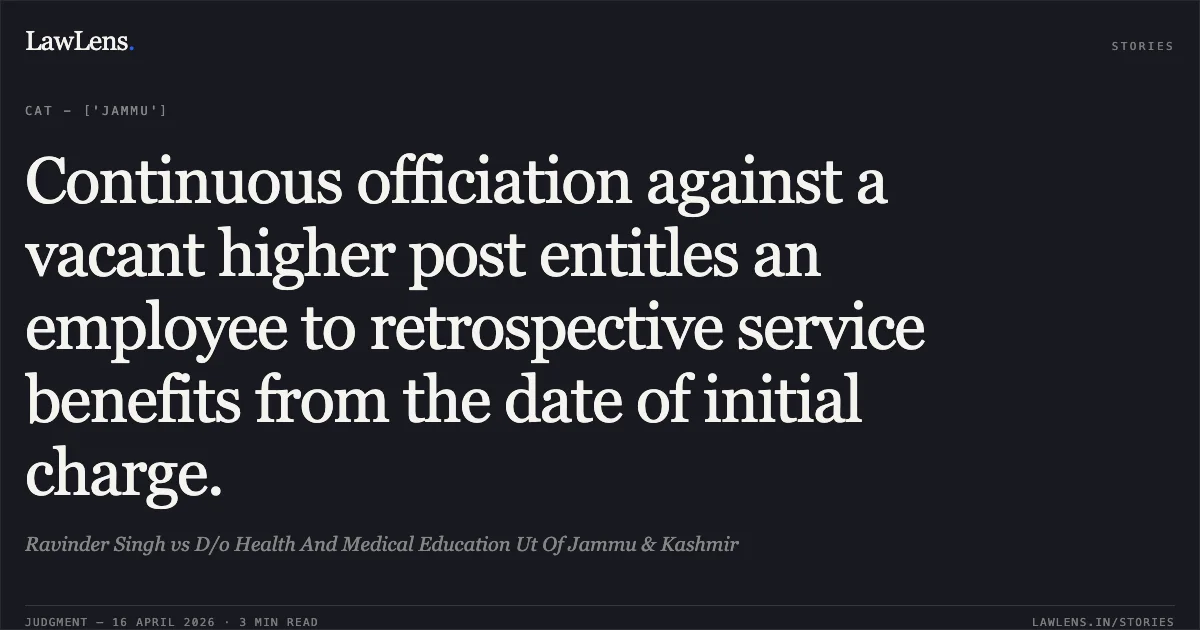
The Tribunal reasoned that the respondents' act of adjusting the applicant in 2018 was a formal recognition of his eligibility and his continuous performance of the Junior Electrician duties since 2009
Source reference: p. 13It rejected the respondents' contention that the 2009 placement was merely a "temporary stop-gap arrangement," noting that the applicant had discharged full responsibilities of the higher post for several years against a clear vacancy
Source reference: p. 12, 14The Tribunal held that when an employee is utilized for a higher post and subsequently regularized on that same post, denying retrospective benefits is arbitrary
Source reference: p. 15It further clarified that general government instructions regarding prospective promotion cannot override the specific facts of this case, where the applicant was already performing the functions of the post
Source reference: p. 14-15Holding
The Tribunal allowed the Transfer Application, holding that the applicant's adjustment must take effect from the date he was initially given charge of the higher post
The respondents were directed to: (a) treat the applicant as adjusted to the post of Junior Electrician effective November 5, 2009; (b) grant all consequential benefits including seniority, pay fixation, and notional monetary benefits from that date; and (c) pay actual monetary arrears restricted to the three years preceding the filing of the writ petition as per the Jai Dev Gupta principle
Source reference: p. 15-16The exercise must be completed within three months
Source reference: p. 15Original Court PDF
Ravinder SinghvsD/o Health And Medical Education Ut Of Jammu & Kashmir
Click to open original judgment
Original judgment, available to read, download and summarize on LawLens.in