Facts
The Petitioner challenged an order dated 21.10.2011 passed by the Commissioner, Santhal Pargana Division, which set aside a previous appellate order and restored an eviction order against the Petitioner
Source reference: p. 2Respondent No. 5, claiming to be the adopted son of the original owner, Tetru Jha, filed for eviction under Sections 20 and 42 of the Santhal Pargana Tenancy (Supplementary Provisions) Act, 1949, alleging that the Petitioner’s father encroached on Plot Nos. 640 and 641
Source reference: p. 2-3The Petitioner contended that his father acquired possession in 1941 via a Kurfanama (unregistered settlement deed) and remained in continuous possession
Source reference: p. 3While the Deputy Commissioner initially ruled in favor of the Petitioner citing continuous possession, the Divisional Commissioner reversed this, finding the possession in contravention of the Act
Source reference: p. 4Issues
1. Whether the Petitioner had completed twelve years of continuous possession prior to the enforcement of the Santhal Pargana Tenancy Act, 1949, to protect him from eviction
Source reference: p. 7 / para. 82. Whether the Kurfanama of 1941 constituted a valid legal basis for possession under the Tasdik Niyamawali and Section 20 of the Act
Source reference: p. 7-8 / para. 9Law Applied
The court applied Sections 20 and 42 of the Santhal Pargana Tenancy (Supplementary Provisions) Act, 1949, which prohibit the transfer of Raiyati land in any form unless specifically permitted, and authorize the Deputy Commissioner to evict those in contravention
Source reference: p. 3, 10It relied on the Tasdik Niyamawali, which stipulates that a Sada (plain/unregistered) Kurfanama is only valid if recognized or exhibited by a court of law
Source reference: p. 7-8Furthermore, it applied the precedent from Ram Kisto Mandal v. Dhankisto Mandal (AIR 1969 SC 204), establishing that even collusive compromises aimed at regularizing illegal transfers of Raiyati land are void
Source reference: p. 10Reasoning
The court observed that the Act came into effect on 01.11.1949; since the Petitioner claimed possession starting from 1941, he had only completed eight years of possession by the time the Act was enacted, failing the requisite 12-year threshold for prescriptive rights
Source reference: p. 7Upon reviewing the Tasdik Niyamawali, the court found that the Petitioner’s Kurfanama was neither registered, nor had it been previously recognized or exhibited by a court of law, rendering it "collusive" and "doubtful"
Source reference: p. 8-9The court rejected the Petitioner's reliance on Bhauri Lal v. S.D.O. and Asharfi Mahaton v. State of Bihar, noting that in those cases, either the 12-year possession was proven or the specific regulations of the Niyamawali were not considered
Source reference: p. 11-12The court emphasized that the Act's primary intent is to prevent the alienation of Raiyati land through disguised or collusive transfers
Source reference: p. 10-11Holding
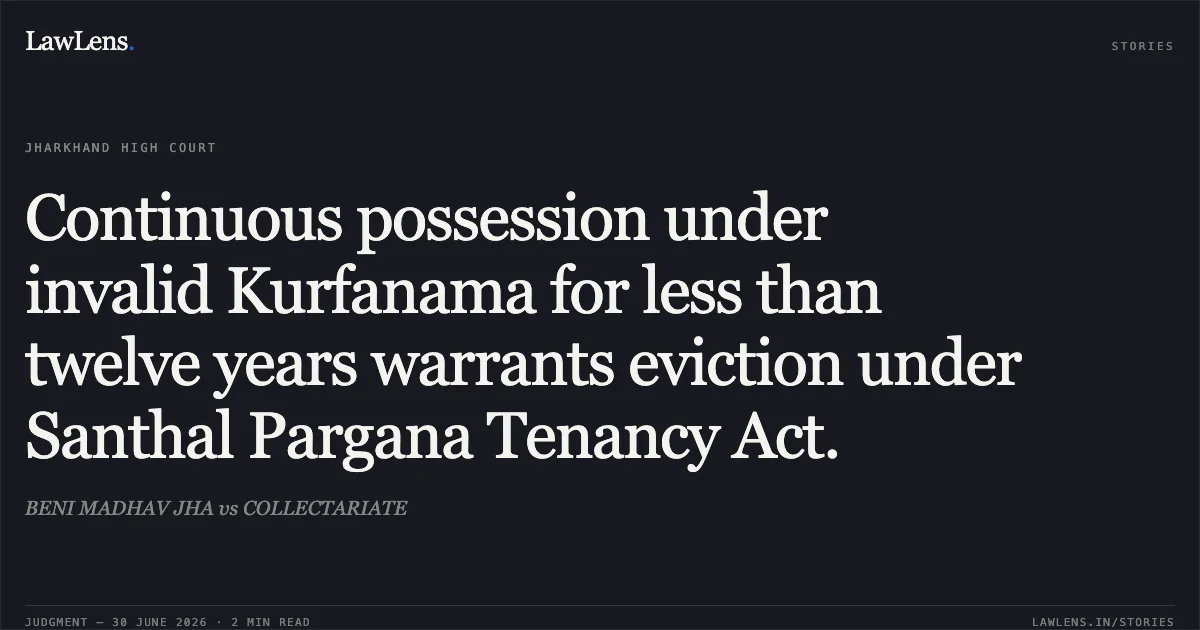
The court answered the issues in the negative, holding that the Petitioner failed to prove 12 years of possession prior to the 1949 Act and that the Kurfanama was invalid
The High Court upheld the Divisional Commissioner’s order of eviction, finding no illegality in the decision; the writ petition was dismissed
Source reference: p. 12Acts & Sections Cited
16 provisions across 1 statute referred to in this judgment. Each provision opens on LawLens.
SANTHAL PARGANAS TENANCY (SUPPLEMENTARY PROVISIONS) ACT, 1949
Original Court PDF
BENI MADHAV JHAvsCOLLECTARIATE
Click to open original judgment
Original judgment, available to read, download and summarize on LawLens.in


