Facts
The petitioner was appointed temporarily as a Grade-IV employee at Paschim Bonbhag Higher Secondary School on March 1, 1991, against a leave vacancy.
Source reference: p.3His appointment was extended periodically, and in 1994, he was appointed on an "honorary basis," continuing his service from 1991.
Source reference: p.3While the Principal and Inspector of Schools requested the sanctioning of additional Grade-IV posts to accommodate him, the petitioner received salary against leave vacancies initially, and later against a retired vacancy from 2002 to 2005.
Source reference: p.3-4Post-2005, the petitioner ceased receiving salary despite continuing his service; by 2026, he was working as a Mid-Day Meal cook at the same school.
Source reference: p.4-5He approached the High Court seeking a direction for the sanctioning of a Grade-IV post and regularization of his service or payment of arrears.
Source reference: p.3Issues
1. Whether an employee who has continuously rendered services for a prolonged period (35 years) is entitled to the payment of salary and consideration for regularization, even in the absence of a sanctioned post?
Source reference: p.62. Whether the non-payment of salary for utilized services constitutes a violation of fundamental rights?
Source reference: p.6Law Applied
The Court relied on the landmark judgment in Secretary, State of Karnataka and Others v. Uma Devi (2006) 4 SCC 1, regarding the regularization of irregularly appointed employees who have worked for ten years or more in duly sanctioned posts.
Source reference: p.4It further referenced Jaggo v. Union of India & Others (2025).
Source reference: p.4The presiding principle applied is that the non-payment of wages for utilized services is unconstitutional and a violation of fundamental rights.
Source reference: p.6The court also invoked the doctrine of "legitimate expectation" for employees who have served an institution for several decades.
Source reference: p.6Reasoning
The Court observed that the petitioner’s service was utilized by the authorities for 35 years without interruption.
Source reference: p.5It noted that while the appointment might be termed "irregular," it was not "illegal" as he was repeatedly adjusted against leave and retired vacancies by school authorities.
Source reference: p.4, 6The Court reasoned that if an authority utilizes the service of an individual, the basic salary must be paid, and failure to do so is a constitutional violation.
Source reference: p.6Although the petitioner approached the Court after a delay (19 years since salary stopped), the Court condoned this due to his status as a Grade-IV employee and his continuous representations to the Inspector of Schools, which created a legitimate expectation of regularization.
Source reference: p.6The Court prioritized the fact that the petitioner never abandoned the school and even shifted roles to remain in service.
Source reference: p.5Holding
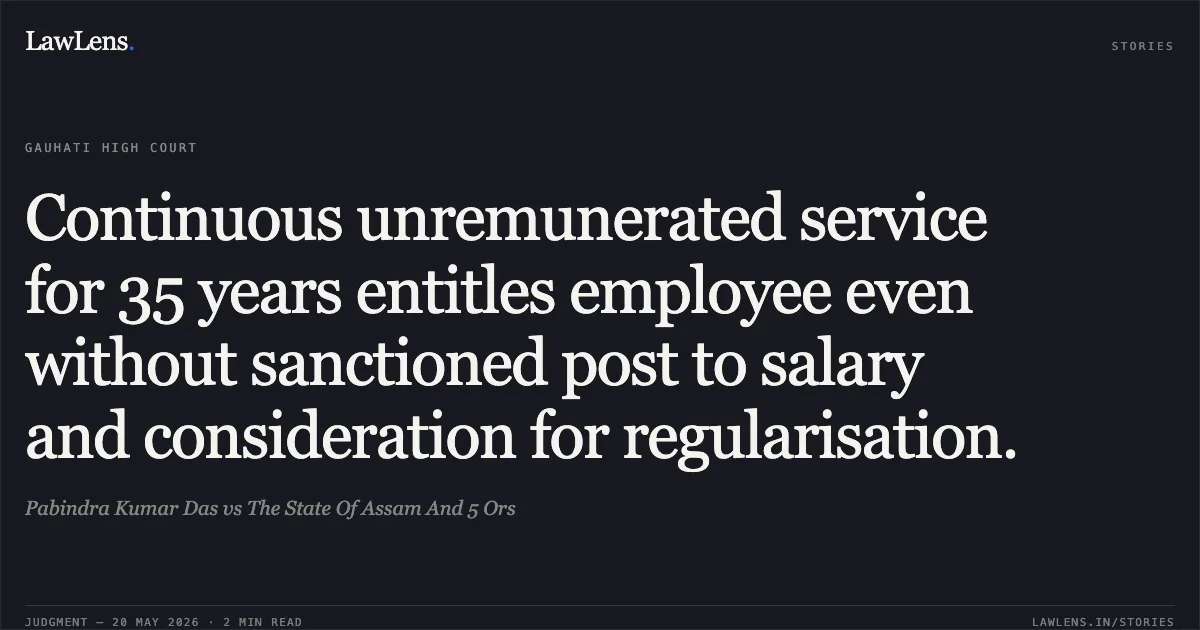
The Court held that the petitioner’s 35 years of service entitles him to have his case considered for regularization and salary payment.
The final order mandates the authorities to decide on the petitioner's regularization and grievance within one month of receipt of the certified copy of the judgment.
Source reference: p.7Original Court PDF
Pabindra Kumar DasvsThe State Of Assam And 5 Ors
Click to open original judgment
Original judgment, available to read, download and summarize on LawLens.in