01Facts
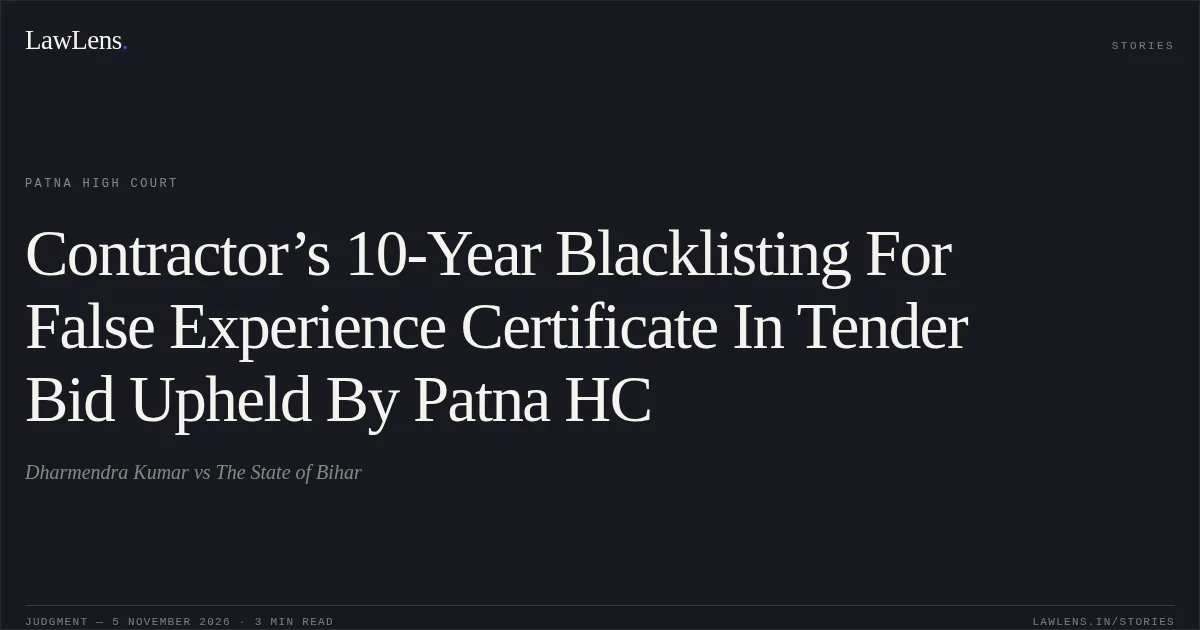
The petitioner was blacklisted for ten years by an order dated 14 March 2023, which was set aside in an earlier writ proceeding with liberty to the respondents to proceed in accordance with law after giving him an opportunity of hearing.
p. 2Following a fresh show-cause notice and the petitioner’s reply, the Chief Engineer again blacklisted him for ten years on 10 December 2025, on the allegation that he had submitted a false experience certificate in a 2021–22 tender.
pp. 3–4, 8–9The petitioner’s appeal was rejected by the Secretary on 28 July 2026.
pp. 5–7He then challenged the appellate and blacklisting orders, arguing, among other things, that his contractor registration had expired, the action exceeded the show-cause notice, the relied-on office order was inapplicable, and the ten-year period was disproportionate.
pp. 5–702Issues
i.Whether the petitioner’s expired contractor registration prevented the respondents from proceeding with blacklisting for alleged misconduct committed while seeking a tender.
pp. 8–10ii.Whether the blacklisting orders were invalid because the show-cause notice did not refer to Office Order No. 154, or because that order was not issued in the Governor’s name or gazetted.
pp. 10–12iii.Whether the ten-year blacklisting was disproportionate in the circumstances.
pp. 13–2003Law Applied
Under the Bihar Contractors Registration Rules, 2007, including Clause 11, the relevant registration regime provides for contractor registration and an appellate remedy; expiry of registration does not itself bar action for misconduct arising from an earlier tender process.
pp. 4, 9–10The Court relied on the principle in Kulja Industries Ltd. v. Chief General Manager, W.T. Project, BSNL that blacklisting is an inherent power of a contracting authority, subject to judicial review for fairness, natural justice, and proportionality.
pp. 12–13It also referred to Patel Engineering Ltd. v. Union of India on the State’s power to blacklist for a legitimate purpose, and to Ashish Anand v. State of Bihar on the proportionality of a ten-year period for submitting a false certificate.
pp. 13–17The Court treated Office Order No. 154 dated 18 June 2015 as relevant to the impugned decision, noting that its validity had not been challenged.
pp. 10–1404Reasoning
The Court held that the blacklisting proceedings concerned alleged submission of a false experience certificate in 2021–22, and that the initial action had begun before the petitioner’s registration expired; in any event, registration expiry did not prevent action for the alleged misconduct.
pp. 9–10It rejected the notice-related objection, reasoning that the proceedings and resulting orders made the petitioner aware that the action relied on the 2007 Rules read with Office Order No. 154, and found no prejudice from the notice’s omission of that order.
pp. 10–11It further held that the authority’s inherent power to blacklist did not depend on Office Order No. 154 being issued by the Minor Irrigation Department or gazetted.
pp. 11–14On proportionality, the Court treated the alleged use of a false certificate to obtain a contract as serious, noted that the allegation was not contested in argument, and declined to reduce the ten-year period, relying on Ashish Anand.
pp. 15–2005Holding
The Court rejected the petitioner’s challenges to the blacklisting and appellate orders, including the objections based on expiry of registration, the show-cause notice, Office Order No. 154, and proportionality.
pp. 9–20It dismissed the writ petition and disposed of any pending applications.
p. 19Original Court PDF
Dharmendra KumarvsThe State of Bihar
Click to open original judgment
Original judgment, available to read, download and summarize on LawLens.in