Facts
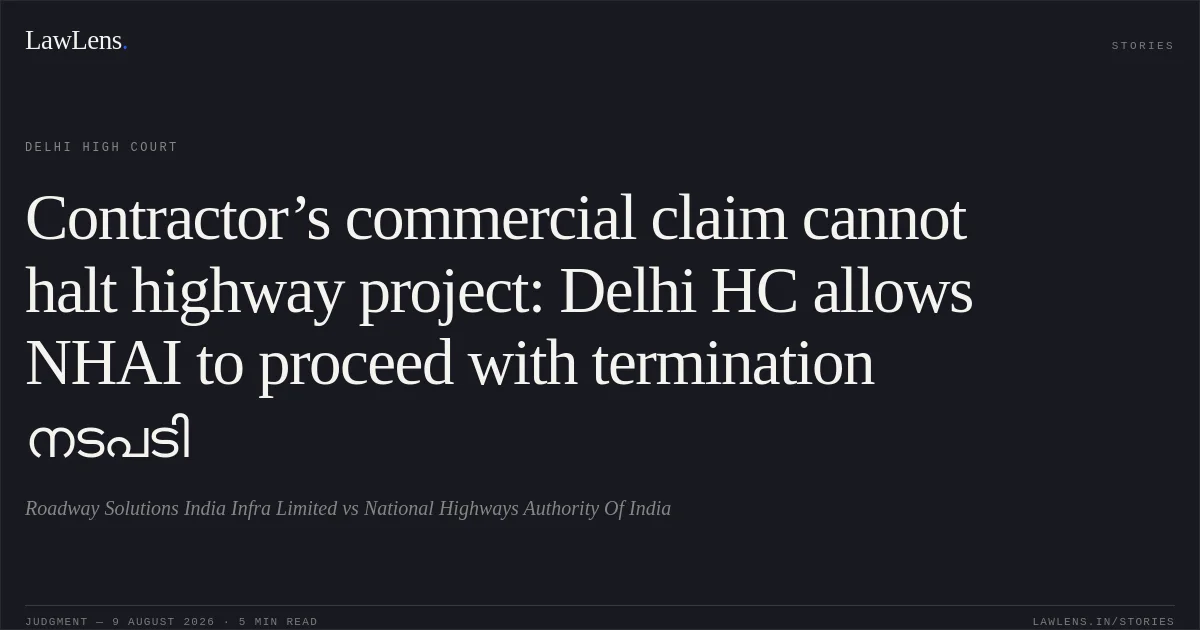
The Petitioner and the National Highways Authority of India (“NHAI”) entered into an EPC Contract dated 17 October 2022 for construction of a six-lane highway on NH-48, Package-I.1.
Source reference: p. 2, para. 2The Appointed Date was declared as 13 January 2023, with the original Scheduled Completion Date being 12 January 2025.
Source reference: p. 2, para. 2The parties subsequently executed a Settlement Agreement dated 25 April 2025, extending the Scheduled Completion Date to 30 April 2026 and revising Milestone-III to 11 January 2026.
Source reference: pp. 2–3, paras. 2–4Disputes arose regarding delay and responsibility for non-completion.
Source reference: p. 3, para. 3The Petitioner attributed the delay to NHAI’s failure to provide encumbrance-free Right of Way, continuous work fronts and approvals, whereas NHAI alleged inadequate deployment of resources, failure to maintain the highway and safety violations by the Petitioner.
Source reference: p. 3, para. 3NHAI issued a Cure Period Notice dated 2 January 2026 alleging defaults under Clauses 23.1(i)(d), (e), (g) and (q) of the Contract and granted 60 days to cure them.
Source reference: pp. 3, 16–19, paras. 5, 36–41Thereafter, NHAI issued a Notice of Intention to Terminate dated 16 July 2026 under Clause 23.1(ii).
Source reference: p. 3, para. 6The Petitioner invoked Section 9 of the Arbitration and Conciliation Act, 1996, seeking restraint against NHAI from proceeding pursuant to the termination notice.
Source reference: p. 3, para. 7It contended that the Cure Period Notice was premature because Milestone-III had not yet fallen due on 2 January 2026 and that the Settlement Agreement restricted coercive action until the revised completion date.
Source reference: pp. 3–6, paras. 7–9, 15–17NHAI opposed the relief, relying on the contractual cure mechanism, the public interest involved in completion of the highway project, and Sections 20A and 41(ha) of the Specific Relief Act, 1963.
Source reference: pp. 5–6, 10–14Issues
Whether the EPC Contract was “determinable in nature” under Section 14(d) of the Specific Relief Act, 1963 merely because it contained a contractual termination clause permitting termination upon specified defaults after notice and an opportunity to cure?
Source reference: pp. 9–16, paras. 21–32Whether the Cure Period Notice dated 2 January 2026 and the subsequent Notice of Intention to Terminate dated 16 July 2026 were prima facie invalid or premature, particularly because Milestone-III was scheduled for 11 January 2026?
Source reference: pp. 16–23, paras. 35–44Whether interim protection under Section 9 of the Arbitration and Conciliation Act, 1996 should be granted to restrain NHAI from proceeding with termination of a highway infrastructure contract, having regard to Sections 20A and 41(ha) of the Specific Relief Act, 1963 and the public interest in timely completion of the project?
Source reference: pp. 7–9, 23–28, paras. 18–21, 45–53Law Applied
Section 9 of the Arbitration and Conciliation Act, 1996 empowers the Court to grant protective interim measures in aid of arbitration, applying the requirements of a prima facie case, balance of convenience and irreparable injury, as explained in ArcelorMittal Nippon Steel (India) Ltd. v. Essar Bulk Terminal Ltd.
Source reference: pp. 7–9, paras. 19–20Section 14(d) of the Specific Relief Act, 1963 bars specific enforcement of contracts that are determinable in nature, while Section 41(e) restricts injunctions to prevent breach of such contracts.
Source reference: pp. 9–10, paras. 23–24The principle from Manjunath is that contracts terminable at will or without cause are determinable, but contracts terminable only for specified breaches and after notice and an opportunity to cure are not determinable merely because they contain a termination clause.
Source reference: pp. 14–16, paras. 29–31Sections 20A and 41(ha) of the Specific Relief Act prohibit injunctions that would impede or delay the progress or completion of specified infrastructure projects, including roads and bridges.
Source reference: pp. 23–25, paras. 46–47The Court also applied the public-infrastructure restraint articulated in N.G. Projects Ltd. v. Vinod Kumar Jain and the Division Bench decision in National Highways Authority of India v. Roadway Solutions India Infra Limited, holding that wrongful termination can ordinarily be compensated through damages, whereas stalling a highway project causes public loss.
Source reference: pp. 23–27, paras. 47–49Reasoning
The Court first held that Clause 23 did not confer an unconditional or at-will termination right.
Source reference: p. 13, para. 25It required the occurrence of specified defaults, issuance of a cure notice, expiry of the applicable cure period and an opportunity to make a representation.
Source reference: pp. 13–16, paras. 25–32Applying Manjunath, the Court therefore held that the EPC Contract was not determinable in nature under Section 14(d), removing the statutory objection based solely on determinability.
Source reference: pp. 13–16, paras. 25–32However, this finding did not establish the Petitioner’s entitlement to an injunction.
Source reference: no citationOn examining the Cure Period Notice, the Court found that NHAI had relied not merely on failure to achieve Milestone-III, but on independent continuing defaults—failure to proceed with the works, inadequate manpower and resources, non-maintenance, safety violations and other contractual breaches—under Clauses 23.1(i)(d), (e), (g) and (q).
Source reference: pp. 16–20, paras. 36–41Consequently, the notice was not prima facie premature merely because Milestone-III was due on 11 January 2026.
Source reference: pp. 16–20, paras. 36–41The Settlement Agreement extended the completion period and waived damages until 30 April 2026, but did not grant immunity from independent contractual defaults or prevent invocation of Clause 23.
Source reference: pp. 20–22, paras. 42–43The Court declined to adjudicate the factual correctness of the alleged defaults, observing that those matters belonged before the Arbitral Tribunal.
Source reference: p. 22, para. 44Finally, because restraining termination could delay completion of a highway infrastructure project, Sections 20A and 41(ha) substantially weighed against injunction.
Source reference: pp. 23–28, paras. 45–52The Petitioner’s alleged injury was principally commercial and compensable in damages, while the balance of convenience lay with NHAI and the public.
Source reference: pp. 23–28, paras. 45–52Holding
The Court held that the EPC Contract was not determinable in nature merely because it contained a termination clause, since termination was conditioned upon specified defaults and compliance with a cure-and-representation procedure.
Nevertheless, the Petitioner failed to establish a prima facie case that the Cure Period Notice or the Notice of Intention to Terminate was invalid or premature.
Source reference: pp. 26–28, paras. 50–53In view of the statutory restrictions protecting infrastructure projects, the public interest in timely highway completion, and the availability of monetary compensation, the Court refused to restrain NHAI from acting upon the Notice of Intention to Terminate dated 16 July 2026.
Source reference: pp. 26–28, paras. 50–53The Section 9 petition and all pending applications were dismissed, with all observations expressly confined to the interim proceedings and the parties’ rights left open for determination by the Arbitral Tribunal.
Source reference: p. 28, paras. 54–55Acts & Sections Cited
6 provisions across 2 statutes referred to in this judgment. Each provision opens on LawLens.
Arbitration and Conciliation Act, 19962
Specific Relief Act, 19634
Original Court PDF
Roadway Solutions India Infra LimitedvsNational Highways Authority Of India
Click to open original judgment
Original judgment, available to read, download and summarize on LawLens.in