Facts
The petitioners’ contract with IOCL ran from 1 September 2023 to 31 August 2024.
Source reference: no citationThey challenged IOCL’s notice dated 3 November 2025, which treated the memorandum of settlement (MOS) reached on 13 May 2025 as binding and sought recovery of wage arrears from the petitioners’ bank guarantee.
Source reference: para. 1–7, 22–23The petitioners argued that their contract and employment relationship with the workers had ended before the MOS was made, and that they had not attended the MOS meeting.
Source reference: para. 1–7, 22–23The Court also noted the petitioners’ participation in an earlier MOS and in a March 2024 meeting concerning the charter of demands.
Source reference: para. 19, 21, 24–25Issues
1. Whether the MOS dated 13 May 2025 could bind the petitioners and require them to pay wage arrears for the contractual period, notwithstanding that the contract had ended and they did not attend the MOS meeting.
Source reference: para. 3–7, 22–272. Whether IOCL was entitled, under the contract, to recover or apply amounts towards the workers’ revised wage arrears.
Source reference: para. 20, 26–29Law Applied
Section 12 of the Industrial Disputes Act, 1947, provides for conciliation proceedings by a conciliation officer; the record showed that the Assistant Labour Commissioner had called the petitioners to attend joint discussions under that provision.
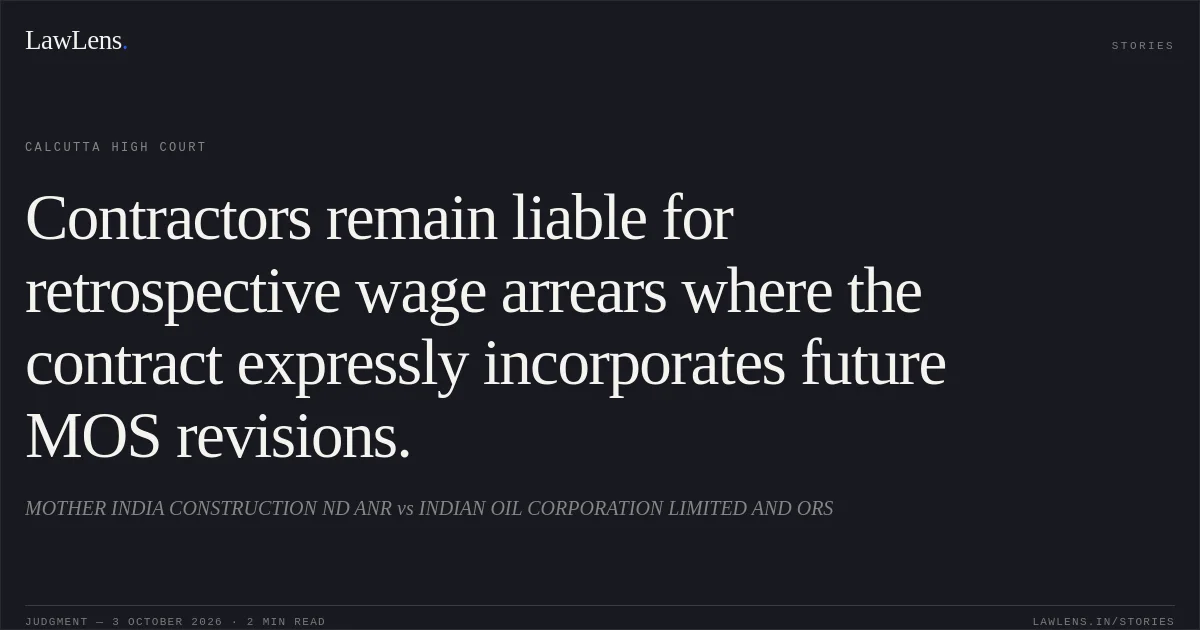
Source reference: para. 9The Court relied principally on the express special conditions of the contract, which placed on the contractor the financial liability arising from a later MOS—including arrears attributable to the contractual period—and authorised IOCL to withhold or deduct amounts, or arrange payment at the contractor’s risk and cost, if the contractor failed to comply.
Source reference: para. 20, 26The Court also referred to National Engineering Industries Ltd. v. State of Rajasthan, (2000) 1 SCC 371, in support of the proposition that a tripartite settlement may bind the parties represented in the dispute.
Source reference: para. 14Reasoning
The Court rejected the argument that the petitioners’ liability ended with the contract.
Source reference: no citationThe special conditions expressly anticipated that a revised MOS might be signed after contract completion and required the contractor to pay resulting arrears for the contractual period, without extra cost to IOCL.
Source reference: para. 20, 26The petitioners’ prior acceptance of an MOS, their participation in the March 2024 meeting, and their history of contracting with IOCL supported the Court’s conclusion that they were bound by the contractual arrangement concerning wage revisions.
Source reference: para. 19, 21, 24–27Their absence from the May 2025 meeting did not displace the contractual obligation.
Source reference: para. 22, 27Holding
The Court held that the petitioners were bound by the contract’s terms concerning arrears under the revised MOS and found no ground to interfere with IOCL’s action.
The writ petition was dismissed.
Source reference: para. 28The Registrar General was directed to release the amount deposited under the Court’s earlier order, with interest, to IOCL; IOCL was directed to disburse it to the entitled workers within three months.
Source reference: para. 29Any interim order was vacated.
Source reference: para. 31Acts & Sections Cited
1 provisions across 1 statute referred to in this judgment. Linked provisions open on LawLens.
Industrial Disputes Act, 19471
Original Court PDF
MOTHER INDIA CONSTRUCTION ND ANRvsINDIAN OIL CORPORATION LIMITED AND ORS
Click to open original judgment
Original judgment, available to read, download and summarize on LawLens.in