Facts
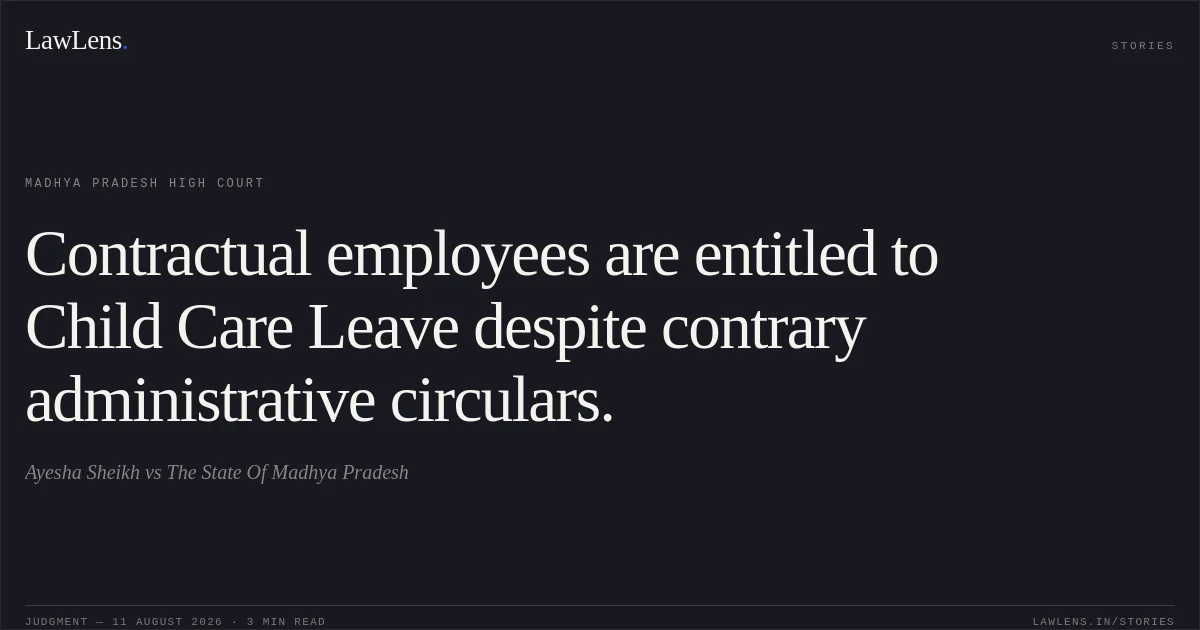
The petitioner challenged the order dated 16 July 2026 by which her application for Child Care Leave (“CCL”) was rejected on the ground that the State Government’s circular dated 22 July 2023 did not provide CCL to contractual employees.
Source reference: para. 1–2Earlier, in W.P. No. 22154 of 2026, the High Court had quashed the rejection of her CCL application dated 2 June 2026 and held that she was entitled to the benefits accruing from the quashing of that order, including CCL.
Source reference: para. 2, quoted order at para. 7The petitioner relied on a series of earlier orders extending CCL benefits to contractual employees, including orders in W.P. No. 842 of 2007, W.P. No. 14425 of 2026, W.P. No. 17457 of 2026, and W.P. No. 22154 of 2026; the State’s challenge in W.A. No. 671 of 2021 and SLP (C) No. 2540 of 2022 had also failed.
Source reference: para. 6Upon directions from the Court, the State stated that CCL would be granted if the petitioner submitted a fresh application.
Source reference: para. 3–4Issues
Whether the respondents could reject the petitioner’s application for Child Care Leave by relying on the State Government circular dated 22 July 2023, despite repeated judicial orders holding that contractual employees are entitled to CCL.
Source reference: para. 2, 6–8Whether the impugned order dated 16 July 2026 was liable to be quashed and the petitioner directed to receive the benefit of Child Care Leave.
Source reference: para. 7–10Law Applied
The Court applied Rule 38-C of the Madhya Pradesh Civil Services (Leave) Rules, 1977, under which a woman Government servant may be granted Child Care Leave for up to 730 days during her entire service for caring for her two eldest surviving children.
Source reference: para. 7It further relied on the constitutional commitment to social and economic justice and the Directive Principles under Articles 38 and 39 of the Constitution, particularly the State’s obligation to promote public welfare and protect the health and strength of workers and children.
Source reference: para. 7Following its earlier decision in W.P. No. 9877 of 2026, the Court extended the protective spirit of Rule 38-C and Section 5(1) of the Maternity Benefit Act, 1961, to non-regular or contractual personnel, holding that the petitioner was entitled to 240 days of CCL.
Source reference: para. 7The Court also applied the principle that judicial interpretation of law is binding on subordinate authorities unless set aside by a higher court; administrative authorities cannot disregard repeated judicial directions by relying on an inconsistent executive circular.
Source reference: para. 8Reasoning
The Court found that the Director, State Education Centre had committed an error of law by relying on the 22 July 2023 circular instead of complying with the binding orders of the High Court and the Supreme Court’s refusal to interfere with the earlier entitlement to CCL.
Source reference: para. 6–8The Court had repeatedly held that contractual employees could receive CCL and had specifically directed that the petitioner’s leave be sanctioned. Despite those directions, the respondents rejected her representation on the same ground that had already been judicially rejected.
Source reference: para. 6–8Applying Rule 38-C in light of Articles 38 and 39 and the protective principles underlying the Maternity Benefit Act, the Court held that the petitioner was entitled to CCL and that the impugned order could not stand.
Source reference: para. 7–10The repeated non-compliance was treated as sufficiently serious to justify imposing costs personally on the Director, State Education Centre.
Source reference: para. 8–11Holding
The Court quashed the order dated 16 July 2026.
It directed the respondents to grant the petitioner the benefit of Child Care Leave from the date on which the order was communicated.
Source reference: para. 10A cost of ₹50,000 was imposed personally on Harjinder Singh, Director, State Education Centre, payable to the Registrar General of the High Court within 30 days, failing which the matter was to be listed for further orders.
Source reference: para. 9–11Copies of the order were directed to be sent to the Principal Secretary, Higher Education Department, Madhya Pradesh, and the Advocate General.
Source reference: para. 12The writ petition was disposed of accordingly.
Source reference: para. 13Acts & Sections Cited
1 provisions across 1 statute referred to in this judgment. Linked provisions open on LawLens.
Constitution of India1
Original Court PDF
Ayesha SheikhvsThe State Of Madhya Pradesh
Click to open original judgment
Original judgment, available to read, download and summarize on LawLens.in