Facts
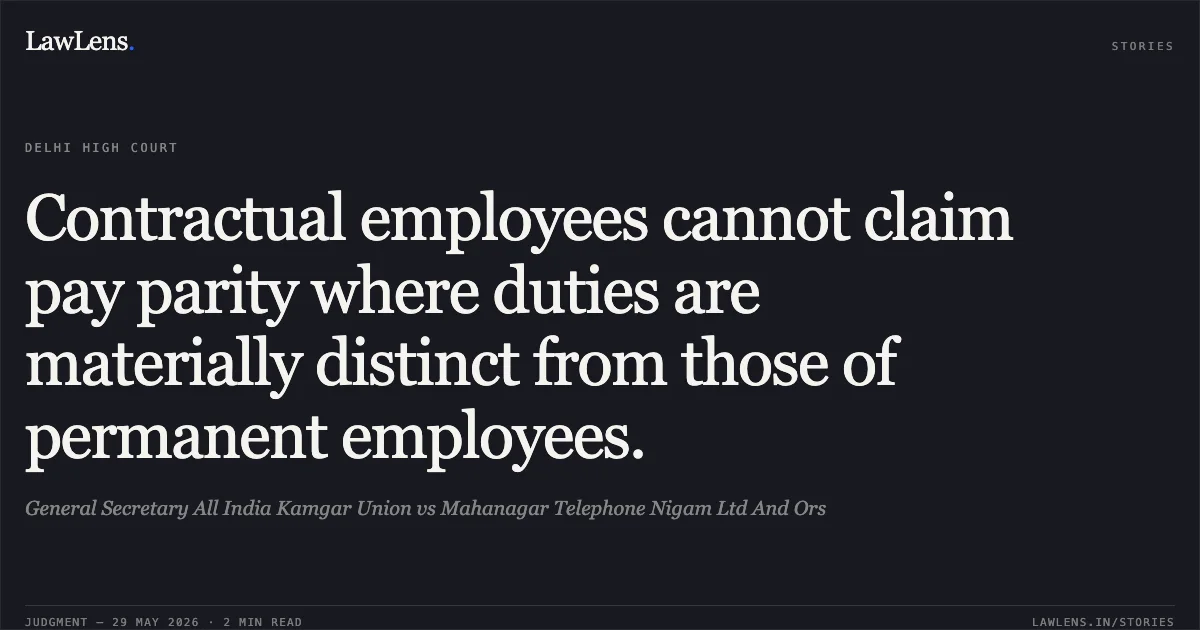
The Appellant, a Trade Union, filed an application under Rule 25(2)(v)(a) of the Contract Labour (Regulation & Abolition) Central Rules, 1971, seeking pay parity for 64 contractual workmen (technicians) deployed by Respondent No. 2 (AMC contractor) to Respondent No. 1 (MTNL)
Source reference: p. 2The Appellant argued that these workmen performed duties identical to MTNL’s permanent "Phone Mechanics"
Source reference: p. 2On 12.03.2018, the Deputy Chief Labour Commissioner (Respondent No. 3) issued an Award granting the pay scale of ₹12500–₹27170 to the contractual workmen
Source reference: p. 2Respondent No. 1 challenged this via a Writ Petition, which the learned Single Judge allowed on 27.02.2024, setting aside the Award on the grounds that the duties were distinct
Source reference: p. 3The Appellant subsequently filed this Letters Patent Appeal
Source reference: p. 1, 3Issues
1. Whether the nature of duties performed by the contractual workmen was identical or similar to those of the permanent employees of the principal employer to warrant the application of the "equal pay for equal work" principle
Source reference: p. 8 / para. 162. Whether the contractual arrangement between Respondent No. 1 and Respondent No. 2 was a sham intended to deny lawful wages to the workmen
Source reference: p. 4 / para. 8.4; p. 9 / para. 17Law Applied
The Court applied Rule 25(2)(v)(a) of the Contract Labour (Regulation & Abolition) Central Rules, 1971, which mandates pay parity for contract labour performing the same or similar kind of work as direct employees
Source reference: p. 2It considered the doctrine of "equal pay for equal work" as interpreted in State of Punjab v. Jagjit Singh (2017), noting that while the principle extends to contractual employees, it requires the establishment of identity in eligibility, nature of duties, and responsibilities
Source reference: p. 3, 5furthermore, the court emphasized that the doctrine cannot be invoked unless there is a "complete identity" between the two posts
Source reference: p. 5Reasoning
The Court compared the "Scope of Services" in the tender document with the duties of permanent employees. It found that permanent employees functioned as linemen, wiremen, and cable splicers, whereas contractual workmen were restricted to "carrying out electrical, mechanical and technical maintenance services at cell sites"
Source reference: p. 8The Court observed that MTNL had no permanent employees deployed for tower maintenance, thus precluding a legitimate comparison
Source reference: p. 8-9The Court further reasoned that granting parity to contract labour—who are selected at the contractor's discretion without a prescribed public recruitment mechanism—would improperly confer legitimacy on an unregulated selection process
Source reference: p. 9Finally, the Court held that the Appellant failed to provide evidence that the contract was a "sham" or "bogus" arrangement, noting the contract was a genuine principal-to-principal agreement
Source reference: p. 9Holding
The Court dismissed the appeal and upheld the Single Judge’s order setting aside the Award.
It held that the contractual workmen were not entitled to pay parity because their duties were materially different from those of the permanent employees.
Source reference: p. 8The Court concluded that "equal pay cannot be granted for unequal work" and that the Appellant failed to prove the contractual arrangement was a sham. No order as to costs was made.
Source reference: p. 7, 9Acts & Sections Cited
1 provisions across 1 statute referred to in this judgment. Linked provisions open on LawLens.
Companies Act, 19561
Original Court PDF
General Secretary All India Kamgar UnionvsMahanagar Telephone Nigam Ltd And Ors
Click to open original judgment
Original judgment, available to read, download and summarize on LawLens.in