Facts
The petitioners, contractual employees with more than five years’ service, applied under the horizontal reservation for contractual employees in recruitment to Supervisor Class-III (Executive) posts.
Source reference: para. 2–6Although they participated in the examination, achieved high ranks and completed document verification, they were excluded from appointments because their contractual posts were at Pay Matrix Levels 4 or 5, whereas the Supervisor post was at Level 6.
Source reference: para. 2–6The State appointed 158 candidates; the petitioners sought consideration against unfilled vacancies and undertook not to disturb those appointments.
Source reference: para. 2–6, 16, 19The Court had earlier made the appointments subject to the outcome of the lead petition and restrained further appointments to the remaining vacancies.
Source reference: para. 2–6, 16, 19Issues
Whether contractual posts at Pay Matrix Levels 4 or 5 could be treated as “equivalent” to the Level 6 Supervisor post for the contractual-employee reservation under the GAD circular dated 22 July 2023.
Source reference: para. 18–21Whether the petitions could be entertained without impleading the appointed candidates, where the petitioners sought relief only against unfilled vacancies.
Source reference: para. 19Whether the petitioners’ exclusion should be referred for functional-equivalence assessment by the Equivalence Committee, notwithstanding the pay-matrix requirement.
Source reference: para. 24–28Law Applied
The GAD circular dated 22 July 2023 governs the reservation and equivalence assessment, superseding the earlier 5 June 2018 circular; its clauses 1.2 and 1.3 and Appendix-1 make Pay Matrix Level the benchmark for equivalence, while clause 3.3 provides for a High-Level Committee to resolve difficulties concerning equivalence.
Source reference: para. 12, 21, 25Relying on Md. Firoz Mansuri v. State of Bihar, the Court stated that prescribing qualifications and assessing equivalence fall principally within the employer’s policy domain and are not ordinarily for courts to rewrite.
Source reference: para. 22Article 14 permits reasonable classification between distinct recruitment streams.
Source reference: para. 23The Court also recognised that there is no estoppel against a statutory requirement, while treating late communication of disqualification as procedurally unfair.
Source reference: para. 24Reasoning
The Court rejected the petitioners’ argument that a shared Class-III classification established equivalence, holding that the 2023 circular deliberately adopted Pay Matrix Level as the governing test and did not permit reliance on the superseded 2018 approach.
Source reference: para. 20–22It also found no relevant parity with Anganwadi workers or earlier appointments made under the 2018 circular, as those arose under distinct recruitment arrangements.
Source reference: para. 23However, because the petitioners’ eligibility was communicated only after they had taken the examination and completed verification, and because clause 3.3 provided a mechanism for resolving equivalence difficulties, the Court directed a functional assessment by the Committee without setting aside the applicable circular or existing appointments.
Source reference: para. 24–27The petitions were maintainable to the limited extent that the petitioners sought consideration against vacancies that would not affect appointed candidates.
Source reference: para. 19Holding
The Court rejected the challenge to the appointment order dated 9 February 2026 but remitted the cases of the 41 petitioners to the Equivalence Committee under clause 3.3 of the 2023 circular.
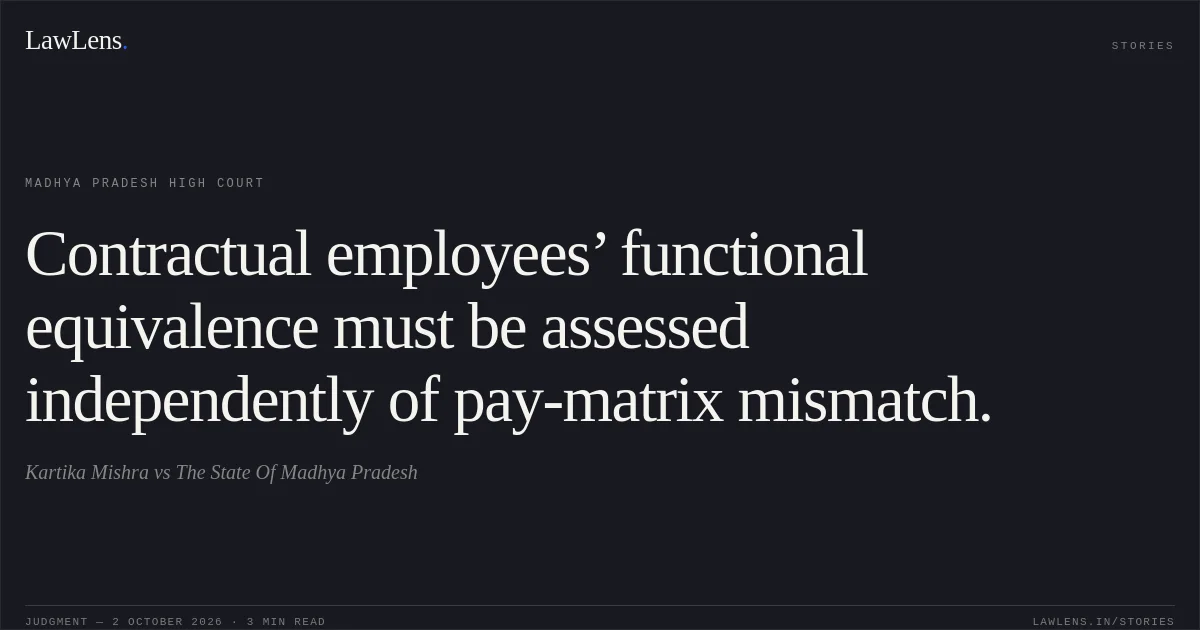
The Committee was directed to assess their substantive, functional and administrative duties against those of a regular Supervisor and issue a reasoned decision within 90 days, independent of the strict pay-matrix mismatch.
Source reference: para. 26–30The State was directed to keep 41 of the 84 unfilled contractual vacancies vacant during that period.
Source reference: para. 26–30The petitions were disposed of without an order as to costs.
Source reference: para. 26–30Original Court PDF
Kartika MishravsThe State Of Madhya Pradesh
Click to open original judgment
Original judgment, available to read, download and summarize on LawLens.in