Facts
The petitioner claimed that he was initially engaged as a Mazdoor in the Public Works Department on 1 May 2000 for a monthly remuneration of ₹1,400 and thereafter worked in various PWD divisions for approximately 24 years and 7 months.
Source reference: pp.2–3He sought regularisation with monetary and service benefits, relying principally on the Full Bench decision in M. Sivappa v. State of Tamil Nadu, reported in 2024 (2) CTC 1, and the Supreme Court’s decision in Vinod Kumar v. Union of India, SLP Nos. 22241–22245 of 2016.
Source reference: pp.2–3Pursuant to an earlier direction to consider his representation, the second respondent rejected his claim by order dated 3 December 2024.
Source reference: pp.3–4The respondents contended that the petitioner was only a contractual/part-time labourer, did not fall within the 86 categories of posts under the Tamil Nadu Basic Service, had not completed ten years of service when G.O.Ms.No.74, Personnel and Administrative Reforms (F) Department, dated 27 June 2013, came into force, and had not resumed duty after 2010.
Source reference: pp.3–4, 6–7Issues
1. Whether the petitioner was entitled to regularisation on the basis of the Full Bench decision in M. Sivappa, notwithstanding his alleged engagement as a contractual/part-time worker outside the 86 categories of posts under the Tamil Nadu Basic Service.
Source reference: pp.4–52. Whether the rejection of the petitioner’s request for regularisation by order dated 3 December 2024 warranted interference under Article 226 of the Constitution.
Source reference: pp.1–2, 73. Whether the petitioner satisfied the applicable requirement of having completed ten years of service by the date of G.O.Ms.No.74 dated 27 June 2013.
Source reference: p.6Law Applied
The Court applied the Full Bench ruling in M. Sivappa v. State of Tamil Nadu, 2024 (2) CTC 1, which held that the benefit of regularisation was available only to persons falling within the 86 categories of posts enumerated under the Tamil Nadu Basic Service.
Source reference: pp.4–5It also clarified that where employment is temporary and the requirement ceases, the Government may engage temporary or part-time personnel.
Source reference: pp.4–5The Court further applied G.O.Ms.No.74, Personnel and Administrative Reforms (F) Department, dated 27 June 2013, in relation to the requirement of completion of ten years of service for the relevant regularisation benefit.
Source reference: p.6The respondents also relied on Rule 18(3) of the Fundamental Rules concerning the effect of prolonged absence from service.
Source reference: p.4The general principles from the regularisation authorities cited by the petitioner, including Vinod Kumar v. Union of India, were held inapplicable because those cases involved appointments against sanctioned posts where the work was perennial and essential.
Source reference: p.4Reasoning
The Court found that the petitioner’s claim was essentially one for parity with the employee in M. Sivappa.
Source reference: p.4However, the material distinction was that the petitioner was treated as a contractual, part-time worker and did not belong to any of the 86 categories covered by the Full Bench ruling.
Source reference: pp.3, 5–6Further, the petitioner had not completed ten years of service when G.O.Ms.No.74 came into force on 27 June 2013.
Source reference: p.6The Court also noted the respondents’ assertion that he had not resumed duty after 2010, which undermined his claim of continuous service and independently attracted the respondents’ reliance on Rule 18(3) of the Fundamental Rules.
Source reference: pp.3–5Since the regularisation principles relied upon by the petitioner presupposed appointment against a sanctioned post and the existence of perennial and essential work, they could not be extended to his contractual and part-time engagement.
Source reference: p.4Consequently, the impugned rejection order was found to be reasoned and legally sustainable.
Source reference: p.7Holding
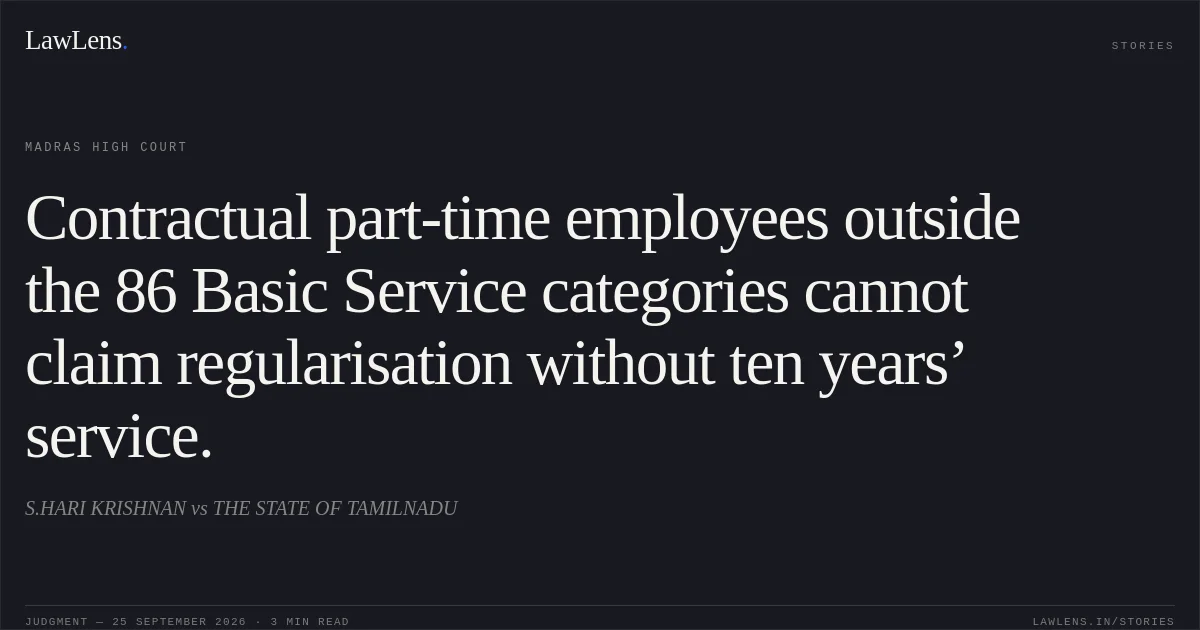
The Court held that the petitioner was not entitled to regularisation because he was a contractual/part-time worker outside the 86 categories under the Tamil Nadu Basic Service and had not completed ten years of service by 27 June 2013.
The order dated 3 December 2024 rejecting his request was upheld as a well-considered order.
Source reference: p.7The writ petition was dismissed, the connected miscellaneous petitions were closed, and no order as to costs was made.
Source reference: p.7Original Court PDF
S.HARI KRISHNANvsTHE STATE OF TAMILNADU
Click to open original judgment
Original judgment, available to read, download and summarize on LawLens.in