Facts
The complainant purchased a Mahindra Nuvo Sport vehicle from Shiv Shakti Vahan Pvt. Ltd. on 25 June 2018.
Source reference: para. 3The vehicle was financed by Mahindra & Mahindra Financial Services Ltd. and insured through ICICI Lombard Insurance Co. Ltd.
Source reference: para. 3The complainant alleged that the dealer wrongfully retained Forms 22 and 23, preventing registration of the vehicle and resulting in the lapse of insurance.
Source reference: paras. 3–4He consequently stopped paying the loan instalments and instituted proceedings before the consumer forum against the dealer and the finance company.
Source reference: paras. 3–4Thereafter, the finance company repossessed the vehicle for alleged default.
Source reference: paras. 3–4The complainant alleged that the petitioner, an Area Collection Manager of the finance company, acted in conspiracy with the other accused and caused him wrongful loss, leading to allegations under Sections 406 and 420 of the IPC.
Source reference: paras. 3–4The Judicial Magistrate took cognizance on 14 February 2020 and summoned the accused.
Source reference: para. 2The petitioner’s criminal revision was dismissed by the Additional District and Sessions Judge on 1 June 2022.
Source reference: para. 2He consequently approached the High Court seeking quashing of both orders.
Source reference: para. 2Issues
Whether repossession of the vehicle by the financer, pursuant to the hire-purchase/loan agreement and on account of default in payment of instalments, constituted criminal breach of trust or cheating under Sections 406 and 420 IPC.
Source reference: paras. 6–7, 12–15Whether the criminal proceedings were liable to be quashed as the dispute was predominantly civil in nature and the complainant had already pursued a consumer remedy.
Source reference: paras. 10, 17–18Whether cognizance could validly be taken against the petitioner when the finance company, allegedly responsible for the acts in question, had not itself been arrayed as an accused.
Source reference: paras. 8–9, 16, 18Law Applied
The Court applied Sections 406 and 420 IPC, holding that criminal breach of trust and cheating require the requisite dishonest or fraudulent intention, which is not ordinarily established by contractual repossession in accordance with a financing agreement.
Source reference: para. 15Relying on Anup Sarmah v. Bhola Nath Sharma, (2013) 1 SCC 400, Sardar Trilok Singh v. Satya Deo Tripathi, (1979) 4 SCC 396, K.A. Mathai @ Babu v. Kora Bibbikutty, (1996) 7 SCC 212, and Charanjit Singh Chadha v. Sudhir Mehra, (2001) 7 SCC 417, the Court held that in a hire-purchase arrangement the financer remains the owner, or retains the relevant proprietary interest, and may repossess the vehicle upon default; such repossession ordinarily gives rise to civil consequences rather than criminal liability.
Source reference: paras. 7, 13–14The Court also relied on Aneeta Hada v. Godfather Travels & Tours Pvt. Ltd., (2012) 5 SCC 661, and the principles referred to in Sharad Kumar Sanghi v. Sangita Rane, (2015) 12 SCC 781, concerning the necessity of impleading the company where an officer’s liability is alleged to be vicarious.
Source reference: paras. 9, 16It further applied the principle that a predominantly civil dispute should not be converted into criminal prosecution, relying on G.H.C.L. Employees Stock Option Trust v. Indian Infoline Ltd., (2013) 4 SCC 505.
Source reference: para. 17Reasoning
The Court distinguished the allegations concerning non-supply of Forms 22 and 23 from those against the petitioner, observing that the registration-related accusation was directed principally against the vehicle dealer and did not implicate the petitioner or his employer.
Source reference: para. 12As to repossession, the loan agreement expressly authorised the financer to take possession upon default, including under its cross-liability clause.
Source reference: para. 5Applying the hire-purchase principles laid down by the Supreme Court, the Court held that repossession pursuant to the contractual terms was an exercise of the financer’s proprietary and contractual rights and did not, on the pleaded facts, disclose the dishonest intention necessary for Sections 406 or 420 IPC.
Source reference: paras. 13–15The complainant’s grievance regarding registration, insurance, default and repossession was essentially contractual and had already been pursued before the consumer forum, further demonstrating its civil character.
Source reference: paras. 10, 17The Court additionally noted that the finance company had not been made an accused, although the allegations substantially concerned its conduct, and that the revisional court had dismissed the revision without adequately considering the parties’ submissions or recording independent reasons.
Source reference: para. 18Holding
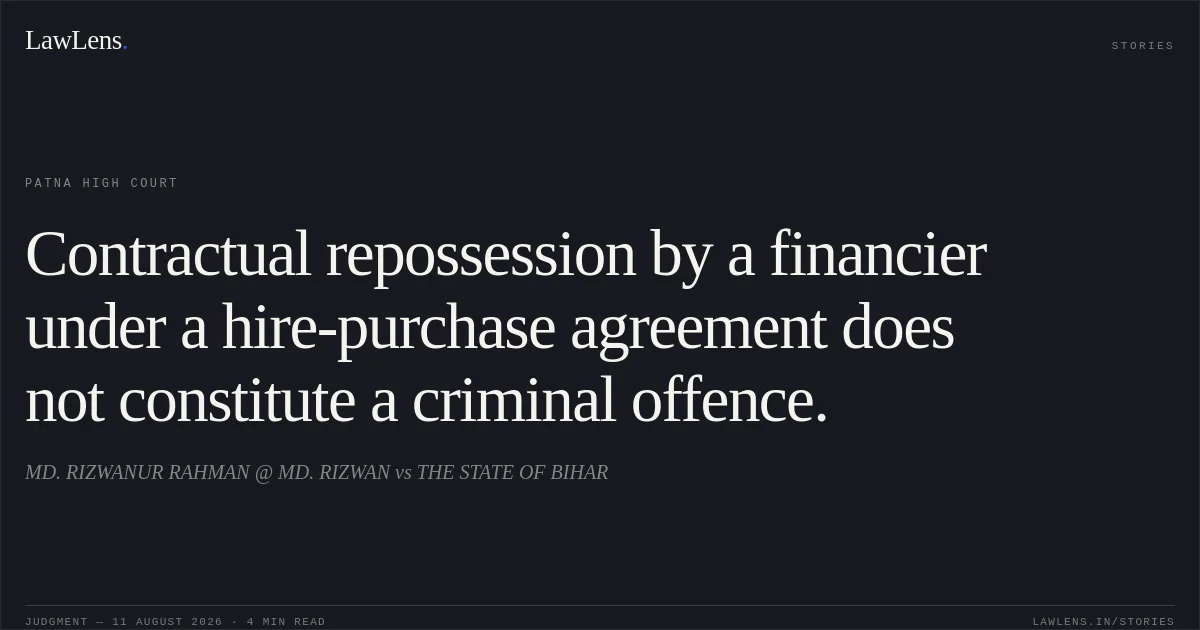
The High Court held that the allegations did not disclose the offences of cheating or criminal breach of trust against the petitioner.
Repossession of the vehicle by the financer in accordance with the financing agreement, following default in instalment payments, was treated as a civil and contractual dispute rather than a criminal offence.
Source reference: paras. 15, 17–18The Court accordingly quashed the order dated 1 June 2022 of the Additional District and Sessions Judge, Darbhanga, and the cognizance and summoning order dated 14 February 2020 of the Judicial Magistrate, insofar as they concerned the petitioner.
Source reference: para. 19The criminal miscellaneous application was allowed.
Source reference: para. 20Acts & Sections Cited
8 provisions across 2 statutes referred to in this judgment. Each provision opens on LawLens.
Indian Penal Code, 18607
Code of Criminal Procedure, 19731
Original Court PDF
MD. RIZWANUR RAHMAN @ MD. RIZWANvsTHE STATE OF BIHAR
Click to open original judgment
Original judgment, available to read, download and summarize on LawLens.in