Facts
The petitioner sought admission to Class I at Kendriya Vidyalaya, Sunwaha, District Tikamgarh, claiming preference available to children of State Government employees under the applicable KVS admission guidelines.
Source reference: para. 2The petitioner’s father was appointed as MIS State Coordinator by order dated 12 April 2013. Although his emoluments were stated to be paid from the Consolidated Fund of the State, the appointment order described his engagement as contractual.
Source reference: para. 2The admission claim under Clause 3(3) of the guidelines was rejected on the ground that the petitioner’s father was not a regular employee.
Source reference: para. 2The State subsequently confirmed, by communication dated 29 April 2026, that he was a contractual and not a regular employee.
Source reference: para. 5Issues
Whether the petitioner’s father could be treated as a “regular employee” under Clause 2(ii) of the KVS admission guidelines merely because his emoluments were drawn from the Consolidated Fund of the State.
Source reference: paras. 2, 5Whether the petitioner was entitled to admission under Clause 3(3) of the KVS guidelines on the basis of his father’s claimed status as a State Government employee.
Source reference: paras. 3–6Whether the petitioner could seek admission under Clause 3(5) of the guidelines in a subsequent academic session.
Source reference: paras. 4, 6–7Law Applied
Clause 2(ii) of the KVS admission guidelines confers the relevant preference on an employee who is regular, meaning an employee working against a post sanctioned by the State Government in a substantive capacity, and whose emoluments are drawn from the Consolidated Fund of the State.
Source reference: paras. 2, 5The requirements of regular substantive appointment and payment from the Consolidated Fund must therefore be satisfied; payment from the Consolidated Fund alone does not establish regular employment.
Source reference: para. 5The Court also considered the principles relied upon from Baleshwar Dass v. State of U.P., (1980) 4 SCC 226, and the KVS precedent in Kendriya Vidyalaya No. 1, Rewa v. Ayan Abdullah Usmani, W.A. No. 1716 of 2018.
Source reference: paras. 2, 4Reasoning
The Court found that the official record, particularly the Collector’s communication dated 29 April 2026, expressly described the petitioner’s father as a contractual employee and did not establish that he held a regular post in a substantive capacity.
Source reference: para. 5Consequently, the fact that his salary was paid from the Consolidated Fund could not independently satisfy Clause 2(ii).
Source reference: para. 5Since the essential requirement of regular employment was absent, the petitioner could not claim the preference under Clause 3(3) or admission as a matter of right.
Source reference: paras. 5–6The Court nevertheless noted that the petitioner’s elder sister had previously obtained admission under Clause 3(5), and permitted the petitioner to apply under that clause in the next academic session.
Source reference: paras. 4, 6Holding
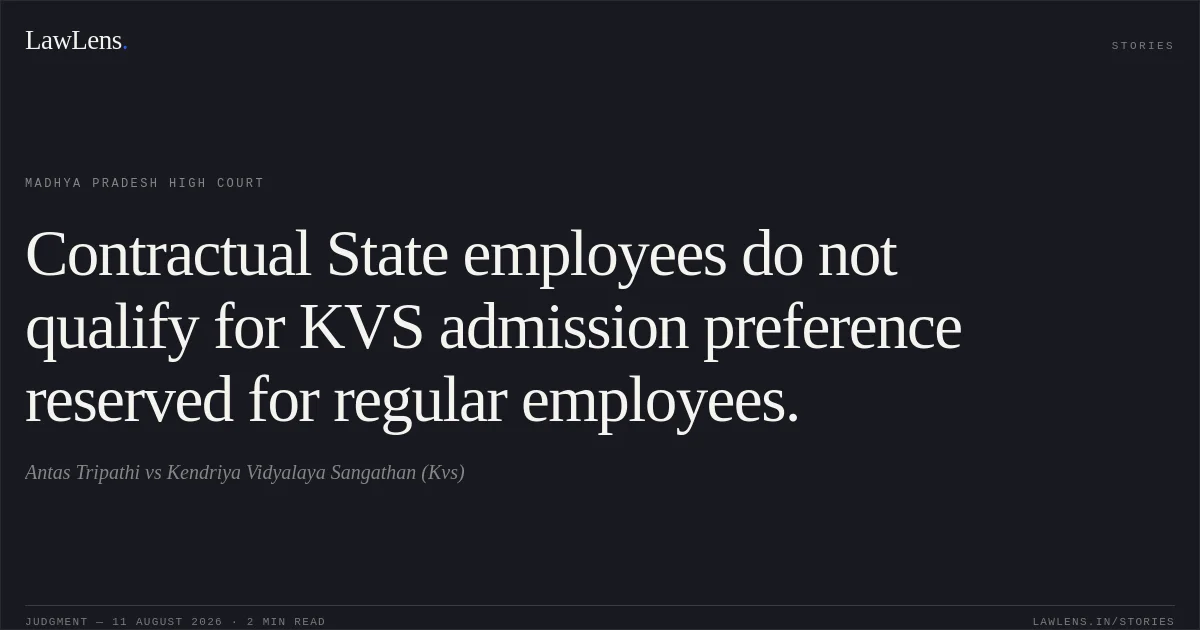
The Court held that the petitioner’s father was a contractual, not regular, employee and that the petitioner was therefore not entitled to admission under Clause 3(3) of the KVS guidelines.
The writ petition was disposed of, with liberty to the petitioner to seek admission under Clause 3(5) in the next academic session; such application was directed to be considered in accordance with law.
Source reference: para. 7Original Court PDF
Antas TripathivsKendriya Vidyalaya Sangathan (Kvs)
Click to open original judgment
Original judgment, available to read, download and summarize on LawLens.in