Facts
The Government of West Bengal sanctioned 900 contractual part-time teacher posts in 2002 for Higher Secondary sections with a workload of 10 periods per week
Source reference: p. 2The writ petitioners were appointed via a selection committee and signed contracts stipulating they would not claim regular pay or permanent status
Source reference: p. 3-4Over time, the State extended their tenure until age 60, provided ex-gratia retirement benefits, and granted medical/casual leave
Source reference: p. 5-6Notably, a 2010 Government Order (G.O.) granted leave subject to these teachers taking a workload equal to regular full-time teachers
Source reference: p. 6, 31The State also decided in 2008 not to sanction additional regular posts for subjects already covered by these part-time teachers
Source reference: p. 4The petitioners sought "equal pay for equal work" via writ petitions. A Single Judge allowed the claim, directing pay parity with regular teachers effective from April 2007
Source reference: p. 7-10Issues
1. Whether part-time contractual teachers are entitled to the same pay scale as regular permanent teachers based on the principle of "equal pay for equal work" despite differences in recruitment processes
Source reference: p. 11, 222. Whether the performance of equal workload and duties, as necessitated by Government mandates, overrides the contractual terms of appointment for the purpose of remuneration
Source reference: p. 25-26, 32Law Applied
The Court applied the principle of "equal pay for equal work" as an extension of Articles 14 and 21 of the Constitution of India, emphasizing that the State cannot perpetrate exploitation through temporary employment stratagems
Source reference: p. 27-28It relied heavily on State of Punjab v. Jagjit Singh (2017), which established that temporary employees performing similar duties as regular employees are entitled to the minimum of the pay scale
Source reference: p. 8, 26It balanced this with State of Bihar v. Bihar Secondary Teachers Struggle Committee (2019), which held that factors like the source/mode of recruitment and financial implications are relevant limitations to the doctrine
Source reference: p. 13-16The Court also considered Section 9 of the West Bengal School Service Commission Act, 1997, and the West Bengal Schools (Control of Expenditure) Act, 2005, regarding valid teacher appointments
Source reference: p. 7, 12Reasoning
The Court observed that while the petitioners were initially appointed as part-time contractual staff with a 10-period workload, the State’s subsequent actions—specifically the 2010 G.O. and the 2008 freeze on new regular posts—effectively coerced these teachers into performing the full workload of regular teachers
Source reference: p. 25-28, 32The Court found that the State exploited these teachers by requiring equal work while denying equal pay, violating the welfare state's socialist goals
Source reference: p. 28The Court distinguished between "regularization" (which it denied due to different recruitment sources) and "equal pay"
Source reference: p. 28-29It noted that for the period between July 28, 2010 (issuance of the leave G.O.) and December 24, 2013 (withdrawal of said G.O.), there was an "implied approval" by the State for these teachers to take classes equal to regular staff
Source reference: p. 31-32For periods outside this window, the Court found the evidence of equal workload insufficient for a blanket order and required individual verification
Source reference: p. 32-34Holding
The High Court partially modified the Single Judge’s order. It held that the petitioners are entitled to the basic pay (minimum of the scale) of regular teachers, but only for the specific period from July 28, 2010, to December 24, 2013, when the State expressly required equal workloads
The Court directed arrears to be paid within four weeks. For the periods from April 2007 to 2009 and post-December 2013, the petitioners were granted liberty to submit representations to the Secretary of School Education, who must pass reasoned orders after verifying attendance registers and class routines to determine if the duties performed were indeed identical to regular teachers.
Source reference: p. 33-35Acts & Sections Cited
7 provisions across 2 statutes referred to in this judgment. Each provision opens on LawLens.
West Bengal Schools ( Control Of Expenditure ) Act, 20055
Original Court PDF
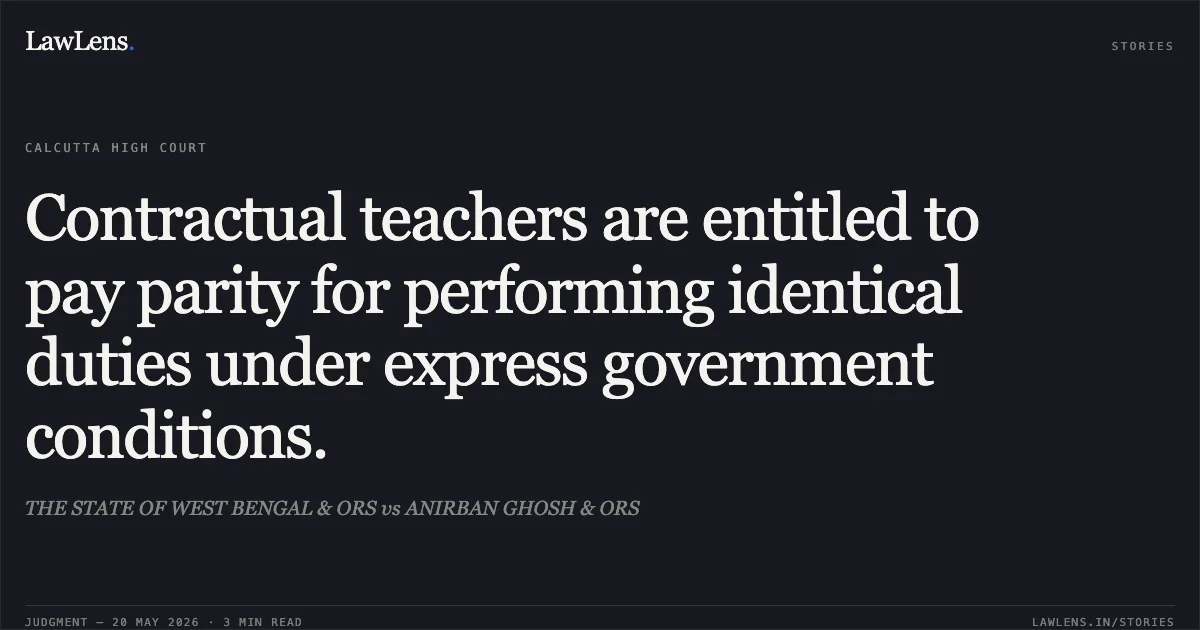
THE STATE OF WEST BENGAL & ORSvsANIRBAN GHOSH & ORS
Click to open original judgment
Original judgment, available to read, download and summarize on LawLens.in