Facts
The Petitioner was appointed as a Lecturer in the Department of Kriya Sharir at CBPACS (an autonomous GNCTD institution) following a 2009 public advertisement
Source reference: p.2Although she underwent a screening test and interview, the sole sanctioned post was filled by another candidate, Dr. Roushan
Source reference: p.3Subsequently, on 22nd September 2010, the Petitioner was offered a "contractual" appointment based on the Selection Committee's recommendation
Source reference: p.3She served continuously for 14 years through successive extensions and interim court protections
Source reference: p.1, 7In 2016, she participated in a fresh recruitment process for an Associate Professor post but was unsuccessful
Source reference: p.5On 11th August 2018, the Respondents issued an office order discontinuing her services with 15 days' notice, prompting the present writ petition for continuation and regularization
Source reference: p.2, 5Issues
1. Whether the Petitioner’s engagement was an "illegal" appointment or an "irregular" but legally cognizable engagement traceable to a public recruitment process
Source reference: para. 22(i)2. Whether the Petitioner can claim a right to regular appointment against a post already filled by a selected candidate
Source reference: para. 22(ii)3. Whether the impugned discontinuance order dated 11th August 2018 was sustainable in law
Source reference: para. 22(iv)4. Whether the court can grant relief like creation of a supernumerary post despite the limits on judicial review regarding regularization
Source reference: para. 22(vi)Law Applied
The court applied the distinction between "illegal" and "irregular" appointments established in Secretary, State of Karnataka v. Umadevi (3), holding that appointments made via public process but lacking minor formalities can be regularized
Source reference: p.17, 19It relied on M.L. Kesari v. State of Karnataka regarding the one-time window for regularizing long-term irregular employees
Source reference: p.14, 17Furthermore, it applied the principles from Vinod Kumar v. Union of India and Jaggo v. Union of India, which state that the label of "contractual" does not override the substantive nature of long-term employment in perennial roles
Source reference: p.17The court also noted that while post-creation is an executive function, arbitrary refusal to address a continuing institutional need is subject to judicial review under Article 14
Source reference: p.23, 25Reasoning
The court reasoned that the Petitioner was not a "back-door" entrant because her appointment was rooted in a public advertisement, she was qualified, and the appointment letter itself cited the Selection Committee’s recommendation
Source reference: p.16, 21It found that CBPACS had utilized her for core teaching functions for over a decade and represented her as regular faculty to the regulatory body (CCIM) to maintain institutional approvals
Source reference: p.3, 24The court rejected the Respondents' argument that the appointment was "illegal" merely because it was against an unsanctioned post, noting the institutional failure to restructure the cadre despite a perennial need
Source reference: p.19, 21The court balanced this against the rights of other candidates, noting the Petitioner could not displace Dr. Roushan (who filled the 2009 vacancy) or claim seniority over those recruited in 2016
Source reference: p.26The impugned order was found arbitrary as it assigned no reasons for discontinuance despite the Petitioner’s long, blemish-free service and the institution’s reliance on her tenure
Source reference: p.25, 26Holding
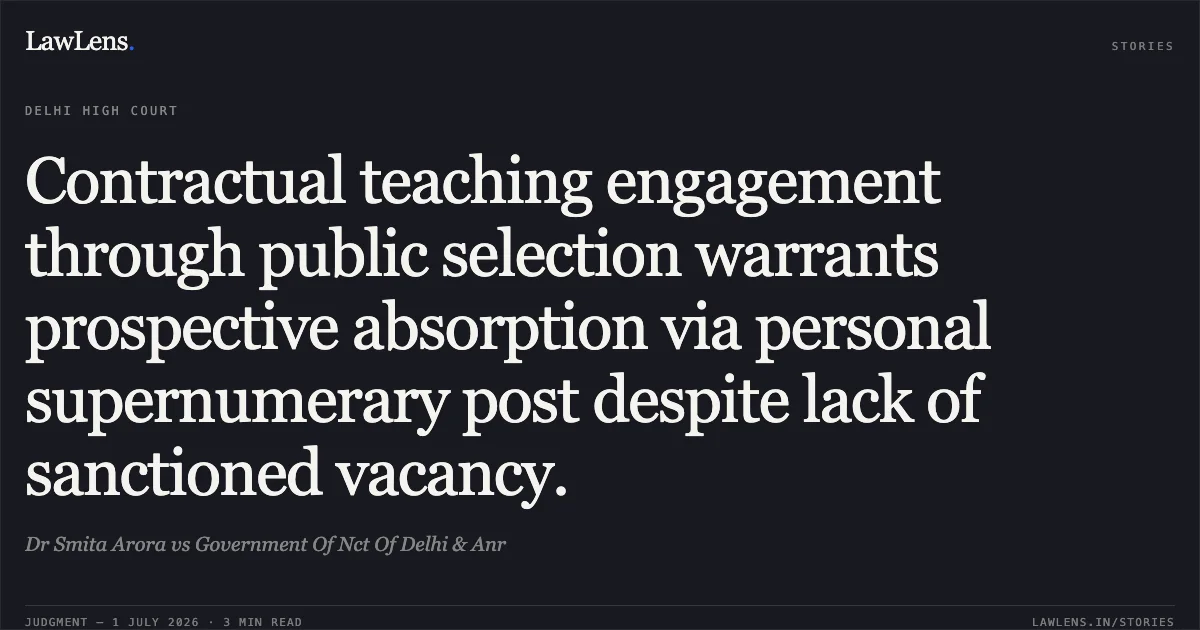
The Court quashed the order dated 11th August 2018
It held that while the Petitioner was not entitled to retrospective regularization or seniority over regularly recruited staff, she was entitled to prospective absorption due to the "irregular" but legitimate nature of her entry
Source reference: p.26The Court directed GNCTD/CBPACS to create a personal supernumerary post of Assistant Professor for the Petitioner within eight weeks
Source reference: para. 52(iv)Upon creation, she is to be absorbed prospectively with pay protection, though she will be placed at the bottom of the seniority list in her cadre; this post is personal to the Petitioner and will lapse upon her cessation of service
Source reference: para. 52(v-viii)Acts & Sections Cited
1 provisions across 1 statute referred to in this judgment. Each provision opens on LawLens.
Code of Civil Procedure, 19081
Original Court PDF
Dr Smita AroravsGovernment Of Nct Of Delhi & Anr
Click to open original judgment
Original judgment, available to read, download and summarize on LawLens.in


