Facts
The petitioner was appointed as a Traffic Manager on a contractual basis by the Bihar State Road Transport Corporation (BSRTC) in 2018. His contract was extended periodically.
Source reference: para 2While posted as Depot Superintendent at Aurangabad, he requested physical verifications of accounts due to suspected staff manipulation.
Source reference: para 3On 15.12.2023, an FIR was lodged alleging financial irregularities of ₹4,00,140/-, and the Regional Manager directed the petitioner to remain at headquarters during the enquiry.
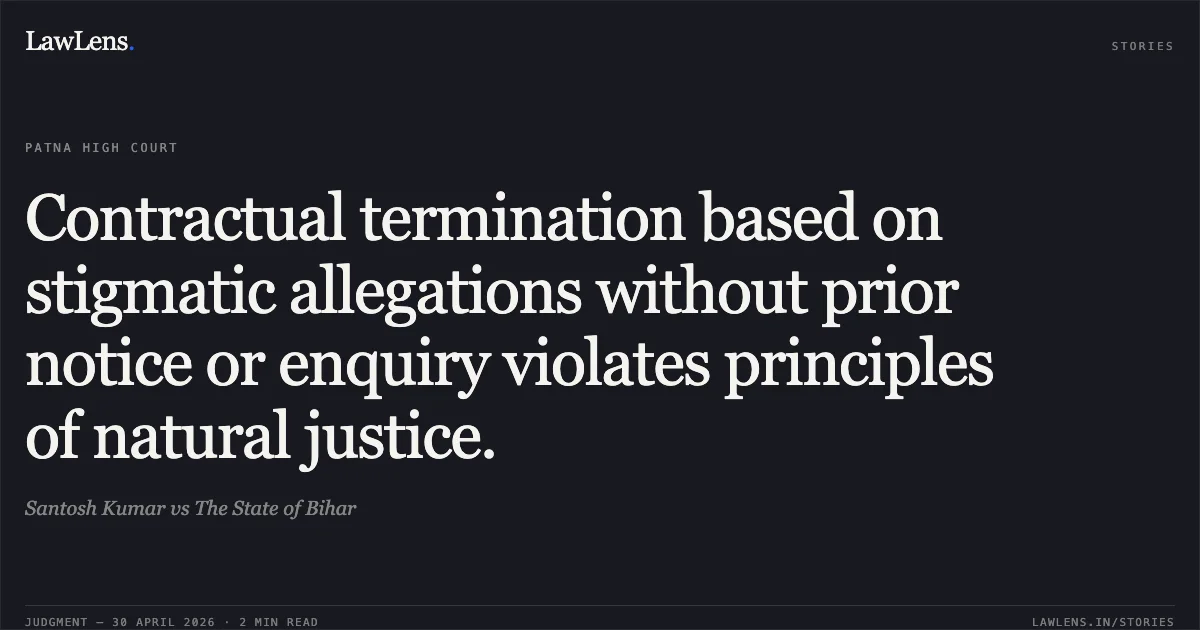
Source reference: para 3-4However, via Letter No. 570 dated 19.02.2024, the respondents terminated the petitioner’s contract on the ground of "unauthorized absence" from 15.12.2023 without issuing a show-cause notice or conducting a formal enquiry.
Source reference: para 2, 4The petitioner challenged this termination as arbitrary and stigmatic.
Source reference: para 5Issues
1. Whether the termination of a contractual employee on grounds of unauthorized absence and alleged financial irregularity, without following the principles of natural justice, is legally sustainable.
Source reference: para 17-182. Whether the court can direct reinstatement in a contract of personal service if the termination is found to be stigmatic and procedurally flawed.
Source reference: para 21-22Law Applied
The court applied the principle of Natural Justice (Audi Alteram Partem), asserting that even contractual service cannot be terminated on stigmatic grounds without a hearing.
Source reference: para 18It relied on Swati Priyadarshani v. State of Madhya Pradesh (2024) 19 SCC 128, which held that termination for inefficiency must be non-stigmatic and simpliciter.
Source reference: para 16It further cited Bhola Nath v. State of Jharkhand (2026) LiveLaw (SC) 95, reinforcing that the State as a "model employer" cannot act arbitrarily or exploit unequal bargaining power.
Source reference: para 6, 16Anuj Shukla v. State of Bihar regarding the necessity of a full-fledged departmental enquiry before passing a stigmatic order.
Source reference: para 20Reasoning
The court found that while the petitioner's appointment was purely contractual, the termination was not a "termination simpliciter" under the contract's notice clause but was based on specific allegations of "unauthorized absence" and financial embezzlement.
Source reference: para 12-13, 4, 14, 17The court observed a factual contradiction: the respondents claimed the petitioner was absent, yet their own Letter No. 885 dated 15.12.2023 directed him to remain at the headquarters for an enquiry.
Source reference: para 15, 17Because the termination order carried a stigma and was issued without a show-cause notice or an opportunity for the petitioner to defend himself, it violated Article 14 of the Constitution.
Source reference: para 18, 21The court reasoned that the State's failure to conduct a fair enquiry before labeling the employee's conduct as unauthorized rendered the administrative action void.
Source reference: para 21Holding
The court allowed the writ petition and quashed the termination order dated 19.02.2024. It held that the order was stigmatic and passed in gross violation of the principles of natural justice.
The respondents were directed to reinstate the petitioner forthwith with all consequential benefits. However, the court granted the respondents liberty to issue a fresh show-cause notice, conduct a proper enquiry, and take a reasoned decision in accordance with the law.
Source reference: para 22, 20, 22Acts & Sections Cited
1 provisions across 1 statute referred to in this judgment. Each provision opens on LawLens.
Specific Relief Act, 19631
Original Court PDF
Santosh KumarvsThe State of Bihar
Click to open original judgment
Original judgment, available to read, download and summarize on LawLens.in