Facts
The prosecution alleged that on 22 August 2018, at approximately 8:30 p.m., near a public toilet at Hoti Camp, Rangpuri Pahari, New Delhi, the ten-year-old victim was pushed into a pit, blindfolded, and subjected to aggravated penetrative sexual assault. The prosecution further alleged that the appellant bit the victim, pressed her neck, and caused other injuries. An FIR was registered on 23 August 2018 under Sections 376 IPC and 6 of the POCSO Act against an unknown person
Source reference: pp. 2–3The appellant was arrested on 23/24 August 2018 in connection with another FIR under Sections 363/365 IPC. During police custody, he allegedly made a disclosure regarding the present offence, following which he was investigated in the present case
Source reference: pp. 2–3, 14–15The Trial Court framed charges under Sections 341/363/365/366/376AB/323 IPC and Section 6 POCSO. Although the kidnapping charges were not proved, the appellant was convicted under Sections 341, 323 and 376AB IPC and Section 6 POCSO. He was sentenced to imprisonment for the remainder of his natural life under Section 376AB IPC, along with sentences for the other offences.
Source reference: pp. 2–5In appeal, the appellant challenged the reliability of the victim’s identification, the alleged police disclosure, the non-matching DNA evidence, and the recovery of the cloth allegedly used for blindfolding the victim
Source reference: pp. 5–7Issues
Whether the testimony of the child victim, particularly her identification of the appellant as the perpetrator, was sufficiently consistent and reliable to sustain conviction without further corroboration?
Source reference: paras. 24–34; pp. 7–14Whether the surrounding circumstances—including the appellant’s alleged custodial disclosure, forensic evidence, and recovery of the blindfolding cloth—provided reliable corroboration of the prosecution case?
Source reference: paras. 35–41; pp. 14–16Whether the prosecution had proved the appellant’s guilt beyond reasonable doubt under Sections 341/323/376AB IPC and Section 6 of the POCSO Act?
Source reference: paras. 34–42; pp. 14–17Law Applied
The Court applied Sections 341, 323 and 376AB of the Indian Penal Code, 1860, and Section 6 of the Protection of Children from Sexual Offences Act, 2012, concerning wrongful restraint, voluntarily causing hurt, aggravated penetrative sexual assault on a child below twelve years, and aggravated penetrative sexual assault under POCSO, respectively
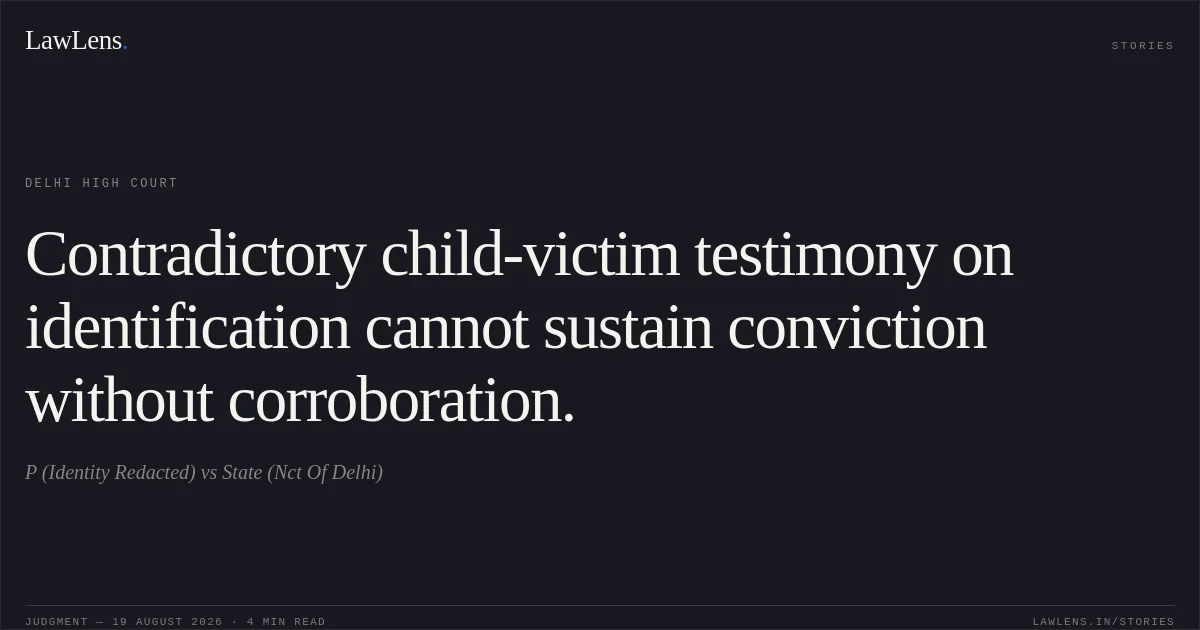
Source reference: paras. 1–2, 7On the evidentiary issue, the Court relied on State of Madhya Pradesh v. Balveer Singh, (2025) 8 SCC 545, holding that a competent child witness can be relied upon without corroboration where the testimony is voluntary, coherent, confidence-inspiring, and free from material discrepancies; however, corroboration may be required as a matter of caution where the testimony is tutored or contains material contradictions
Source reference: paras. 27–29; pp. 9–13The Court further applied the criminal-law principle that conviction must be founded on proof beyond reasonable doubt and cannot rest on mere suspicion or an unreliable identification
Source reference: paras. 34, 41–42Reasoning
The Court found that the victim’s testimony contained a material contradiction concerning whether she had been able to see the perpetrator’s face. Although she initially stated that it was dark and indicated that there was insufficient light to identify the assailant, she subsequently stated that a light was on and affirmed that she had seen his face
Source reference: paras. 30–32; pp. 13–14The alleged presence of a light was not supported by either of the site plans, which showed no lamp-post or other source of illumination near the place of occurrence. The Court therefore held that the victim’s identification of the appellant in court could not safely be treated as reliable substantive identification, particularly since the appellant was not named in the FIR or the MLC and the assailant was initially described as an unknown person
Source reference: paras. 32–35; pp. 14–15The alleged custodial disclosure also raised suspicion because the appellant’s name surfaced while he was already in police custody in another case registered at the same police station, after the present FIR had been registered. The Court considered this circumstance capable of suggesting that the appellant may have been implicated as a scapegoat
Source reference: paras. 36–37; pp. 15The FSL report did not corroborate the prosecution: although the blood stains on the victim’s microslides matched the victim’s blood sample, the semen stains did not match the appellant’s sample. The recovery of the alleged blindfolding cloth was also considered doubtful because it was an easily available article, no independent witness joined the seizure, and the recovery was from an open place. In these circumstances, the Court held that the prosecution evidence raised substantial doubt and did not meet the standard required for conviction
Source reference: paras. 38–42; pp. 15–17Holding
The Court answered the issues in favour of the appellant. It held that, although the child victim’s testimony could in principle form the sole basis of conviction, her material inconsistencies regarding the opportunity to identify the assailant required corroboration, which was absent in the present case
The custodial disclosure, non-matching forensic evidence, and doubtful recovery did not establish the appellant’s involvement beyond reasonable doubt. Accordingly, the appeal was allowed; the judgment of conviction dated 4 September 2025 and order on sentence dated 24 September 2025 were set aside; and the appellant was acquitted of all charges. His bail and surety bonds were discharged, and he was directed to be released forthwith if not required in any other case.
Source reference: paras. 35–44; p. 17Acts & Sections Cited
9 provisions across 4 statutes referred to in this judgment. Each provision opens on LawLens.
Bharatiya Nagarik Suraksha Sanhita, 20231
Code of Criminal Procedure, 19731
Indian Penal Code, 18606
Protection of Children from Sexual Offences Act, 20121
Original Court PDF
P (Identity Redacted)vsState (Nct Of Delhi)
Click to open original judgment
Original judgment, available to read, download and summarize on LawLens.in