Facts
The Respondent obtained an eviction order dated 25 February 2019 in respect of the subject premises. An execution petition was filed on 20 October 2023, and warrants of possession were issued on 10 January 2025 in the absence of any stay.
Source reference: p.2, paras 4–5When the warrants were being executed on 12 February 2025, the Petitioner, General Talkies Pvt. Ltd., filed objections under Order XXI Rule 99 of the Code of Civil Procedure, claiming that it was the owner and occupant of the premises pursuant to an arrangement dating from the 1970s and alleging fraud, collusion and lack of service in the eviction proceedings.
Source reference: pp.2–4, paras 4–5The Executing Court stayed execution temporarily and directed the Petitioner to file an affidavit specifying the date and legal capacity of its possession, including particulars of any claim based on title, adverse possession, tenancy or licence.
Source reference: pp.3–4, para. 5Instead of filing the directed affidavit, the Petitioner filed a subsequent application dated 27 February 2025, asserting that it had been in possession since June 1995 and had acquired title by adverse possession.
Source reference: p.4, paras 7–8The Executing Court rejected the objections, holding that the Petitioner had taken mutually inconsistent positions—ownership since the 1970s and adverse possession since 1995—and had failed to establish a prima facie independent title.
Source reference: pp.8–10, paras 10–12The Petitioner challenged that order under the proviso to Section 25B(8) of the Delhi Rent Control Act, 1958.
Source reference: p.1, para. 1Issues
Whether the Executing Court erred in rejecting the Petitioner’s objections after finding that it had taken inconsistent and mutually irreconcilable pleas regarding the nature and commencement of its alleged title.
Source reference: pp.4–5, paras 9–12; pp.8–10, paras 21–22Whether the plea of adverse possession, introduced through the subsequent application, disclosed a legally sustainable claim requiring a detailed inquiry into the documents relied upon by the Petitioner.
Source reference: pp.13–15, paras 31–37Whether the Impugned Order suffered from jurisdictional error, manifest illegality, material irregularity, perversity or an error apparent on the face of the record warranting interference under the proviso to Section 25B(8) of the Delhi Rent Control Act, 1958.
Source reference: pp.5–7, paras 14–20; pp.15–16, paras 38–42Law Applied
The Court applied the proviso to Section 25B(8) of the Delhi Rent Control Act, 1958, holding that the High Court’s jurisdiction is supervisory and revisional, not appellate; interference is limited to jurisdictional errors, manifest illegality, material irregularity, perversity, or an error apparent on the face of the record, and the High Court cannot undertake a fresh appreciation of evidence merely because another view is possible.
Source reference: pp.5–7, paras 14–19Relying on Sarla Ahuja v. United India Insurance Co. Ltd., (1998) 8 SCC 119; Hindustan Petroleum Corporation Ltd. v. Dilbahar Singh, (2014) 9 SCC 78; Abid-Ul-Islam v. Inder Sain Dua, (2022) 6 SCC 30; Pankaj Pahwa v. Prem Wati, 2024:DHC:9322; and Sanjeev Hiranandani v. Sunny Grover, 2025:DHC:11285, the Court reiterated that revisional scrutiny examines the legality and propriety of the decision-making process rather than substituting the Court’s view for that of the Rent Controller.
Source reference: pp.5–7, paras 15–19Under Order XXI Rules 97 and 99 CPC, a person claiming an independent right or alleging dispossession during execution may raise objections before the Executing Court.
Source reference: pp.9–10, paras 11–12A plea of adverse possession presupposes title in another person and requires specific pleadings establishing the identity of the true owner, the date and circumstances from which possession became hostile, the nature of the hostile possession, and its continuity for the statutory period; mere long or uninterrupted possession is insufficient.
Source reference: pp.13–15, paras 31–35The principle against approbation and reprobation prohibits a litigant from obtaining an advantage on one representation and subsequently taking an inconsistent position to secure further relief.
Source reference: pp.12–13, paras 28–30Reasoning
The Court found that the Petitioner’s initial application asserted ownership acquired through an arrangement in the 1970s, and that this assertion formed the basis for the interim stay of the possession warrants.
Source reference: pp.10–11, paras 24–25The Petitioner thereafter failed to file the affidavit directed by the Executing Court and, only after the Respondent had replied, introduced a materially different plea of adverse possession commencing in 1995.
Source reference: p.11, paras 26–29The Court held that ownership acquired under an arrangement and ownership claimed through adverse possession rested on fundamentally different premises: the former asserted independent title, while the latter acknowledged title in another and alleged hostile possession against it.
Source reference: pp.11–14, paras 27, 31–33The Petitioner neither consistently identified the true owner nor specified when and how its possession became hostile. Consequently, the adverse-possession plea was not legally sustainable even on its own terms.
Source reference: pp.14–15, paras 34–36The Executing Court had considered the pleadings, procedural history, directions issued, and the Petitioner’s conduct, and had provided cogent reasons for rejecting the objections. A fresh examination of the possession letter and other documents would improperly convert the revision into an appeal, which was impermissible under the limited scope of Section 25B(8).
Source reference: pp.15–16, paras 37–40Holding
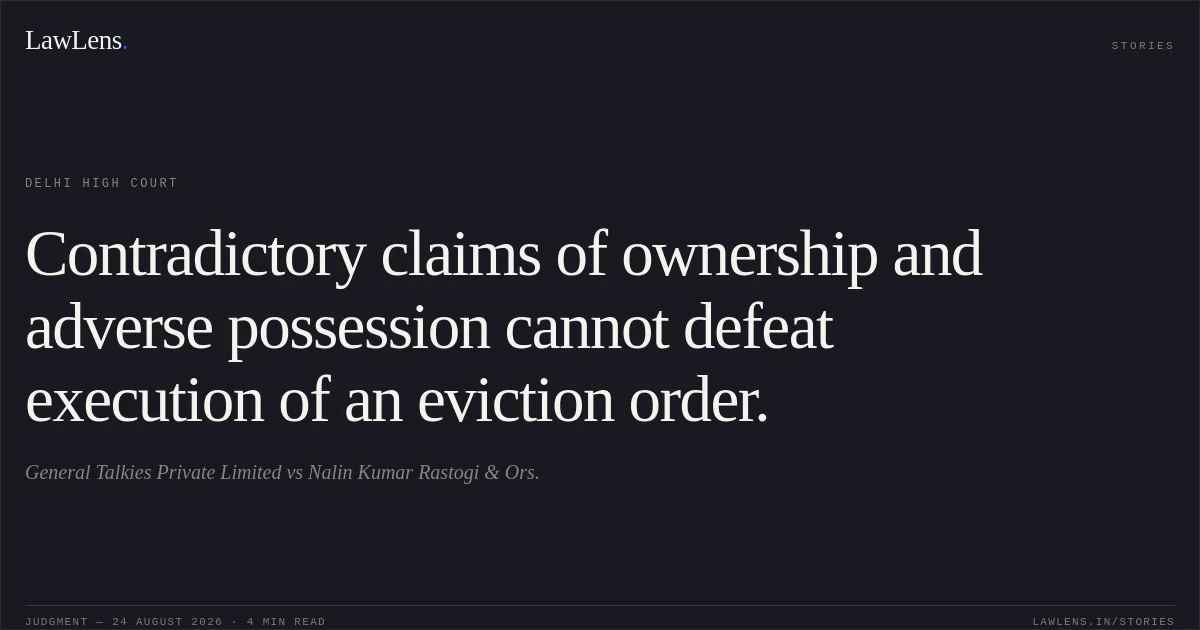
The High Court answered the issues against the Petitioner. It held that the Petitioner had taken contradictory and mutually destructive positions, had attempted to replace its original ownership claim with an unpleaded and inadequately particularised plea of adverse possession, and could not approbate and reprobate.
The Impugned Order dated 5 May 2025 disclosed no jurisdictional error, material irregularity, perversity or other infirmity warranting revisional interference.
Source reference: pp.15–16, paras 38–42Accordingly, RC.REV. 155/2025 was dismissed, and the pending applications were disposed of.
Source reference: p.16, para. 42; p.17, para. 43Acts & Sections Cited
2 provisions across 1 statute referred to in this judgment. Linked provisions open on LawLens.
Delhi Rent Control Act, 19582
Original Court PDF
General Talkies Private LimitedvsNalin Kumar Rastogi & Ors.
Click to open original judgment
Original judgment, available to read, download and summarize on LawLens.in