01Facts
The prosecution case was that, on 29 January 2000 at approximately 11:00 p.m., accused Nos. 1 and 2 allegedly assaulted Premsingh @ Pappu Shivsevaksingh with a sword and dhariya, causing injuries that resulted in his death. Accused No. 3 allegedly assaulted complainant Mukesh Vidhyaram Prajapati with an iron knuckle, causing injuries to his forehead, chest and stomach. The accused were charged under Sections 302, 324, 34 and 114 of the Indian Penal Code and Section 135(1) of the Bombay Police Act.
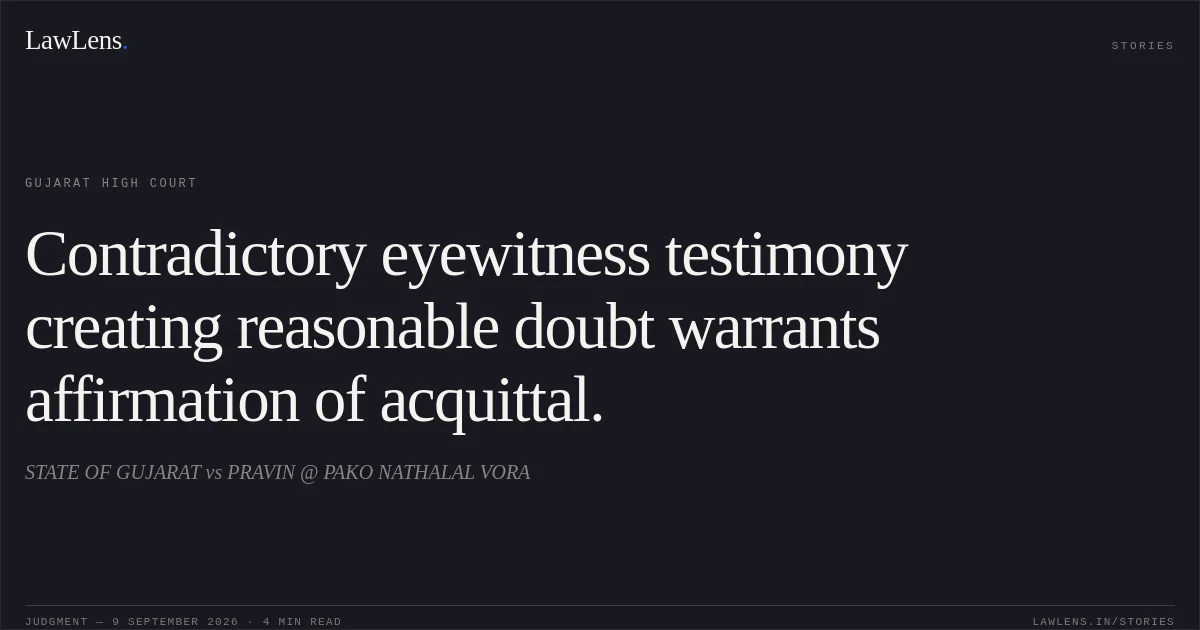
pp. 2, 6–7The Sessions Court, Ahmedabad, acquitted all the accused by judgment dated 9 November 2001 in Sessions Case No. 247 of 2000. The State preferred an appeal under Section 378 of the Code of Criminal Procedure, 1973.
¶ 1During the appeal, proceedings against accused No. 1 were reported to have abated, while accused No. 2 was absconding; the appeal was considered in relation to the surviving proceedings.
¶ 1.1The prosecution primarily relied on complainant Mukesh Prajapati, an injured eyewitness; Guddusingh Pavar, an alleged eyewitness; Shivsevaksingh, the deceased’s father; medical evidence; discovery panchnamas; the scene-of-offence panchnama; and forensic evidence.
pp. 7–802Issues
i.Whether the prosecution proved beyond reasonable doubt that the accused, sharing a common intention or acting in furtherance of common intention, committed the murder of Premsingh under Sections 302 and 34 IPC and caused hurt to Mukesh under Section 324 IPC read with Sections 34/114 IPC?
pp. 2, 6–7, 16ii.Whether the testimony of the injured complainant and the alleged eyewitness was reliable and sufficient to sustain a conviction despite the contradictions regarding the place of assault, the weapons used, and the circumstances of the incident?
¶ 8–15iii.Whether the Sessions Court’s acquittal disclosed such perversity or illegality as to justify appellate interference under Section 378 CrPC?
¶ 16–18iv.Whether the recording of the complainant’s deposition in Gujarati, despite his stated inability to understand Gujarati and the absence of an endorsement that it was explained to him in Hindi, affected the evidentiary value of his testimony?
¶ 10–1103Law Applied
The Court applied Sections 302, 324, 34 and 114 of the Indian Penal Code, concerning murder, voluntarily causing hurt by dangerous weapons, common intention and abetment, respectively, together with Section 135(1) of the Bombay Police Act.
pp. 1–2, 6–7The State’s appeal against acquittal was governed by Section 378 CrPC.
The Court also applied Rule 150(2) of the Criminal Manual, which requires a witness’s deposition to be read over to the witness and an endorsement to be made regarding its correctness; this safeguard is particularly material where the deposition is recorded in a language not understood by the witness.
¶ 10–11On appellate review, the Court relied on Chandrappa v. State of Karnataka, (2007) 4 SCC 415, and Rajesh Prasad v. State of Bihar & Anr., (2022) 3 SCC 471, for the principle that an appellate court may reappreciate evidence in an appeal against acquittal, but the accused benefit from a double presumption of innocence; where two reasonable views are possible, the acquittal ordinarily should not be disturbed.
¶ 16Provisions in the judgment · 5 · Linked ones open on LawLens
Code of Criminal Procedure, 1973 Section 378
Indian Penal Code, 1860 Section 302Section 324Section 34Section 114
04Reasoning
The High Court found that the prosecution evidence suffered from material inconsistencies. The charge attributed the sword and dhariya differently from the discovery panchnama and the eyewitness accounts, creating a defect regarding the weapons allegedly used.
¶ 7The complainant Mukesh’s testimony was considered unreliable because he did not understand Gujarati, his deposition was recorded in Gujarati without an endorsement that it had been explained to him in Hindi, and his account materially conflicted with the FIR regarding whether he ran to inform the deceased’s father or lost consciousness.
¶ 8–11His close relationship with the deceased and the absence of independent eyewitnesses from a densely populated location further weakened the prosecution case.
¶ 8The testimony of Guddusingh was also found inconsistent with the scene-of-offence panchnama and with Mukesh’s account. His assertion that he later found Mukesh near the Gafur Chali gate was inconsistent with the prosecution theory that Mukesh had witnessed the assault at the place of occurrence; Mukesh had not mentioned Guddusingh’s presence as an eyewitness.
¶ 12The alleged assault on Mukesh was not corroborated by the forensic evidence, as no blood was detected on the recovered metal knuckle. Likewise, the sword allegedly used in the assault on the deceased did not show traces of blood in the serological report.
¶ 13These deficiencies, together with the varying accounts concerning the three alleged places of assault and the interested nature of the principal witnesses, created reasonable doubt.
¶ 14–15Applying the rule governing appeals against acquittal, the High Court held that the Sessions Court had assigned cogent and convincing reasons for rejecting the prosecution evidence. Since the trial court’s view was a reasonable one supported by the record, the enhanced presumption of innocence prevented appellate interference.
¶ 16–1705Holding
The High Court answered the issues against the prosecution. It held that the prosecution failed to establish the accused persons’ guilt beyond reasonable doubt and that the eyewitness testimony was not sufficiently reliable or corroborated to sustain convictions under Sections 302, 324, 34 or 114 IPC.
¶ 16Finding no perversity or legal error in the Sessions Court’s acquittal, the Court dismissed the State’s appeal, discharged the bail bonds, and directed that the record and proceedings be returned to the concerned Sessions Court.
¶ 18Original Court PDF
STATE OF GUJARATvsPRAVIN @ PAKO NATHALAL VORA
Click to open original judgment
Original judgment, available to read, download and summarize on LawLens.in