Facts
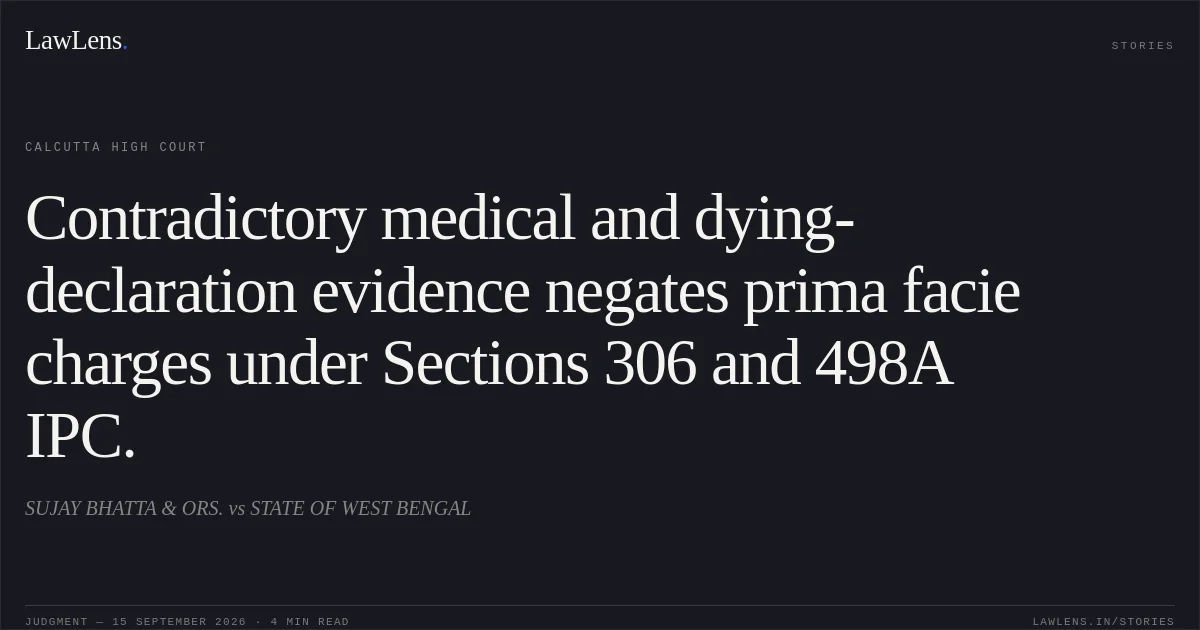
The petitioners sought quashing of Berhampore P.S. Case No. 1396 of 2018, corresponding to G.R. Case No. 4518 of 2018, arising from allegations that petitioner no. 1’s wife was subjected to physical and mental cruelty by her husband and in-laws because of his alleged illicit relationship with another woman.
Source reference: para. 2; p. 2It was further alleged that on 9 November 2018 the accused assaulted the victim and set fire to her clothes, resulting in severe burn injuries and her subsequent death.
Source reference: para. 2; p. 2The police submitted a charge-sheet against the petitioners, initially referred to under Sections 498A/307/34 IPC, while the proceedings were considered by the Court principally with reference to Sections 498A and 306 IPC.
Source reference: paras. 2, 5, 25; pp. 2–3, 11The petitioners relied on the victim’s dying declaration, in which she stated that her nightdress accidentally caught fire while she was cooking near a gas oven, that her husband attempted to extinguish the fire, and that she had no allegation against anyone.
Source reference: para. 10; p. 5The post-mortem report attributed death to ante-mortem burn injuries and stated that the distribution of the burns ruled out homicide, leaving the question of suicide or accident to be determined from the circumstances.
Source reference: para. 9; p. 4The petitioners also relied on the alleged delay in lodging the FIR and witness statements indicating that petitioner no. 1 had taken the victim to hospital and remained present during her treatment.
Source reference: paras. 3–4; pp. 2–3The State opposed quashing on the basis of the statements recorded during investigation.
Source reference: para. 6; p. 3Issues
Whether the materials collected during investigation disclosed a prima facie offence under Sections 306/107 IPC, namely, suicide by the victim and abetment or instigation thereof by the petitioners?
Source reference: paras. 11–16; pp. 5–8Whether the allegations and materials disclosed “cruelty” within the meaning of Section 498A IPC against the petitioners?
Source reference: paras. 17–21; pp. 8–10Whether, in view of the dying declaration, post-mortem report, and contradictions in the prosecution case, continuation of the criminal proceeding would amount to an abuse of the process of court warranting exercise of the High Court’s quashing jurisdiction?
Source reference: paras. 22–24; pp. 10–11Law Applied
The Court applied Sections 306 and 107 IPC, holding that an offence under Section 306 requires proof, at least prima facie, of suicide and abetment through instigation, intentional aid, or a direct or indirect act closely connected with the suicide.
Source reference: para. 11; p. 5Relying on Ramesh Kumar v. State of Chhattisgarh, (2001) 9 SCC 618, the Court held that “instigation” means goading, urging, provoking, inciting, or encouraging the commission of an act, and requires a reasonable certainty that the accused’s conduct would produce the consequence.
Source reference: para. 12; pp. 6–7Relying also on Pawan Kumar v. State of Himachal Pradesh, (2017) 7 SCC 780, it held that mere harassment, a casual remark, reprimand, or words uttered in anger, without a positive act proximate to the suicide, do not constitute abetment.
Source reference: para. 13; pp. 6–7Section 498A IPC was applied, including Explanations (a) and (b), which require either wilful conduct of such gravity as is likely to drive the woman to suicide or cause grave injury, or harassment connected with an unlawful demand for property or valuable security.
Source reference: paras. 17, 19–21; pp. 8–10For quashing, the Court relied on State of Haryana v. Bhajan Lal, 1992 Supp (1) SCC 335, particularly categories permitting intervention where allegations are inherently improbable or where proceedings are manifestly attended by mala fides and instituted to wreak vengeance.
Source reference: para. 22; p. 10Reasoning
The Court found that the prosecution’s allegation that petitioner no. 1, assisted by the other accused, had set fire to the victim was materially contradicted by the post-mortem report, which ruled out homicide, and by the victim’s dying declaration, which described the incident as accidental and exonerated all persons.
Source reference: paras. 9–10, 14; pp. 4–7Since the prosecution had produced no reliable material showing that the victim had committed suicide, the foundational requirement for Section 306 IPC was absent.
Source reference: paras. 11, 15–16; pp. 5–8In any event, there was no evidence of a direct, proximate, or positive act of instigation or intentional aid creating a situation in which the victim had no alternative but to commit suicide.
Source reference: paras. 11, 15–16; pp. 5–8As to Section 498A IPC, the Court noted the absence of any allegation of dowry demand and the lack of specific evidence establishing conduct of the degree and intensity required under Explanation (a).
Source reference: paras. 17–21; pp. 8–10The alleged matrimonial discord concerning the husband’s supposed illicit relationship, unsupported by the investigation witnesses and inconsistent with the dying declaration, was held insufficient by itself to constitute statutory cruelty.
Source reference: paras. 8, 17–21; pp. 4–10The substantial contradictions between the FIR, witness statements, post-mortem report, and dying declaration rendered the prosecution case inherently unreliable and brought the matter within the quashing principles stated in Bhajan Lal.
Source reference: paras. 18, 21–23; pp. 8–11Holding
The Court held that the materials did not establish even a prima facie case under Sections 306 or 498A IPC.
The alleged death was not shown to be suicidal or homicidal, there was no prima facie evidence of abetment or instigation, and the alleged matrimonial discord did not satisfy the statutory definition of cruelty.
Source reference: paras. 16, 20–23; pp. 7–11Accordingly, CRR 2796 of 2019 was allowed, and the criminal proceeding in Berhampore P.S. Case No. 1396 of 2018, corresponding to G.R. Case No. 4518 of 2018, pending before the competent court at Berhampore, was quashed.
Source reference: paras. 24–25; p. 11Acts & Sections Cited
7 provisions across 3 statutes referred to in this judgment. Each provision opens on LawLens.
Indian Penal Code, 18605
Code of Criminal Procedure, 19731
Bharatiya Nagarik Suraksha Sanhita, 20231
Original Court PDF
SUJAY BHATTA & ORS.vsSTATE OF WEST BENGAL
Click to open original judgment
Original judgment, available to read, download and summarize on LawLens.in