Facts
For Assessment Year 2003–04, Torrent Power Limited filed its return declaring total income of ₹39,72,59,199. During scrutiny proceedings under Section 143(3) of the Income-tax Act, 1961, the assessee explained a payment of ₹10.90 crores made to the Gujarat Electricity Board (“GEB”) towards augmentation of its transmission network and claimed it as revenue expenditure under Section 37(1).
Source reference: p.2The Assessing Officer had specifically called for details of the service-line contribution and related expenditure under Section 142(1), and the assessee furnished the relevant correspondence and details.
Source reference: p.2–3The payment was made to facilitate increased power supply, but the augmented service line remained the property of GEB; GEB was responsible for its maintenance and retained the right to supply power to other consumers through it.
Source reference: p.3The Assessing Officer allowed the claim, although the assessment order did not expressly discuss the issue.
Source reference: p.4Subsequently, the Principal Commissioner of Income Tax invoked Section 263, treating the expenditure as potentially capital in nature and the assessment order as erroneous and prejudicial to the interests of the Revenue.
Source reference: p.4The Income Tax Appellate Tribunal quashed the revision order, holding that the expenditure was revenue in nature and that the Assessing Officer had examined the claim during assessment proceedings.
Source reference: p.5–7The Revenue appealed under Section 260A.
Source reference: p.1–2Issues
Whether the Tribunal was correct in law and on facts in quashing the order passed by the Commissioner/Principal Commissioner under Section 263 of the Income-tax Act, 1961.
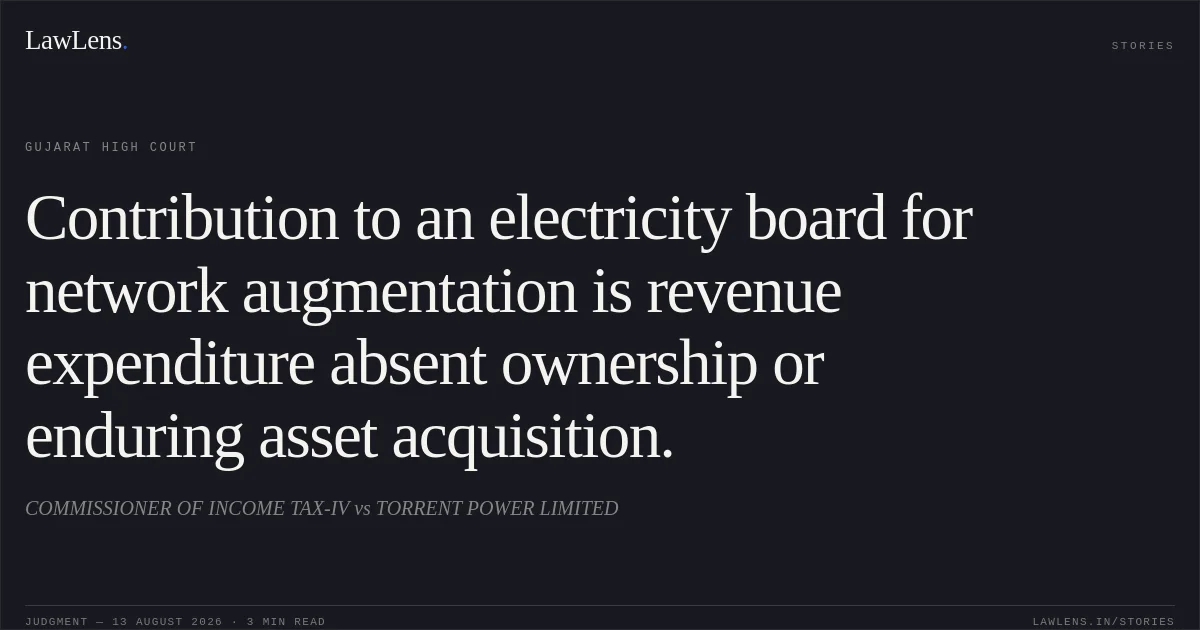
Source reference: p.2, para. 2–3Whether the assessee’s contribution of ₹10.90 crores to GEB for augmentation of the transmission network was allowable as revenue expenditure under Section 37(1), or was capital expenditure.
Source reference: p.4–7Law Applied
Section 37(1) permits deduction of expenditure laid out wholly and exclusively for business purposes, provided it is not personal expenditure, capital expenditure, or expenditure covered by Sections 30 to 36.
Source reference: p.5–6Section 263 can be invoked only where the assessment order is both erroneous and prejudicial to the interests of the Revenue; revision is impermissible merely because the Commissioner prefers another possible view.
Source reference: no citationExpenditure incurred to improve or augment the existing profit-making apparatus, without the assessee acquiring ownership, possession, or a capital asset or enduring proprietary benefit, is ordinarily revenue expenditure.
Source reference: no citationThe Court relied on Sarabhai M. Chemicals Pvt. Ltd. v. CIT, Gujarat-I, (1981) 127 ITR 74 (Guj), and CIT, Bombay City-IV v. Excel Industries Ltd., (1980) 122 ITR 995 (Bom), which held that contributions to an electricity board for service or supply lines remaining the property of the Board were revenue expenditure incurred to augment the assessee’s existing profit-making structure.
Source reference: p.6–8Reasoning
The Court found that the Assessing Officer had made a specific inquiry regarding the service-line contribution under Section 142(1) and had considered the assessee’s detailed response and supporting documents before allowing the deduction.
Source reference: p.2–4, 7The absence of an elaborate discussion in the assessment order did not establish non-application of mind where the record demonstrated that the issue had been examined.
Source reference: no citationOn the substantive character of the payment, the augmented transmission network belonged exclusively to GEB, GEB bore the maintenance costs, and GEB could use the line to supply other consumers.
Source reference: p.7The assessee therefore acquired no ownership, possession, tangible right, or enduring proprietary benefit.
Source reference: no citationThe payment merely enabled the assessee to secure and improve the supply of electricity required for its existing business and augmented its profit-making capacity.
Source reference: no citationApplying Sarabhai M. Chemicals and Excel Industries, the Court held that the expenditure was revenue expenditure under Section 37(1), and consequently the Assessing Officer’s view was neither erroneous nor prejudicial to the interests of the Revenue so as to justify Section 263 revision.
Source reference: p.7–8Holding
The Gujarat High Court answered the substantial question of law in favour of the assessee and against the Revenue.
It upheld the Tribunal’s order quashing the Section 263 revision order, holding that the ₹10.90-crore contribution to GEB was allowable as revenue expenditure and that the assessment order did not satisfy the statutory conditions of being both erroneous and prejudicial to the Revenue.
Source reference: p.9The Revenue’s appeal was dismissed.
Source reference: p.9Acts & Sections Cited
12 provisions across 1 statute referred to in this judgment. Linked provisions open on LawLens.
Income Tax Act, 1961
Original Court PDF
COMMISSIONER OF INCOME TAX-IVvsTORRENT POWER LIMITED
Click to open original judgment
Original judgment, available to read, download and summarize on LawLens.in