Facts
M.C. Manjunath died in a road accident on 11 May 2015 while riding a motorcycle. His wife, minor daughter and parents claimed compensation, alleging that the lorry driver caused the accident.
Source reference: pp. 5–9, paras. 1–9The insurer disputed liability, alleging that the deceased contributed to the accident, and challenged the compensation awarded by the Motor Accidents Claims Tribunal (MACT). The MACT awarded ₹11,95,000. The claimants appealed seeking enhancement; the insurer separately appealed against liability and quantum.
Source reference: pp. 5–9, paras. 1–9The deceased was 37 years old. The claimants produced unsigned salary slips asserting monthly earnings of ₹40,000, but did not prove them through the employer or supporting financial records.
Source reference: pp. 11–14, paras. 17–21Issues
Whether the insurer established that the deceased contributed to the accident.
Source reference: pp. 9–11, paras. 12–15Whether the Tribunal’s assessment of compensation required modification, including whether the unproved salary slips could establish the deceased’s asserted income.
Source reference: pp. 11–15, paras. 17–22Law Applied
The appeals were brought under Section 173(1) of the Motor Vehicles Act.
Source reference: pp. 3, 5The Court applied the principles in National Insurance Co. Ltd. v. Pranay Sethi, (2017) 16 SCC 680, concerning future prospects and conventional heads of compensation; Magma General Insurance Co. Ltd. v. Nanu Ram, (2018) 18 SCC 130, and United India Insurance Co. Ltd. v. Satinder Kaur, (2021) 11 SCC 780, concerning spousal, parental and filial consortium and the absence of a separate award for loss of love and affection.
Source reference: pp. 12–15, paras. 19, 22In assessing dependency, the Court used the deceased’s age-based multiplier, a deduction of one-fourth for personal expenses, and a 40% addition for future prospects, while adopting a reasonable notional income where the claimed salary was not proved.
Source reference: p. 14, para. 21Reasoning
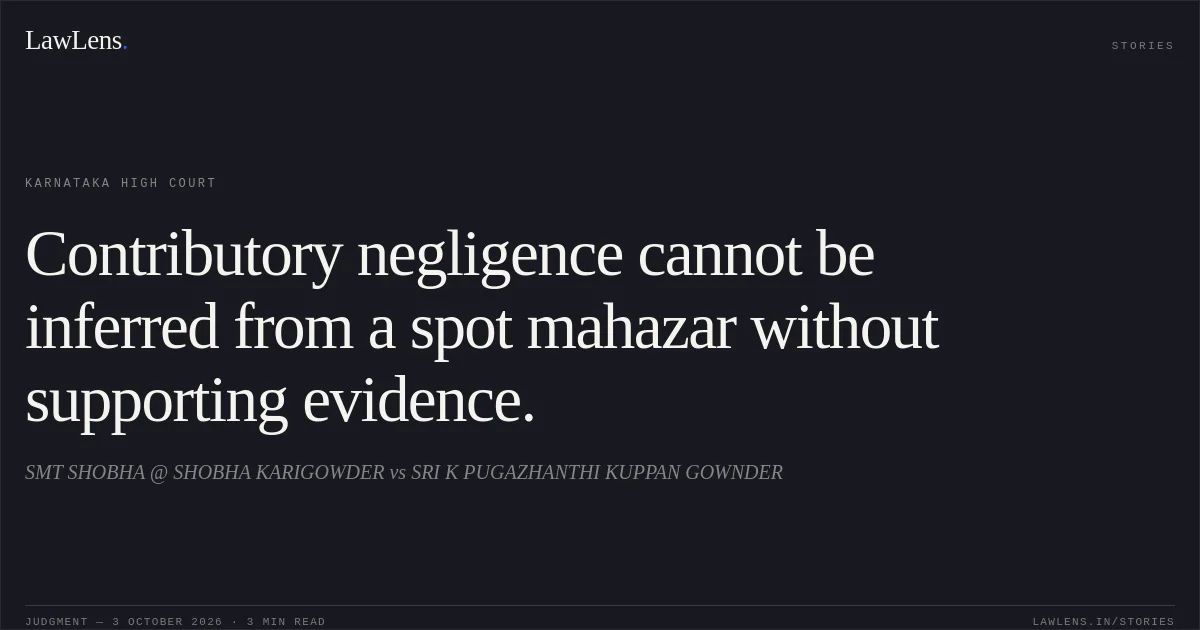
The insurer’s contributory-negligence plea rested on its pleading, a suggestion put to the claimant in cross-examination and its interpretation of the spot mahazar. The Court found that the mahazar did not establish that the motorcycle was in the middle of the road, that no eyewitness or signatory to the mahazar was examined by the insurer, and that the police had filed a charge sheet against the lorry driver. It therefore rejected the plea.
Source reference: pp. 9–11, paras. 12–15On quantum, the salary slips were not authenticated, and the claimants had not produced supporting records; the Court consequently declined to accept the asserted ₹40,000 monthly salary. It nevertheless found that the deceased was employed and adopted a notional monthly income of ₹9,000, adding 40% for future prospects and applying a 15 multiplier and a one-fourth deduction to assess dependency at ₹17,01,000.
Source reference: pp. 13–15, paras. 19–22Applying the cited consortium principles, it awarded ₹1,20,000 for consortium to the three surviving claimants and ₹15,000 each for loss of estate and funeral expenses, with no separate award for loss of love and affection.
Source reference: pp. 13–15, paras. 19–22Holding
The claimants’ appeal was allowed in part and the insurer’s appeal was dismissed.
The award was enhanced from ₹11,95,000 to ₹18,51,000, with interest at 8% per annum from the date of the claim petition until realization.
Source reference: pp. 15–17, paras. 23–25Following the death of the deceased’s father during the appeal, the Court apportioned the compensation 40% to the widow, 30% to the daughter and 30% to the mother. The claimants were denied interest for the delayed period of 237 days, and the Tribunal was directed to adjust amounts already released against the revised apportionment.
Source reference: pp. 15–17, paras. 23–25Acts & Sections Cited
1 provisions across 1 statute referred to in this judgment. Each provision opens on LawLens.
Motor Vehicles Act, 19881
Original Court PDF
SMT SHOBHA @ SHOBHA KARIGOWDERvsSRI K PUGAZHANTHI KUPPAN GOWNDER
Click to open original judgment
Original judgment, available to read, download and summarize on LawLens.in