Facts
On 1 December 2013 at approximately 4:45 a.m., the appellant was travelling on a motorcycle with his brother on Arcot Road, Vadapalani, Chennai, when an autorickshaw allegedly driven rashly and negligently collided with the motorcycle, causing him grievous injuries, including cervical vertebral fractures, quadriparesis and spinal injuries.
Source reference: pp.1–4, paras. 2–6He underwent surgery and remained hospitalised from 1 December 2013 to 20 January 2014. He filed M.C.O.P. No. 408 of 2014 claiming ₹51,00,000 in compensation.
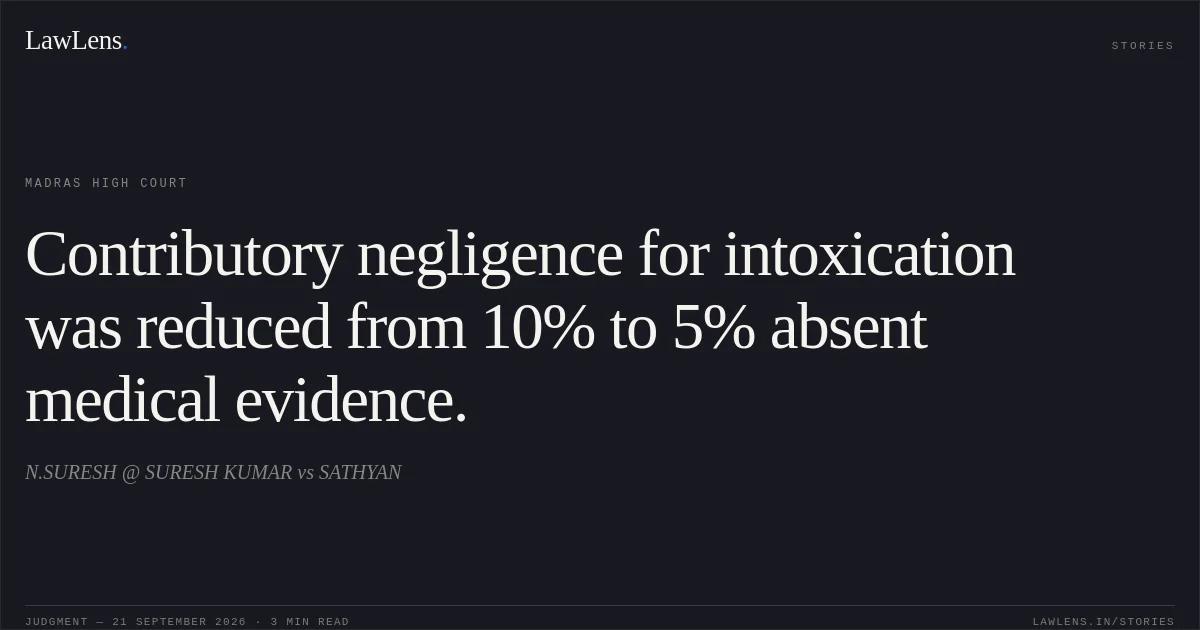
Source reference: pp.1–4, paras. 2–6The Tribunal held the autorickshaw driver negligent but attributed 10% contributory negligence to the claimant on the basis that the Accident Register and discharge summary recorded that he was under the influence of alcohol.
Source reference: pp.1–4, paras. 2–6It assessed disability at 35% and awarded ₹4,41,200. The claimant appealed under Section 173 of the Motor Vehicles Act seeking enhancement.
Source reference: pp.1–4, paras. 2–6Issues
Whether the Tribunal was justified in attributing 10% contributory negligence to the claimant merely because the medical records stated that he was under the influence of alcohol, in the absence of supporting medical evidence from the insurer?
Source reference: pp.5–6, para. 10Whether the Tribunal correctly assessed the claimant’s disability at 35% and adopted the percentage method instead of the multiplier method?
Source reference: pp.6–7, para. 11Whether the compensation awarded under the various heads, particularly attendant charges, required enhancement?
Source reference: pp.7–8, para. 12Law Applied
The Court exercised appellate jurisdiction under Section 173 of the Motor Vehicles Act, 1988, to examine the correctness of the Tribunal’s award.
Source reference: pp.3, 6–7, paras. 6, 10–11Contributory negligence must be established on the basis of reliable evidence connecting the claimant’s conduct with the occurrence or consequences of the accident; a mere reference to alcohol consumption in medical records, without supporting medical evidence, did not justify the full 10% deduction.
Source reference: p.6, para. 10However, such records could support a limited inference of possible contribution to the accident.
Source reference: p.6, para. 10For non-functional or percentage-based disability, the Court relied on National Insurance Co. Ltd. v. G. Ramesh, 2013 (2) TN MAC 583, applying ₹3,000 for each percentage of disability.
Source reference: pp.6–7, para. 11The Court further applied the principle that the multiplier method is appropriate where functional disability and corresponding loss of earning capacity are proved; in its absence, compensation may be assessed by the percentage method.
Source reference: pp.6–7, para. 11Reasoning
The Court accepted that the accident was caused by the rash and negligent driving of the autorickshaw, as supported by the claimant’s testimony and the FIR.
Source reference: p.6, para. 10Although the Accident Register and discharge summary referred to the claimant being under the influence of alcohol, the insurer neither examined medical evidence nor produced independent proof establishing that the claimant’s condition caused or materially contributed to the accident.
Source reference: p.6, para. 10Accordingly, the Court reduced contributory negligence from 10% to 5%, rather than eliminating it altogether, since the medical records indicated a possibility of some contribution.
Source reference: p.6, para. 10Regarding disability, the Court found that the claimant had not established the assessed disability as functional disability affecting his earning capacity; therefore, the Tribunal was justified in applying the percentage method and awarding ₹1,05,000 for 35% disability at ₹3,000 per percentage.
Source reference: p.7, para. 11Since the claimant had undergone inpatient treatment for 51 days, attendant charges at ₹200 per day were considered inadequate and were enhanced to ₹400 per day, resulting in an award of ₹20,400 under that head.
Source reference: pp.7–8, para. 12The remaining heads were found reasonable and were not disturbed.
Source reference: pp.7–8, para. 12Holding
The appeal was partly allowed.
The Court modified the Tribunal’s award by enhancing the total compensation from ₹4,41,200 to ₹4,51,400 before deduction for contributory negligence.
Source reference: pp.8–9, paras. 12–13After deducting 5% contributory negligence, the claimant was held entitled to ₹4,28,830, with interest at 7.5% per annum from the date of the claim petition until deposit, excluding interest for any period of default.
Source reference: pp.8–9, paras. 12–13The second respondent-insurer was directed to deposit the amount, after adjusting sums already deposited, within six weeks; the claimant could withdraw the amount in accordance with the Tribunal’s procedure and was directed to pay court fee on the enhanced compensation.
Source reference: pp.8–9, paras. 12–13Acts & Sections Cited
1 provisions across 1 statute referred to in this judgment. Each provision opens on LawLens.
Motor Vehicles Act, 19881
Original Court PDF
N.SURESH @ SURESH KUMARvsSATHYAN
Click to open original judgment
Original judgment, available to read, download and summarize on LawLens.in