Facts
On 20 July 2008, Vijaykumar was riding motorcycle No. GJ-2-AE-3910, with Gopalji as one pillion rider and Shaileshbhai as the other, when a truck allegedly driven rashly and negligently collided with the motorcycle.
Source reference: pp. 1–2, paras. 1–7Vijaykumar and Gopalji died at the spot, while Shaileshbhai sustained serious injuries.
Source reference: pp. 1–2, paras. 1–7An FIR was registered at Patan Police Station.
Source reference: pp. 1–2, paras. 1–7The respective dependants of Vijaykumar and Gopalji filed claim petitions under Section 166 of the Motor Vehicles Act, 1988, seeking compensation of ₹12 lakh each.
Source reference: pp. 1–2, paras. 1–7The Motor Accident Claims Tribunal held the motorcycle rider 80% negligent and the truck driver 20% negligent, awarding ₹1,28,400 in each claim.
Source reference: pp. 1–2, paras. 1–7The claimants challenged the findings on negligence and the quantum of compensation before the High Court.
Source reference: pp. 1–2, paras. 1–7Issues
Whether the Tribunal was justified in attributing 80% contributory negligence to Vijaykumar, the motorcycle rider, on the basis of the accident circumstances, the motorcycle’s alleged entry from a side road, and triple riding, despite the absence of supporting evidence from the insurer?
Source reference: pp. 3–7, paras. 9–18Whether contributory negligence could be attributed to Gopalji, who was a pillion rider and not shown to have contributed to the occurrence or impact of the accident?
Source reference: pp. 3, 8–10, paras. 9.1, 16–18Whether the compensation required enhancement by applying the applicable minimum wage, future prospects, the correct deduction for personal expenses, the appropriate multiplier, and conventional heads of compensation?
Source reference: pp. 11–13, paras. 19–24Law Applied
The Court applied Sections 166 and 173 of the Motor Vehicles Act, 1988, governing claims for compensation and appeals against awards.
Source reference: pp. 6–7, paras. 12–13It reiterated that motor-accident proceedings are beneficial in nature and are decided on the preponderance-of-probabilities standard rather than the strict criminal standard of proof, relying on Rajwati alias Rajjo v. United India Insurance Co. Ltd. and Sunita v. Rajasthan SRTC.
Source reference: pp. 6–7, paras. 12–13Under Jiju Kuruvila v. Kunjujamma, the mere post-accident position of vehicles cannot, without direct or corroborative evidence, establish negligence.
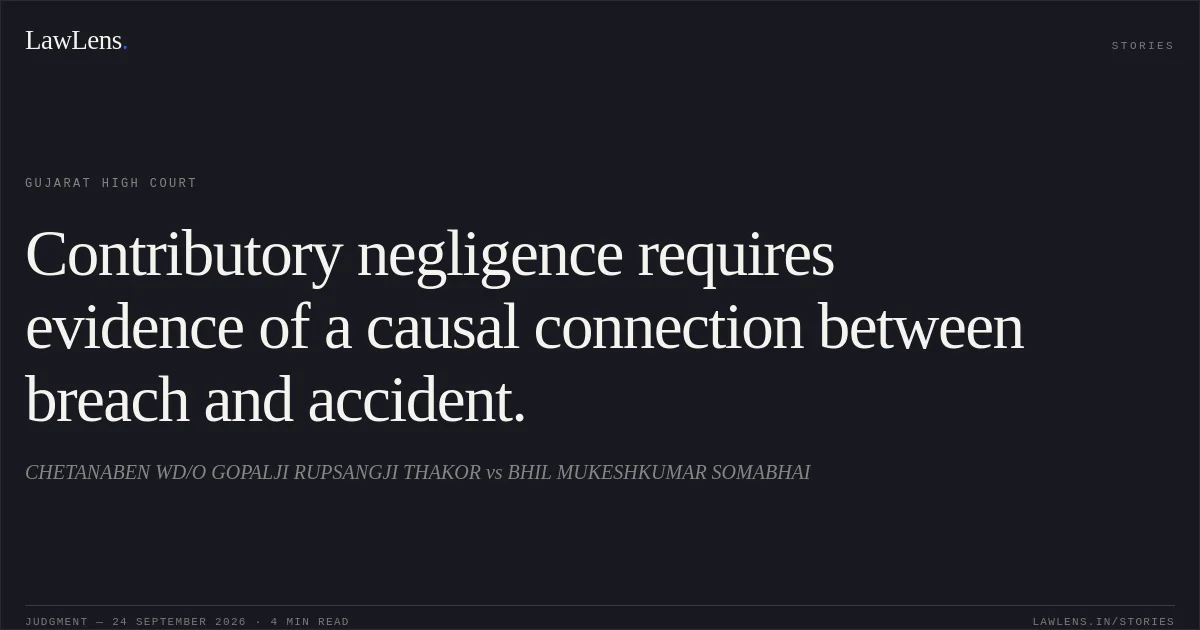
Source reference: pp. 6–7, para. 14Under Mohammad Siddique v. National Insurance Co. Ltd., triple riding by itself does not establish contributory negligence unless a causal connection is proved between the violation and either the accident or the injuries.
Source reference: pp. 8–9, para. 16A pillion rider cannot be held contributorily negligent merely because the motorcycle was involved in the accident; negligence must be causally connected to the accident or its consequences.
Source reference: pp. 9–11, paras. 17–18The Court also applied the principles on composite negligence stated in Khenyei v. New India Assurance Co. Ltd. and reiterated in Manomati Chouhan v. Oriental Insurance Co. Ltd.
Source reference: pp. 9–11, paras. 17–18For quantum, the Court applied National Insurance Co. Ltd. v. Pranay Sethi on future prospects, deduction and multiplier; Satinder Kaur and Magma General Insurance Co. Ltd. v. Nanu Ram on consortium; and adopted the applicable minimum wage of ₹2,900 per month.
Source reference: pp. 11–13, paras. 19–22Reasoning
The High Court found that the Tribunal’s attribution of 80% negligence to Vijaykumar rested substantially on inference from the position of the vehicles and the alleged manner of entry onto the main road.
Source reference: p. 7, para. 15The truck driver and owner had not contested the claim petitions, and although the insurer filed a written statement, it neither examined the truck driver nor produced an eyewitness or other corroborative evidence to establish negligence on the part of Vijaykumar.
Source reference: p. 7, para. 15The FIR or other unproved documents could not, standing alone, justify a finding of contributory negligence.
Source reference: p. 7, para. 15Triple riding constituted, at most, a statutory violation; the insurer failed to prove that it caused the accident or aggravated the injuries, and therefore it could not support a deduction for contributory negligence.
Source reference: pp. 8–9, para. 16The Tribunal’s application of the same 80% deduction to Gopalji was especially impermissible because he was only a pillion rider and no conduct attributable to him was shown to have caused or contributed to the accident.
Source reference: pp. 9–11, paras. 17–18On quantum, the Court treated the deceased persons as 25 years old, adopted ₹2,900 monthly income, added 40% for future prospects, deducted one-fourth for personal expenses because there were five dependants, applied multiplier 18, and awarded consortium to each dependant together with funeral expenses and loss of estate.
Source reference: pp. 11–13, paras. 19–22Holding
The appeals were allowed.
The findings attributing 80% contributory negligence to Vijaykumar and applying that deduction to Gopalji were quashed and set aside.
Source reference: pp. 11–13, paras. 23–25.1For each claim petition, the Court computed compensation at ₹9,79,868 in the calculation table, against the Tribunal’s award of ₹1,28,400, resulting in an enhancement of ₹8,51,468.
Source reference: p. 13, para. 22The operative paragraph states that each claimant group was entitled to ₹9,79,468 with interest at 7.5% per annum from the date of filing until realization, while also referring to an enhanced amount of ₹8,51,468; this reflects an apparent arithmetical inconsistency in the judgment.
Source reference: p. 13, para. 24The insurer was directed to deposit the enhanced compensation within eight weeks, after which the Tribunal was to disburse the awarded amount, including accrued interest, subject to verification and deduction of applicable court fees.
Source reference: p. 14, paras. 25.2–25.4Acts & Sections Cited
4 provisions across 1 statute referred to in this judgment. Each provision opens on LawLens.
Motor Vehicles Act, 19884
Original Court PDF
CHETANABEN WD/O GOPALJI RUPSANGJI THAKORvsBHIL MUKESHKUMAR SOMABHAI
Click to open original judgment
Original judgment, available to read, download and summarize on LawLens.in