Facts
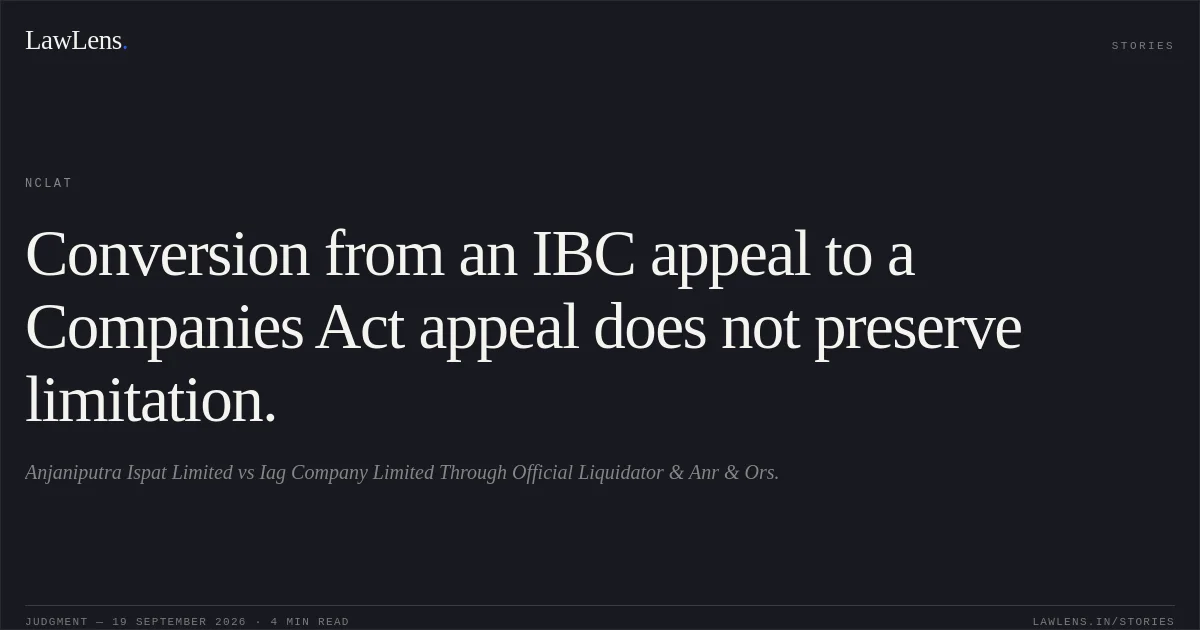
The appellant challenged an order dated 8 September 2025 passed in proceedings arising under Sections 433(E) and 433(F) of the Companies Act, 1956, by filing Company Appeal (AT) (Ins.) No. 1874 of 2025 under Section 61 of the Insolvency and Bankruptcy Code, 2016 on 20 November 2025. The appeal was accompanied by an application seeking condonation of 53 days’ delay.
Source reference: paras. 2–3The Tribunal subsequently held that the impugned order arose from proceedings under the Companies Act and that the appeal ought to have been filed under Section 421 of the Companies Act, 2013, rather than Section 61 of the IBC.
Source reference: paras. 3–4By order dated 29 January 2026, the Tribunal permitted the appellant to convert the appeal under Section 61 of the IBC into an appeal under Section 421 of the Companies Act and directed the filing of an amended memorandum of appeal.
Source reference: paras. 5, 13Instead of amending the existing appeal, the appellant filed a fresh appeal under Section 421 on 30 January 2026, accompanied by a delay-condonation application.
Source reference: para. 6The Tribunal held that the Section 61 appeal had itself been filed beyond the maximum condonable period under Section 61(2) of the IBC and that the fresh Section 421 appeal was filed 144 days after the impugned order, exceeding the statutory 45-day period and the additional condonable period of 45 days.
Source reference: paras. 10–12, 17Issues
Whether an appeal filed under Section 61 of the IBC against an order arising from proceedings under the Companies Act could be treated as maintainable or converted into an appeal under Section 421 of the Companies Act, 2013?
Source reference: paras. 3–5, 11–13Whether the period during which the appellant pursued the misconceived Section 61 IBC appeal could be excluded under Section 14 of the Limitation Act, 1963 while determining limitation for the Section 421 Companies Act appeal?
Source reference: paras. 6, 9, 16, 28Whether the appellant’s filing of a fresh appeal under Section 421 on 30 January 2026, instead of amending the existing appeal, was within the condonable period prescribed by Section 421(3) of the Companies Act, 2013?
Source reference: paras. 13–17, 26–29Law Applied
Section 61(2) of the IBC requires an appeal to be filed within 30 days, with a strictly limited power to condone delay for a further period not exceeding 15 days.
Source reference: para. 7Section 421(3) of the Companies Act, 2013 requires an appeal to be filed within 45 days from the date the order is made available, with a further condonable period not exceeding 45 days.
Source reference: para. 8The Tribunal treated both provisions as self-contained limitation provisions and held that the limitation applicable to one statutory appeal could not automatically be borrowed for another.
Source reference: paras. 8, 12, 16Section 14 of the Limitation Act, 1963 was held inapplicable because the appellant had wrongly invoked Section 61 despite the Companies Act framework being applicable, and because the original IBC appeal was itself beyond the maximum condonable period.
Source reference: paras. 11–12, 16, 28The Tribunal distinguished UltraTech Cement Ltd. v. Maxout Infrastructures Pvt. Ltd., which concerned transfer of proceedings under Section 434 of the Companies Act, and Forech India Ltd. v. Edelweiss Asset Reconstruction Co. Ltd., which recognised continuity upon judicial transfer of winding-up proceedings to the NCLT; those principles were held inapplicable to a party’s attempted “transformation” of an appeal under one statute into an appeal under another.
Source reference: paras. 18–27Reasoning
The Tribunal reasoned that the impugned order arose from proceedings under the Companies Act, making Section 421—not Section 61 of the IBC—the applicable appellate provision.
Source reference: paras. 3–4The original Section 61 appeal was filed on the 76th day and was already 31 days beyond the maximum permissible period of 45 days under Section 61(2), leaving no scope for condonation or for using that proceeding to preserve limitation.
Source reference: para. 10Although the Tribunal permitted conversion, the order contemplated amendment of the existing memorandum, not institution of a fresh Section 421 appeal.
Source reference: paras. 13, 26The appellant instead filed a new appeal on 30 January 2026. Consequently, limitation had to be calculated from 8 September 2025, resulting in a delay of approximately 144 days—54 days beyond the maximum 90-day period contemplated by Section 421(3).
Source reference: para. 17The Tribunal further held that this was not a case of judicial transfer under Section 434, where continuity of proceedings could preserve the original filing date, but a case of “transformation” from an incompetent IBC appeal into a Companies Act appeal; such transformation did not carry forward the earlier limitation period.
Source reference: paras. 23–27Holding
The Tribunal held that the Section 61 IBC appeal was not maintainable and was filed beyond the maximum condonable period. The period spent pursuing that appeal could not be excluded under Section 14 of the Limitation Act. The fresh appeal under Section 421 of the Companies Act, filed on 30 January 2026, was also beyond the maximum condonable period under Section 421(3).
Accordingly, the delay-condonation applications were rejected, and both Company Appeal (AT) No. 39 of 2026 and Company Appeal (AT) (Ins.) No. 1874 of 2025 were dismissed as barred by limitation.
Source reference: para. 29Acts & Sections Cited
6 provisions across 3 statutes referred to in this judgment. Each provision opens on LawLens.
Insolvency and Bankruptcy Code, 2016.2
Companies Act, 20133
Limitation Act, 19631
Original Court PDF
Anjaniputra Ispat LimitedvsIag Company Limited Through Official Liquidator & Anr & Ors.
Click to open original judgment
Original judgment, available to read, download and summarize on LawLens.in