Facts
Two Public Interest Litigations (PILs) were filed challenging the Kerala Lok Ayukta (Amendment) Act, 2022 (Act 7 of 2024)
Source reference: para 1, 43The petitioners, an elected Member of the Legislative Assembly and a private citizen, contested the amendments to Sections 2, 3, and 14 of the Kerala Lok Ayukta Act, 1999 (KLAA)
Source reference: para 2-3Under the unamended Act, a "declaration" by the Lok Ayukta that a public servant (including the Chief Minister) should not continue in office was binding on the competent authority
Source reference: para 6, 45The amendment replaced "declaration" with "recommendation," allowing the competent authority—now defined as the State Legislative Assembly for the Chief Minister and the Speaker for MLAs—to "examine" and potentially reject the report
Source reference: para 43-46The petitioners argued this amendment denuded the Lok Ayukta of its authority, subjected judicial findings to executive/legislative review, and violated the basic structure of the Constitution
Source reference: para 4, 11, 49Issues
1. Whether the substitution of a binding "declaration" with a "recommendation" in Section 14 of the KLAA violates the doctrine of separation of powers and judicial independence
Source reference: para 47, 592. Whether the Lok Ayukta functions as a Court or Tribunal, making its findings immune to administrative or legislative review
Source reference: para 5, 50, 553. Whether the amendments are unconstitutional for being "manifestly arbitrary" or violating the basic structure of the Constitution
Source reference: para 20, 24, 61Law Applied
The court primarily applied the provisions of the Kerala Lok Ayukta Act, 1999, as amended by Act 7 of 2024
Source reference: para 40-45It relied on Articles 163 and 164 of the Constitution, which establish that Ministers hold office during the "pleasure" of the Governor
Source reference: para 31-33, 53The court followed the precedent in Justice Chandrashekaraiah v. Janekere C. Krishna (2013) 3 SCC 117, which characterized the Lok Ayukta as a sui generis quasi-judicial authority, distinct from a Court or Tribunal
Source reference: para 5, 50-51Applying Anjum Kadari v. Union of India (2024), the court held that ordinary statutes cannot be challenged solely for violating the "basic structure" unless they infringe upon specific constitutional provisions
Source reference: para 61-62To prevent statutory absurdity, the court applied the doctrine of Casus Omissus, as seen in X (Juvenile) v. State of Karnataka (2024) 8 SCC 473, to read "deemed acceptance" into the amended Section 14(2)
Source reference: para 72-73Reasoning
The court rejected the contention that the Lok Ayukta is a Court or Tribunal, affirming its status as a sui generis investigative body whose reports do not determine the rights of parties
Source reference: para 51, 55Consequently, the legislature's decision to treat the report as a "recommendation" rather than a binding "declaration" does not constitute an impermissible "administrative review" of a judicial order
Source reference: para 55The court noted that the unamended Section 14 created a constitutional incongruity by allowing a statutory body to effectively terminate a Minister’s tenure, thereby overriding the Governor’s constitutional "pleasure" under Articles 163 and 164
Source reference: para 53, 56The amendment was thus seen as a measure to align the KLAA with the constitutional framework
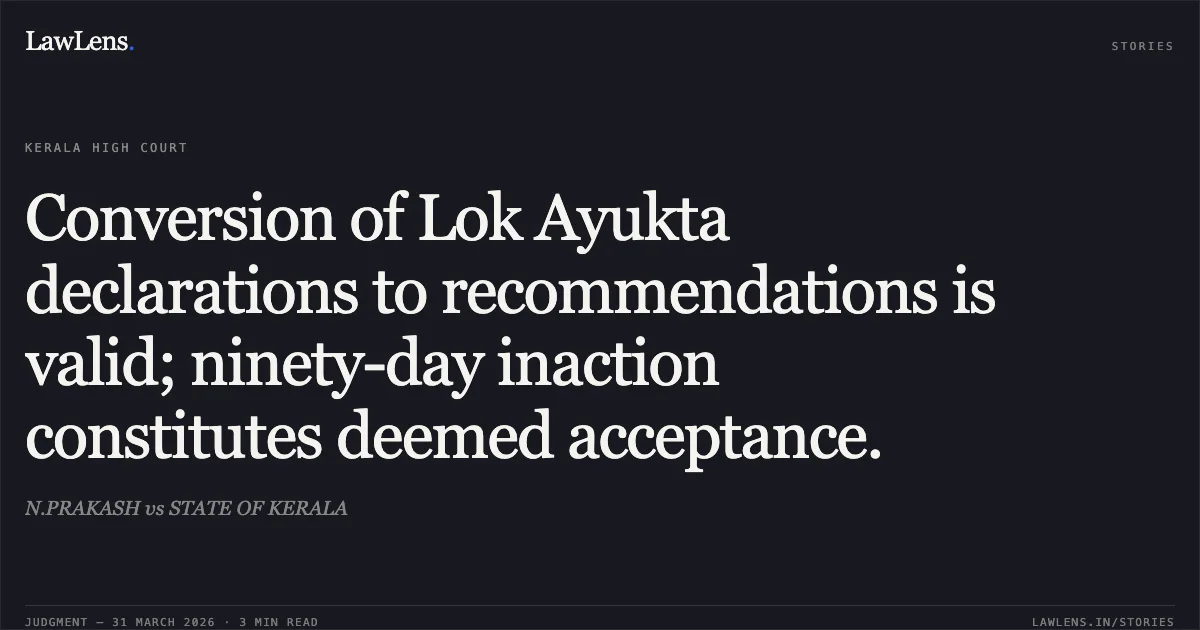
Source reference: para 56Regarding the lack of a "deemed acceptance" clause in the 90-day review period for the Assembly, the court held that to prevent the Act from becoming "toothless" or "otiose," it was necessary to read in a provision that if the recommendation is not rejected within 90 days, it shall be "deemed to have been accepted"
Source reference: para 65, 71, 73Holding
The High Court upheld the constitutional validity of Sections 3 and 14 of the Kerala Lok Ayukta Act, as amended
The court held that the amendments do not violate the separation of powers or judicial independence
Source reference: para 59However, it interpreted Section 14(2) to include a "deemed acceptance" provision: if the State Legislature (the competent authority) fails to reject the Lok Ayukta's report within 90 days, the recommendation is deemed accepted, triggering further action under Section 12(5)
Source reference: para 71, 73, 75The writ petitions were disposed of with this clarification
Source reference: para 75Acts & Sections Cited
13 provisions across 4 statutes referred to in this judgment. Each provision opens on LawLens.
Lokpal and Lokayuktas Act, 20134
KARNATAKA LOKAYUKTA ACT, 19847
All-India Services Act, 19511
Indian Penal Code, 18601
Original Court PDF
N.PRAKASHvsSTATE OF KERALA
Click to open original judgment
Original judgment, available to read, download and summarize on LawLens.in