01Facts
The petitioners (former MLA Chowdareddy and former Municipal Commissioner B.H. Narayanappa) sought to quash FIR No. 4/2017 registered by the Anti-Corruption Bureau (ACB) for offences under Sections 13(1)(c) and (d) of the Prevention of Corruption Act, 1988, and Section 447 r/w 34 of the IPC.
p. 5Respondent No. 5 (Complainant) alleged that Petitioner No. 1 and his sons grabbed 1 acre 19 guntas of Government 'B' Kharab land in Survey No. 11, Kannampalli Village, by treating it as ancestral property.
pp. 11-12Despite revenue records from 1965 to 2026 consistently showing the land as Government "Hullu Banni Kharab", the petitioners allegedly converted the land into residential sites, executed a GPA in favor of a housing society, and sold sites to third parties.
pp. 15-16, 21Petitioner No. 2, as then-Commissioner of the City Municipal Council, was alleged to have illegally registered these khatas.
p. 10A preliminary enquiry by the ACB prima facie confirmed the encroachment and administrative connivance.
pp. 52-5302Issues
i.1. Whether the investigation into allegations of land grabbing and corruption against public servants and private individuals should be interdicted at the threshold under Article 226/Section 482 of the Cr.P.C.
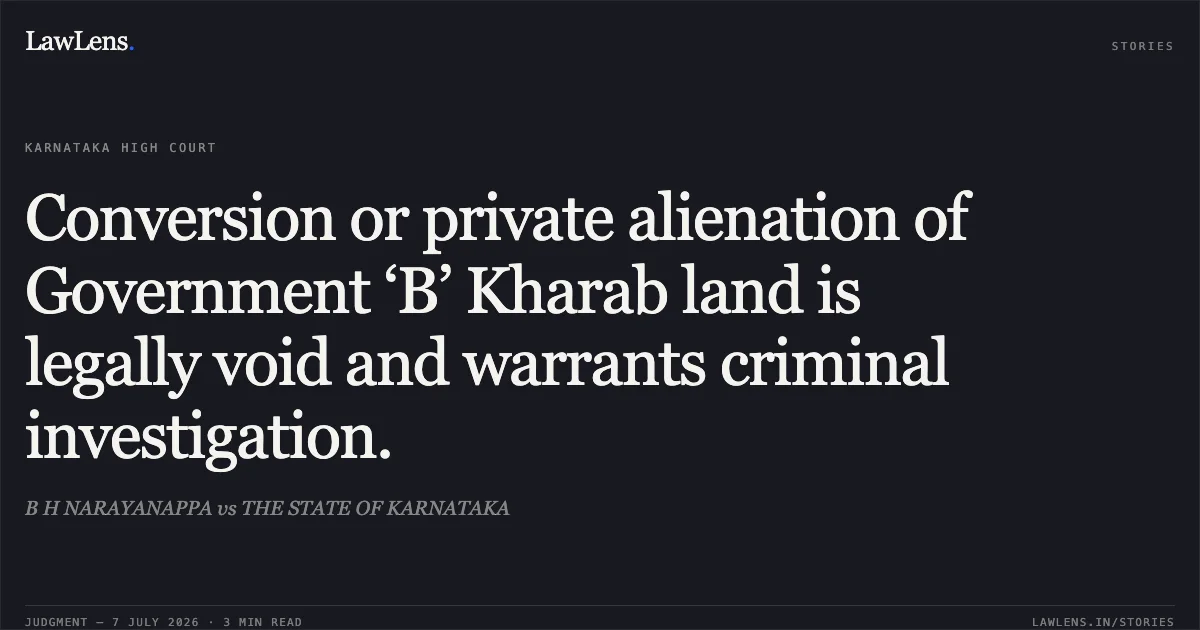
p. 14 / para. 11ii.2. Whether ‘B’ Kharab land (Government land) can be appropriated or converted for private residential use through adverse possession or administrative entries.
p. 55 / para. 2203Law Applied
Rule 21(2)(b) of the Karnataka Land Revenue Rules, which stipulates that "Pot Kharab" (specifically 'B' Kharab) land is unarable land reserved for public purposes and belongs to the State.
p. 56Section 67 of the Karnataka Land Revenue Act, 1964, which declares all lands not being property of individuals to be Government property.
pp. 58-59The principle from Neeharika Infrastructure (P) Ltd. v. State of Maharashtra, holding that an FIR is not an encyclopaedia and the police must be permitted to complete investigations into cognizable offences without premature judicial interference.
p. 66Precedents in APMC v. Executive Officer and Sena Vihar Owners Welfare Association v. Sri Bandarappa Bhakthadigala Sangha to reiterate that even a single gunta of Government Kharab land cannot be taken by private citizens.
p. 57, 65Provisions in the judgment · 5 · Linked ones open on LawLens
Prevention of Corruption Act, 1988 Section 13Section 2
Indian Penal Code, 1860 Section 447Section 34Section 120
04Reasoning
The Court observed that the mutation and revenue records (RTCs) spanning six decades proved Survey No. 11 remained Government land.
pp. 15-16Petitioner No. 1’s own representation to the Deputy Commissioner, which pleaded "adverse possession" and offered to return the land if encroached, was viewed by the Court as a tacit admission of illegal possession.
p. 24, 44The Court found that Petitioner No. 1 and his sons treated Government land as ancestral property in a partition deed and created third-party interests by selling sites.
pp. 20-21Regarding Petitioner No. 2 (the Commissioner), the Court reasoned that since he held office when the illegal khatas were issued, his role required investigation despite his retirement.
p. 31, 55The Court emphasized that when political figures and public servants are alleged to have connived to grab public land, the high court should not stifle the truth-seeking process of investigation.
p. 6705Holding
The Court held that the allegations disclosed serious, triable issues involving the misappropriation of public property and abuse of official position which necessitate a thorough investigation.
p. 54, 67The Court dismissed both Writ Petitions and directed the investigating agency to conclude the probe with "utmost expedition" and within an outer limit of six months.
p. 68Original Court PDF
B H NARAYANAPPAvsTHE STATE OF KARNATAKA
Click to open original judgment
Original judgment, available to read, download and summarize on LawLens.in