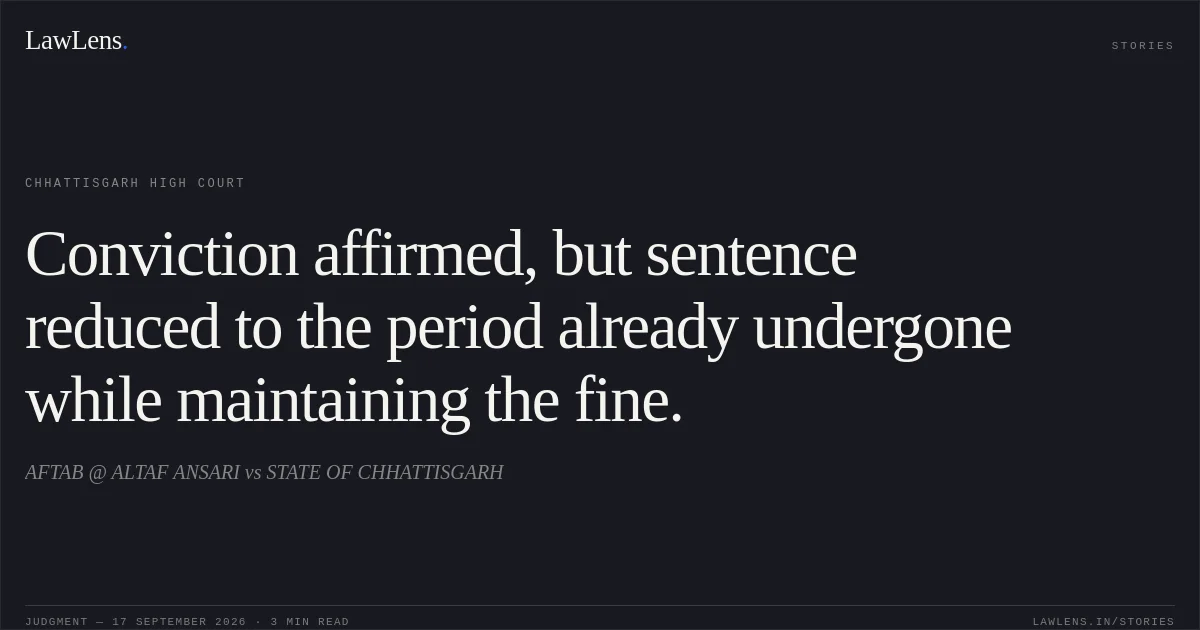
Facts
The appellant was prosecuted for creating a fake Instagram account in the name of a 13-year-old minor girl, uploading her obscene/edited photographs, sending obscene material, and threatening to circulate the photographs unless she appeared naked on a video call.
Source reference: paras. 2–2.1The prosecution relied, inter alia, on the prosecutrix’s testimony, seizure of the appellant’s mobile phone and SIM cards, the seized Instagram material, and the Cyber Forensic Laboratory report.
Source reference: paras. 2–2.1An FIR was registered, investigation was completed, and a charge-sheet was filed for offences under the POCSO Act, IPC, and Information Technology Act.
Source reference: paras. 2–2.1The Sessions Court convicted the appellant under Sections 12 of the POCSO Act, 67(b) of the Information Technology Act, 2000, and Section 506 Part I of the IPC, sentencing him to concurrent terms of two years’ rigorous imprisonment under the POCSO Act and IT Act, and one year’s rigorous imprisonment under Section 506 Part I IPC, along with fines.
Source reference: para. 1In appeal under Section 415(2) of the BNSS, the appellant did not challenge the conviction and sought reduction of sentence to the period already undergone.
Source reference: para. 6He claimed to have undergone approximately 550 days in custody and stated that the fine had been deposited.
Source reference: para. 6Issues
Whether the conviction of the appellant under Section 12 of the POCSO Act, Section 67(b) of the Information Technology Act, 2000, and Section 506 Part I of the IPC was sustainable on the evidence on record?
Source reference: para. 9Whether, having regard to the period of custody already undergone and the circumstances of the case, the substantive sentence should be reduced to the period already undergone?
Source reference: paras. 6, 10–11Law Applied
The Court applied Section 415(2) of the Bharatiya Nagarik Suraksha Sanhita, 2023, governing the criminal appeal; Section 12 of the Protection of Children from Sexual Offences Act, 2012, concerning punishment for sexual harassment of a child; Section 67(b) of the Information Technology Act, 2000, concerning publication or transmission of obscene material in electronic form; and Section 506 Part I of the Indian Penal Code, concerning criminal intimidation.
Source reference: paras. 1, 9–10The Court also applied the principle that a conviction may be sustained where the victim’s testimony is corroborated by relevant electronic and forensic evidence, and that the appellate court may modify the sentence while maintaining the conviction where the period already undergone and the circumstances of the case justify such relief.
Source reference: paras. 1, 9–10Reasoning
The Court found that the prosecutrix’s testimony, the seizure of the appellant’s mobile phone, and the Cyber Forensic Laboratory report corroborated the allegation that the appellant had edited the minor’s photograph, transmitted obscene material, and threatened to circulate it to compel her to appear naked on a video call.
Source reference: para. 9Although the Court noted that there was no evidence of a threat to cause death or grievous hurt, it held that the threat to circulate the prosecutrix’s obscene video constituted the intimidation proved against the appellant.
Source reference: para. 9Accordingly, the Court found no illegality or perversity in the Sessions Court’s findings and affirmed the conviction.
Source reference: para. 9On sentence, the Court considered that the appellant had already undergone approximately one year and six months, or 550 days, in custody, and concluded that no useful purpose would be served by requiring him to undergo the remaining period of imprisonment.
Source reference: para. 10Holding
The appeal was partly allowed.
The appellant’s convictions under Section 12 of the POCSO Act, Section 67(b) of the Information Technology Act, 2000, and Section 506 Part I of the IPC were maintained.
Source reference: paras. 11–12However, the custodial sentences were reduced to the period already undergone, namely 550 days.
Source reference: paras. 11–12The fines were maintained, and the appellant was directed to be released forthwith if not required in any other case.
Source reference: paras. 11–12Acts & Sections Cited
8 provisions across 5 statutes referred to in this judgment. Each provision opens on LawLens.
Bharatiya Nagarik Suraksha Sanhita, 20231
Protection of Children from Sexual Offences Act, 20122
Information Technology Act, 20001
Indian Penal Code, 18602
Code of Criminal Procedure, 19732
Original Court PDF
AFTAB @ ALTAF ANSARIvsSTATE OF CHHATTISGARH
Click to open original judgment
Original judgment, available to read, download and summarize on LawLens.in
![Relief is made contingent on the Supreme Court’s eventual determination in the analogous pending case.. Ashok Tolani vs REVENUE. CAT - ['Jaipur']. LawLens](/stories/thumbnails/relief-is-made-contingent-on-the-supreme-courts-eventual-determination-in-the-analogous-pe-0a05b6600e0644cf9facfda571d15955.webp)