Facts
Raja Beti, the deceased, left her parental home on 27 June 2015 to attend college and did not return. On 28 June 2015, her father, Kishunpal, was informed that an unidentified girl’s body was hanging from a Neem tree at Village Kakora; he identified the body as that of Raja Beti and a merg intimation under Section 174 CrPC was recorded
Source reference: para. 3On 29 June 2015, Kishunpal submitted a written complaint alleging that appellants Rahul @ Rinku and Akshay had abducted Raja Beti on a motorcycle, with Akshay driving and Rahul travelling as a pillion rider
Source reference: para. 3The prosecution alleged that the appellants had last been seen with the deceased, that Rahul had made an extra-judicial confession, and that a broken mobile phone allegedly belonging to the deceased had been recovered from Rahul. The appellants were arrested on 6 July 2015, and the motorcycle and mobile phones were seized
Source reference: para. 4The trial court convicted both appellants under Sections 302 and 364 IPC and Section 11/13 of the Madhya Pradesh Dacoity Evam Vypharan Prabhavit Kshetra Adhiniyam, 1981, sentencing them to life imprisonment under Section 302 IPC and seven years’ rigorous imprisonment under Section 364 IPC
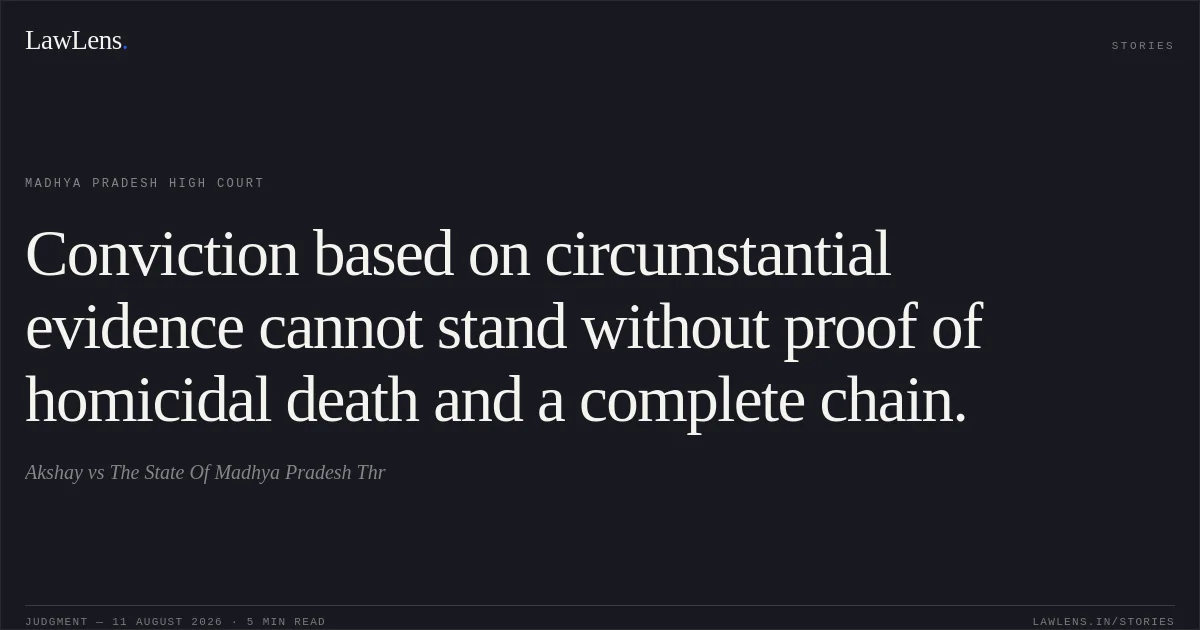
Source reference: paras. 2, 5The prosecution case was based entirely on circumstantial evidence. In appeal, the High Court examined whether the death was homicidal and whether the alleged circumstances formed a complete chain proving the appellants’ guilt beyond reasonable doubt
Source reference: paras. 10, 18–27Issues
1. Whether the prosecution proved beyond reasonable doubt that Raja Beti died a homicidal death by strangulation and that her hanging was post-mortem
Source reference: paras. 18–252. Whether the prosecution established a complete and conclusive chain of circumstantial evidence connecting Rahul @ Rinku and Akshay with the abduction and death of Raja Beti
Source reference: paras. 25–27, 443. Whether the evidence of last seen together, alleged extra-judicial confession, recovery of the broken mobile phone, motive, and the appellants’ alleged conduct was sufficient to sustain the convictions under Sections 302 and 364 IPC
Source reference: paras. 27–43Law Applied
The Court applied Sections 302 and 364 IPC concerning murder and kidnapping or abduction with intent to cause murder, along with Section 11/13 of the MPDVPK Act
Source reference: para. 2Since the case rested on circumstantial evidence, the Court relied on Sharad Birdhichand Sarda v. State of Maharashtra, (1984) 4 SCC 116, Hanumant v. State of Madhya Pradesh, and Padala Veera Reddy v. State of A.P., 1989 Supp (2) SCC 706, holding that every circumstance must be fully and cogently proved, must point unerringly to the accused’s guilt, must exclude every reasonable hypothesis of innocence, and must form a complete chain
Source reference: paras. 14–18, 26The Court further applied the principles that “last seen together” cannot by itself sustain a conviction and requires close proximity between the last sighting and death, as stated in Digamber Vaishnav v. State of Chhattisgarh, AIR 2019 SC 1367, Kanhaiya Lal v. State of Rajasthan, (2014) 4 SCC 715, and Nizam v. State of Rajasthan, (2016) 1 SCC 550
Source reference: paras. 29–30Section 106 of the Evidence Act does not shift the prosecution’s primary burden and an adverse inference can arise only after incriminating circumstances are otherwise established
Source reference: para. 30The Court also relied on Raj Kumar Singh v. State of Rajasthan, (2013) 5 SCC 722, holding that a statement under Section 313 CrPC is not substantive evidence and cannot fill gaps in the prosecution case
Source reference: paras. 42–43Reasoning
The High Court found the medical opinion that the death was homicidal to be unreliable. Although the post-mortem report noted a ligature mark, fracture of the hyoid bone, and injuries to the trachea or larynx, the doctor admitted that the ligature mark could result from suicide, that no struggle injuries were present, and that the possibility of suicide had not been ruled out
Source reference: paras. 19–23The condition of the decomposed body also suggested that death could have occurred approximately three days earlier, which conflicted with the prosecution’s claim that the deceased was seen alive on 27 June 2015
Source reference: para. 24The alleged last-seen evidence was materially inconsistent and delayed. Kishunpal did not name either appellant in his initial report on 28 June 2015, despite allegedly having been informed of the last-seen circumstance on 27 June 2015. The names appeared for the first time in the written complaint dated 29 June 2015
Source reference: paras. 31–32Sukke made material improvements regarding when he informed Kishunpal and could not explain discrepancies in his police statement, including that the deceased and Rahul had covered their faces
Source reference: para. 35These inconsistencies, coupled with the medical uncertainty regarding the time of death, rendered the last-seen theory unreliable
Source reference: para. 36The alleged extra-judicial confession was not a confession at all: Rahul’s statement that his “life has already been spoiled” did not amount to an admission that he had abducted or killed the deceased
Source reference: para. 38The broken mobile-phone pieces were neither identified by the deceased’s father nor properly proved or marked before the court, so the recovery could not be connected to the deceased
Source reference: para. 39Friendship or telephone contact between Rahul and the deceased did not establish an illicit relationship or motive for murder
Source reference: para. 40The alleged absence of the appellants from their houses did not prove guilt, and their denials under Section 313 CrPC could not be used to cure deficiencies in the prosecution evidence
Source reference: paras. 41–43Accordingly, the circumstances were neither individually proved nor cumulatively capable of excluding reasonable hypotheses consistent with innocence
Source reference: para. 44Holding
The Court held that the prosecution failed to prove that Raja Beti had been murdered or that her hanging was post-mortem.
It further held that the prosecution failed to establish a complete chain of circumstantial evidence proving the appellants’ involvement in her alleged abduction or death beyond reasonable doubt
Source reference: paras. 25, 44, 46Both appeals were allowed; the convictions and sentences under Sections 302 and 364 IPC and Section 11/13 of the MPDVPK Act were set aside
Source reference: paras. 46–47As the appellants were no longer required in the case, the Court directed their immediate release from custody
Source reference: para. 48They were also granted liberty to institute a civil suit for recovery of compensation for malicious prosecution
Source reference: para. 51Acts & Sections Cited
8 provisions across 2 statutes referred to in this judgment. Each provision opens on LawLens.
Indian Penal Code, 18603
Code of Criminal Procedure, 19735
Original Court PDF
AkshayvsThe State Of Madhya Pradesh Thr
Click to open original judgment
Original judgment, available to read, download and summarize on LawLens.in