Facts
The deceased, Inder Kumar Singh, was found dead with a rope tied around his neck on 17.10.2002 in his home at Molarband Extension
Source reference: p.2Appellant Meera (the deceased's wife) and Appellant Ajay (a former tenant) were allegedly seen leaving the house together shortly before the body was discovered
Source reference: p.10-11Evidence suggested an illicit relationship between the appellants, which had previously caused a quarrel on Holi 2002
Source reference: p.17-18The appellants were arrested together on 02.11.2002
Source reference: p.22Both were convicted by the Trial Court under Section 302/34 IPC but acquitted of Section 120-B
Source reference: p.4, 7They appealed on grounds of inconsistent medical timelines, weak "last seen" evidence, and non-examination of material witnesses (Meera's children)
Source reference: p.4-6Issues
1. Whether the prosecution established an unbroken chain of circumstantial evidence to sustain a conviction for murder under Section 302/34 IPC
Source reference: p.132. Whether the non-examination of the deceased’s children by the Investigating Officer was fatal to the prosecution's case
Source reference: p.11-12, 233. Whether the plea of alibi and property dispute raised by the appellants were sufficient to create reasonable doubt
Source reference: p.15, 24Law Applied
The court applied the "Five Golden Principles" (Panchsheel) of circumstantial evidence as established in Sharad Birdhichand Sarda v. State of Maharashtra, requiring a complete chain that excludes every hypothesis of innocence
Source reference: p.13It applied Section 302/34 of the IPC regarding common intention in murder
Source reference: p.2Regarding the "last seen" theory, it followed Nizam & Anr. v. State of Rajasthan, holding that while last seen evidence shifts the burden of explanation, it cannot be the sole basis for conviction without a complete chain
Source reference: p.15It also applied the principle from Shaikh Sattar v. State of Maharashtra regarding the strict burden of proof on the accused when pleading alibi
Source reference: p.16Rajesh Yadav v. State of U.P., which states that non-examination of a witness does not per se vitiate a trial if other evidence is credible
Source reference: p.23Reasoning
The Court found that the "last seen" evidence provided by independent neighbors (PW-3, PW-4, PW-5) was credible, placing the appellants at the scene around 4:00 PM, which aligned with the medical estimation of the time of death (approx. 44 hours prior to post-mortem)
Source reference: p.13-14Although the IO failed to examine the children, the Court noted the defense also failed to produce them despite them being in Meera's brother's custody, thus no adverse inference was drawn against the State
Source reference: p.12, 23The motive was established through PW-2’s testimony regarding the Holi incident, which, despite a delayed disclosure to police, was deemed a natural reaction to protect "family honor"
Source reference: p.19-20The Court rejected Meera’s alibi as unsubstantiated and noted her post-crime conduct (absconding with Ajay for 15 days) as a strong indicator of guilt
Source reference: p.15, 22The lack of a conspiracy conviction (120-B) did not preclude common intention (34 IPC) given the synchronized departure of the appellants from the crime scene
Source reference: p.10, 24Holding
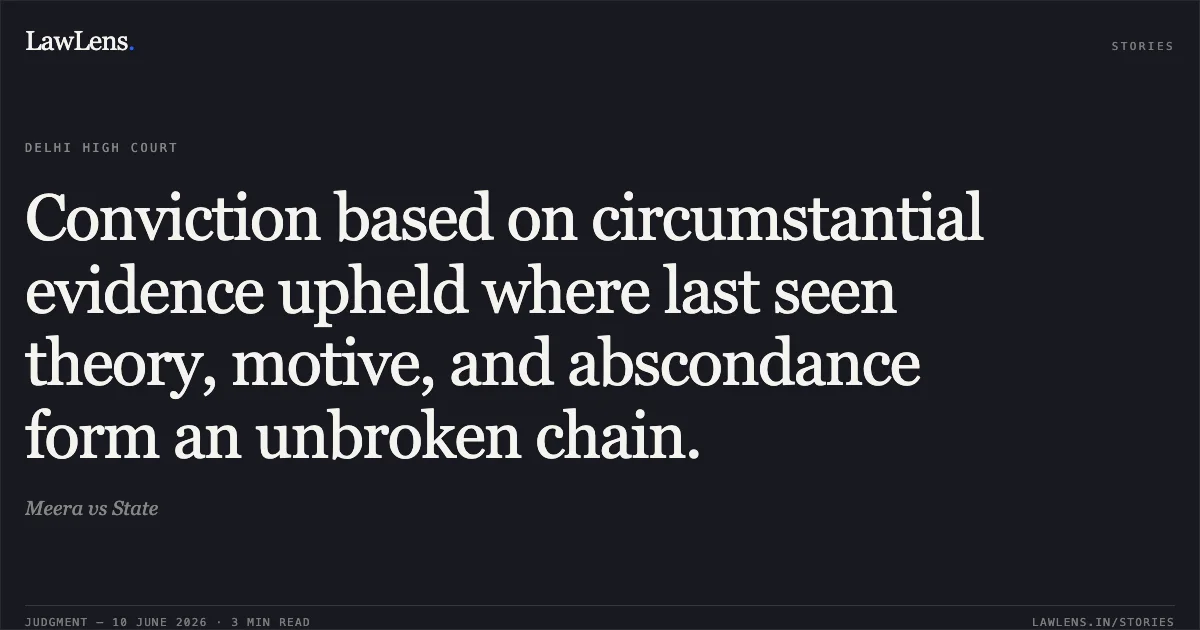
The Court held that the prosecution successfully proved a complete chain of circumstances—motive, last seen proximity, and post-incident conduct—that pointed unerringly to the appellants' guilt.
The Court dismissed the appeals and affirmed the conviction and life sentences under Section 302/34 IPC. The appellants were directed to surrender within two weeks to serve their remaining sentences
Source reference: p.25-26Acts & Sections Cited
4 provisions across 2 statutes referred to in this judgment. Each provision opens on LawLens.
Indian Penal Code, 18602
Code of Criminal Procedure, 19732
Original Court PDF
MeeravsState
Click to open original judgment
Original judgment, available to read, download and summarize on LawLens.in


