Facts
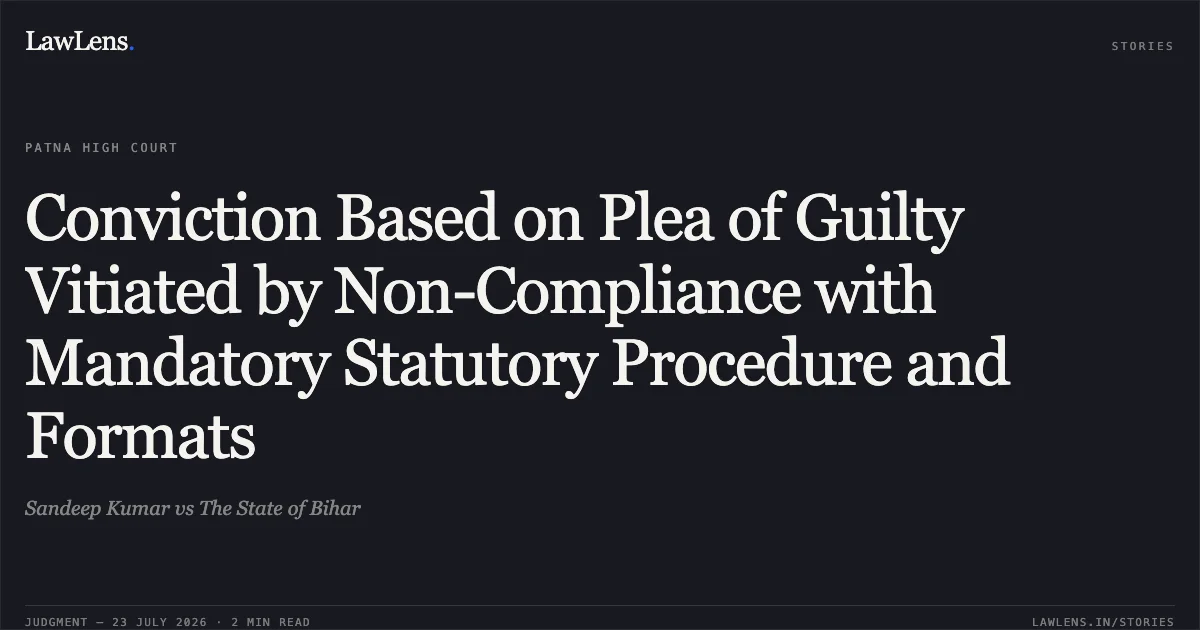
The appellant was arrested and charged under Section 37 of the Bihar Prohibition and Excise (Amendment) Act, 2022, for consuming liquor.
Source reference: p. 2On the same day he was produced before the Court of the Exclusive Special Judge, Excise-II, Bettiah, the court took cognizance, explained the accusation, and convicted the appellant based on his oral plea of guilt.
Source reference: p. 2The appellant challenged this conviction, contending that the plea was not voluntary, he was not apprised of the consequences, and no blood or urine samples were collected for chemical analysis.
Source reference: p. 2Issues
1. Whether the conviction based on the appellant’s plea of guilt was legally sustainable given the lack of evidence regarding its voluntariness.
Source reference: p. 22. Whether the trial court failed to comply with the mandatory statutory procedures prescribed under Rule 18 of the Bihar Prohibition and Excise (Amendment) Rules, 2022.
Source reference: p. 3Law Applied
Section 37 of the Bihar Prohibition and Excise (Amendment) Act, 2022, concerning the consumption of liquor.
Source reference: p. 3Rule 18 of the Bihar Prohibition and Excise (Amendment) Rules, 2022, which mandates that a plea of guilt must be recorded in Form VIA and the corresponding order sheet in Form VII.
Source reference: p. 3State of Jharkhand v. Ambay Cements (2005) 1 SCC 368, which stipulates that when a statute prescribes a specific manner for an act to be performed, it must be done in that manner alone and no other.
Source reference: p. 3Reasoning
The trial court's summary proceedings on a single day did not inspire confidence regarding the voluntariness of the plea.
Source reference: p. 2Since the appellant was produced directly from police custody and convicted immediately, he lacked the time to understand the legal consequences of his admission.
Source reference: p. 2-3Rule 18 mandates the use of specific forms (VIA and VII), but the order sheet in Form VII lacked the signature of the Presiding Officer.
Source reference: p. 3Applying the doctrine from Ambay Cements, the Court held that such non-compliance with statutory procedure vitiated the entire proceeding, rendering the conviction unsustainable.
Source reference: p. 3Holding
The Court answered the issues in the negative, holding that the conviction was procedurally and substantively flawed.
The appeal was allowed, and the judgment of conviction and sentence dated 07.11.2023 were set aside. The trial court was directed to proceed with a fresh trial from the stage of explaining the accusation to the appellant in accordance with the law.
Source reference: p. 4Acts & Sections Cited
1 provisions across 1 statute referred to in this judgment. Each provision opens on LawLens.
BIHAR PROHIBITION AND EXCISE ACT, 20161
Original Court PDF
Sandeep KumarvsThe State of Bihar
Click to open original judgment
Original judgment, available to read, download and summarize on LawLens.in