Facts
The prosecution alleged that on the night of 31.03.1997, the appellants murdered Mahavir Yadav while he was outside his house to ease himself.
Source reference: p.2-3According to the fardbayan of the informant (PW 3), the appellants used a sword, garasa (pole-axe), and lathis to decapitate the deceased due to a long-standing land dispute.
Source reference: p.3The Trial Court convicted Rajendra @ Karu Yadav and Indradeo Yadav under Section 302 IPC, and others under Section 302 r/w 149 IPC, sentencing them to life imprisonment.
Source reference: p.2During trial, the informant (PW 3) and his brother (PW 4) turned hostile, leaving the conviction dependent on the sole testimony of the deceased's son, Churaman Yadav (PW 2).
Source reference: p.13-14, 20Issues
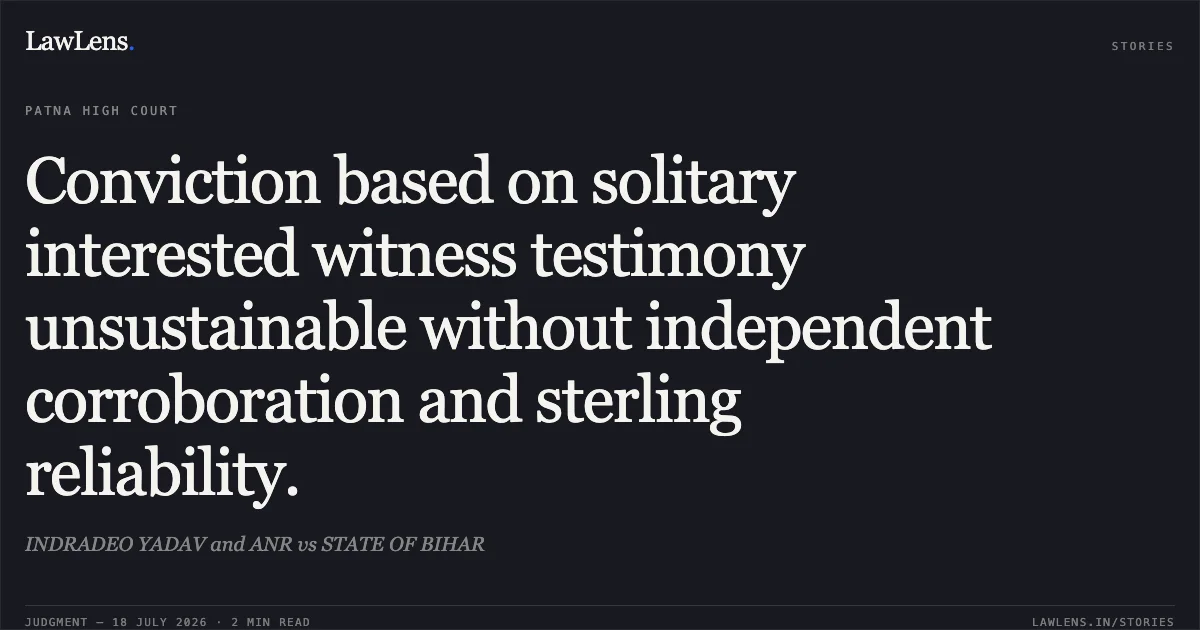
1. Whether the conviction can be sustained based on the uncorroborated, solitary testimony of an interested witness (PW 2) when other eyewitnesses have turned hostile.
Source reference: p.20-212. Whether the material improvements and contradictions in the ocular evidence vis-à-vis the medical evidence and initial fardbayan render the prosecution case unreliable.
Source reference: p.21-223. Whether the failure to examine independent witnesses (Chowkidar, co-villagers) and the police officer who recorded the fardbayan constitutes a fatal flaw.
Source reference: p.20, 24Law Applied
The court primarily applied Section 302 (Murder) and Section 149 (Unlawful Assembly) of the Indian Penal Code.
Source reference: p.2It relied on Section 134 of the Indian Evidence Act, which mandates that the quality, not quantity, of evidence matters.
Source reference: p.21The court invoked the principle that while a conviction can rest on a solitary witness, such testimony must be of "sterling quality" and "wholly reliable" [Vadivelu Thevar v. State of Madras].
Source reference: p.9, 21It further applied the doctrine that "enmity is a double-edged weapon," which can provide motive but also suggests false implication, requiring heightened scrutiny of interested witnesses [State of MP v. Ratan Singh].
Source reference: p.23-24Reasoning
The High Court found the testimony of the solitary witness (PW 2) significantly flawed. While the fardbayan claimed Indradeo Yadav struck the neck, PW 2 testified in court that the blow was to the shoulder—an improvement made only after the post-mortem report revealed a shoulder injury.
Source reference: p.21-22The Court noted that despite PW 2 being just steps away in a "full moonlit night," his failure to disclose the assailants’ names to the village Chowkidar at 3 AM or to co-villagers at 7 AM was contrary to natural human conduct.
Source reference: p.22-23The hostility of PW 3 (informant) and PW 4 (grandson), combined with the prosecution's failure to examine the Chowkidar and the officer who recorded the fardbayan, created serious gaps in the narrative.
Source reference: p.19-20The Court observed that the admitted land dispute between relatives made false implication a distinct possibility, and the prosecution failed to provide independent corroboration to bridge these doubts.
Source reference: p.23-24Holding
The Court held that the prosecution failed to prove the charges beyond a reasonable doubt, as the solitary testimony of PW 2 lacked the "ring of truth" and was marred by material improvements.
The appeals were allowed, and the judgment of conviction dated 30.03.1999 was set aside. The appellants were acquitted under the benefit of doubt, their bail bonds were cancelled, and they were discharged from their sureties.
Source reference: p.25Acts & Sections Cited
5 provisions across 2 statutes referred to in this judgment. Each provision opens on LawLens.
Indian Penal Code, 18604
Code of Criminal Procedure, 19731
Original Court PDF
INDRADEO YADAV and ANRvsSTATE OF BIHAR
Click to open original judgment
Original judgment, available to read, download and summarize on LawLens.in