Facts
The victim ('X'), a deaf and dumb female, was allegedly raped and blinded on 12.01.2021
Source reference: p. 3The informant (PW-5) lodged a fardbeyan stating he saw co-accused Lakshmi Mukhiya fleeing the scene with blood-stained clothes
Source reference: p. 4The appellants, Krishna and Ramawatar Mukhiya, were not named in the initial FIR but were later arrested and implicated based on the custodial confessional statements of Lakshmi Mukhiya and themselves
Source reference: p. 10, 18The trial court convicted the appellants under Sections 376(D), 326, 324, 201, and 511/34 IPC, predominantly relying on the victim's identification by gestures and the aforementioned confessions
Source reference: p. 9The appellants challenged this conviction on grounds of lack of legal evidence
Source reference: p. 10Issues
1. Whether the confessional statements recorded by the police are admissible in evidence to sustain a conviction?
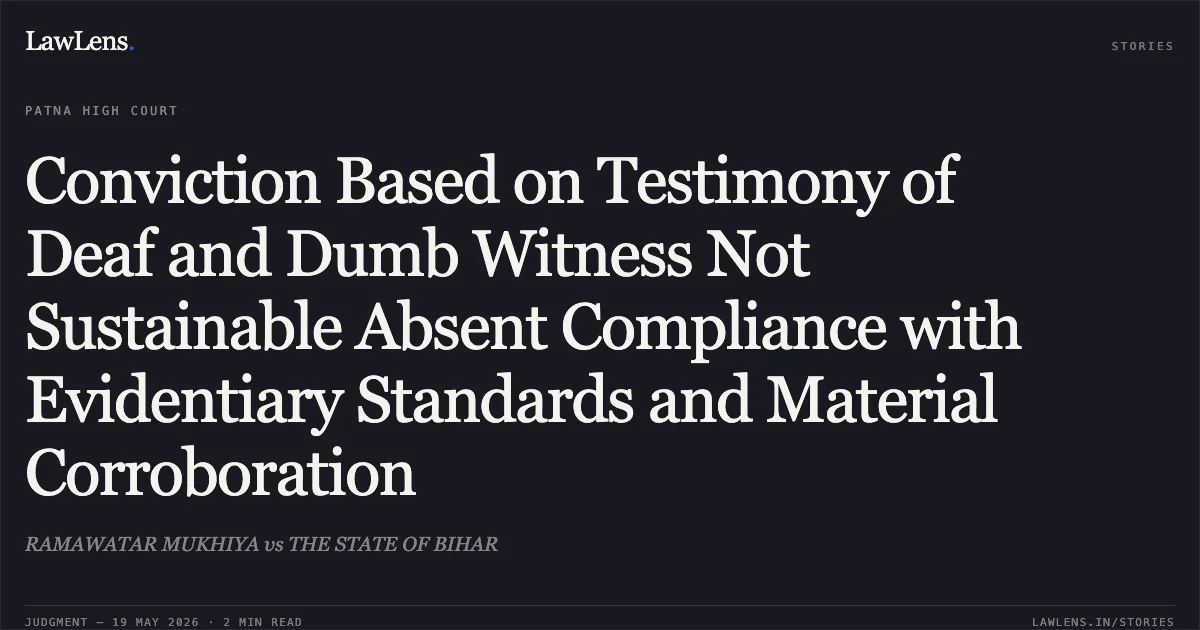
Source reference: p. 18, 222. Whether the testimony of a deaf and dumb witness recorded without following the prescribed legal safeguards (oath to interpreter, non-use of written medium) is reliable?
Source reference: p. 22-243. Whether the prosecution established the guilt of the appellants beyond reasonable doubt in light of material contradictions and lack of scientific corroboration?
Source reference: p. 14, 25-27Law Applied
the court primarily applied Section 25 of the Indian Evidence Act, which mandates that confessions made to police officers cannot be proved against an accused
Source reference: p. 22It relied on Section 119 of the Indian Evidence Act regarding evidence from a witness unable to communicate orally
Source reference: p. 22the court applied the principles from State of Rajasthan v. Darshan Singh @ Darshan Lal (2012) 5 SCC 789, which established that for a deaf/dumb witness, the interpreter must be administered an oath and, if the witness is literate, questions/answers should preferably be in writing
Source reference: p. 23Reasoning
The High Court found the prosecution's case fundamentally flawed as the appellants were implicated solely via custodial confessions, which are inadmissible under Section 25 of the Evidence Act
Source reference: p. 18, 22Regarding the victim’s testimony (PW-4), the court noted that the interpreter (PW-8) was not administered an oath, and the trial court failed to record whether the witness—who could sign her name and reportedly studied to Class VIII—could have communicated in writing
Source reference: p. 24-25The court observed significant contradictions: while the informant claimed the victim was unconscious, PW-11 (a neighbor) claimed she was weeping
Source reference: p. 27Scientifically, while blood samples were taken, the FSL report failed to match the blood found on the weapons or the victim's clothes to these specific appellants
Source reference: p. 19-20The court also highlighted a nine-hour delay in lodging the FIR and the fact that the actual "first version" recorded by the police from the victim’s family was suppressed
Source reference: p. 20-21Holding
The High Court held that the prosecution failed to prove the charges beyond reasonable doubt.
The court set aside the judgment of conviction dated 05.06.2023 and the order of sentence dated 13.06.2023. The court granted the appellants the benefit of doubt, acquitted them of all charges, and ordered their immediate release. The appeals were allowed.
Source reference: p. 31Acts & Sections Cited
12 provisions across 3 statutes referred to in this judgment. Each provision opens on LawLens.
Indian Penal Code, 18607
Code of Criminal Procedure, 19732
Original Court PDF
RAMAWATAR MUKHIYAvsTHE STATE OF BIHAR
Click to open original judgment
Original judgment, available to read, download and summarize on LawLens.in