Facts
The appellant was convicted by the Additional Sessions Judge–X, Patna, under Sections 302 of the Indian Penal Code and 27 of the Arms Act for the alleged murder of Mahendra Singh on 7 January 1990.
Source reference: paras. 2–5, 31, 42, 49The prosecution alleged that, after hearing two gunshots near the village school, informant Arun Kumar (PW 1) saw the appellant and co-accused Pramod Singh fleeing with pistols; PW 2 Ravi Ranjan Singh and PW 3 Naubind Singh claimed to have witnessed the appellant and Pramod shooting the deceased
Source reference: paras. 2–5, 31, 42, 49During investigation, however, the police submitted a charge-sheet against PW 2 and PW 3 for the murder and showed the appellant and Pramod Singh as “not sent up” or exonerated
Source reference: paras. 6–7, 57–60The medical evidence recorded two firearm entry wounds—one on the neck and another on the left side of the chest—and an abdominal wound described as an exit wound
Source reference: paras. 23–29Issues
Whether the prosecution proved beyond reasonable doubt that the appellant caused the fatal firearm injuries to Mahendra Singh, primarily on the basis of the testimony of PW 2 and PW 3?
Source reference: paras. 73–80Whether the testimony of PW 2 and PW 3 could safely be relied upon when they had themselves been charge-sheeted by the investigating agency for the same offence?
Source reference: paras. 77–80Whether the material inconsistencies between the eyewitness account and the post-mortem findings created a reasonable doubt regarding the prosecution’s version of the occurrence?
Source reference: paras. 81–88Whether the prosecution’s failure to examine available independent and material witnesses weakened its case and warranted an adverse inference?
Source reference: paras. 95–97Law Applied
The Court applied Sections 302 of the Indian Penal Code and 27 of the Arms Act, requiring the prosecution to establish the appellant’s guilt beyond reasonable doubt
Source reference: paras. 1, 8It relied on the principle that the testimony of an interested or related witness is not inadmissible, but must be scrutinised with caution to exclude false implication, as explained in Sudhakar alias Sudharshan v. State
Source reference: para. 79It further applied the rule that ocular evidence may be rejected where medical evidence presents a gross contradiction that renders the eyewitness account improbable, relying on Pruthiviraj Jayantibhai Vanol v. Dinesh Dayabhai Vala
Source reference: paras. 87–88Under Takhaji Hiraji v. Thakore Kubersing Chamansing, non-examination of material witnesses may justify an adverse inference where such witnesses could have supplied an important gap or infirmity in the prosecution case; however, their non-examination is not fatal where the existing evidence is reliable
Source reference: para. 96The governing criminal-law principle was that suspicion, however strong, cannot replace proof and that reasonable doubt must operate in favour of the accused
Source reference: paras. 103–105Reasoning
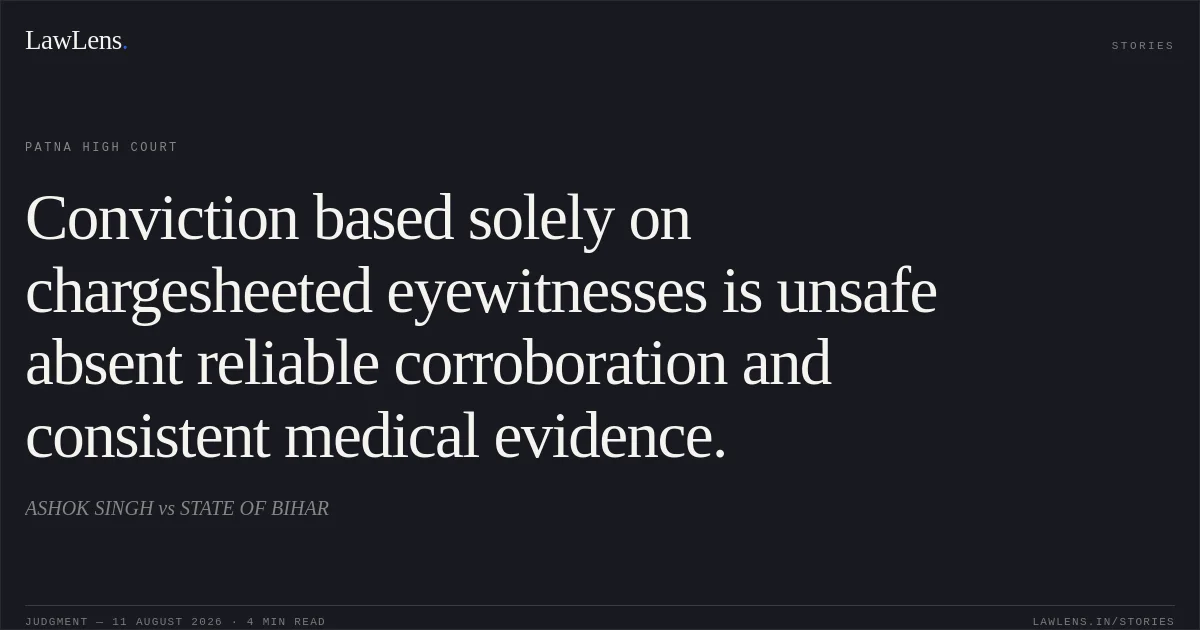
The Court held that PW 1 was not an eyewitness to the actual assault and that his evidence was merely corroborative of the appellant’s presence near the scene, while the substantive case rested on PW 2 and PW 3
Source reference: paras. 73–75Their evidence required heightened scrutiny because the investigating agency had charge-sheeted them for the same murder and had initially exonerated the appellant
Source reference: paras. 77–80Their account that the second shot was fired by Pramod Singh into the deceased’s abdomen was materially inconsistent with the post-mortem report, which described the abdominal injury as an exit wound rather than an entry wound
Source reference: paras. 81–83The Court also found inconsistencies concerning the appellant’s alleged close-range firing, since the doctor found no blackening or charring around the neck wound
Source reference: paras. 84–86The prosecution’s motive changed from opposition to a criminal case involving Manju Devi to an alleged illicit relationship, and these later versions were not supported by the investigating officer’s evidence
Source reference: paras. 89–94Further, despite the alleged presence of numerous villagers and the availability of several charge-sheet witnesses, no independent eyewitness was examined
Source reference: paras. 95–97The defence evidence, including evidence suggesting the presence of the appellant elsewhere and the possible involvement of PW 2 and PW 3, reinforced the reasonable doubt arising from the prosecution evidence
Source reference: paras. 98–100Holding
The Court answered the issues in favour of the appellant and held that the prosecution failed to prove his participation in the murder beyond reasonable doubt.
The evidence of the principal eyewitnesses was insufficiently reliable, materially contradicted by the medical evidence, and unsupported by independent corroboration
Source reference: paras. 101–105The appeal was allowed; the conviction under Section 302 of the Indian Penal Code and Section 27 of the Arms Act and the sentences imposed by the trial court were set aside.
Source reference: paras. 106–108The appellant was acquitted by giving him the benefit of doubt. As he was on bail, his bail bonds were cancelled and the sureties were discharged
Source reference: paras. 106–108Acts & Sections Cited
6 provisions across 3 statutes referred to in this judgment. Each provision opens on LawLens.
Indian Penal Code, 18603
Arms Act, 19591
Code of Criminal Procedure, 19732
Original Court PDF
ASHOK SINGHvsSTATE OF BIHAR
Click to open original judgment
Original judgment, available to read, download and summarize on LawLens.in