Facts
On 7 July 2007, the prosecutrix alleged that while returning from a village fair, the appellant forcibly took her on a bicycle to a ditch near Murligaraha Pahari and committed rape after gagging her mouth.
Source reference: pp. 1–4; paras. 2–9Villagers subsequently found and apprehended the appellant and brought him to the village; the prosecutrix lodged the written report at the police station the following morning.
Source reference: pp. 1–4; paras. 2–9An FIR was registered under Section 376 IPC, followed by investigation and submission of a charge-sheet.
Source reference: pp. 1–4; paras. 2–9The Trial Court convicted the appellant under Section 376 IPC and sentenced him to seven years’ rigorous imprisonment and a fine of ₹5,000.
Source reference: pp. 1–4; paras. 2–9In appeal, the appellant challenged the alleged delay in lodging the FIR, material contradictions in the prosecutrix’s account, lack of independent corroboration, the medical evidence, and the possibility of false implication arising from a prior dispute concerning a water-pump machine.
Source reference: p. 4; para. 10Issues
Whether the conviction under Section 376 IPC could be sustained solely on the testimony of the prosecutrix in light of the inconsistencies and omissions in her various statements.
Source reference: p. 5; para. 13; pp. 10–12, paras. 19–24Whether the medical evidence and surrounding circumstances sufficiently corroborated the allegation of rape.
Source reference: pp. 8, 10–11; paras. 15, 21Whether the alleged delay in lodging the FIR and the defence plea of prior enmity created reasonable doubt regarding the prosecution case.
Source reference: p. 5; para. 18; pp. 11–12, paras. 23–24Law Applied
The Court applied Section 376 of the Indian Penal Code, under which rape must be proved beyond reasonable doubt.
Source reference: p. 10; para. 19It reiterated that the testimony of a prosecutrix in a rape case can, in principle, be sufficient for conviction without independent corroboration if, upon careful scrutiny, it is reliable and inspires confidence.
Source reference: p. 10; para. 19However, where the prosecutrix does not satisfy the standard of a “sterling witness” and her testimony contains material contradictions, conviction solely on that testimony is unsafe.
Source reference: p. 10; para. 19The Court relied on Santosh Prasad @ Santosh Kumar v. State of Bihar, (2020) 3 SCC 443, in which material contradictions, absence of supporting medical or independent evidence, and a possible motive for false implication justified extending the benefit of doubt to the accused.
Source reference: pp. 11–12; para. 22Reasoning
The Court found material discrepancies between the prosecutrix’s written report and her deposition: the written report stated that the appellant dragged her on a bicycle, whereas in deposition she stated that he came on foot, gagged her, and carried her on his shoulder.
Source reference: pp. 10–11; paras. 20–21There were also inconsistencies concerning the place of occurrence, the manner in which she was taken away, and the distance between the relevant locations.
Source reference: pp. 10–11; paras. 20–21The medical examination conducted shortly after the occurrence revealed only a simple abrasion on the knee; the hymen was intact, there was no injury to the private parts, no sign of rape, and no spermatozoa was detected in the vaginal swab.
Source reference: p. 8; para. 15The doctor opined that there was no sign of rape.
Source reference: p. 8; para. 15Although the Court accepted that the FIR delay had been explained by the villagers’ alleged inability to travel to the police station at night, it held that the cumulative effect of the prosecutrix’s material contradictions, the absence of medical corroboration, and the possible background dispute meant that she did not qualify as a wholly reliable or “sterling” witness.
Source reference: p. 5; para. 18; pp. 10–12, paras. 21–24Consequently, the prosecution had failed to establish guilt beyond reasonable doubt.
Source reference: pp. 10–12, paras. 21–24Holding
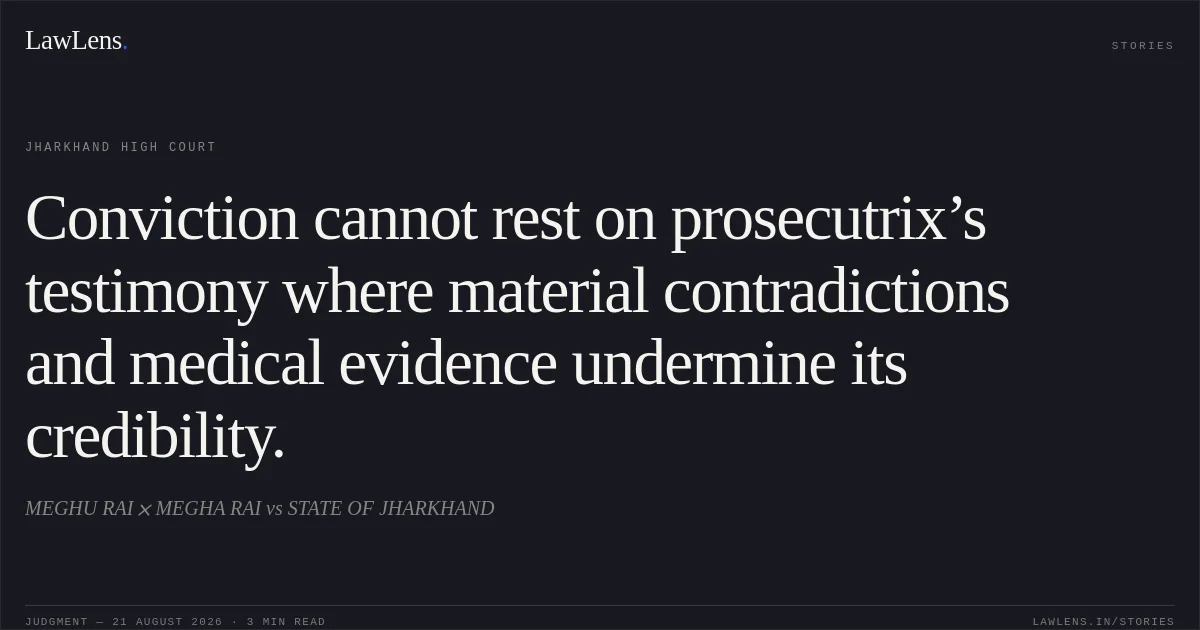
The High Court allowed the appeal and set aside the appellant’s conviction under Section 376 IPC and the sentence of seven years’ rigorous imprisonment with a fine of ₹5,000.
Holding that it was unsafe to sustain the conviction on the prosecutrix’s testimony in the presence of material contradictions and contrary medical evidence, the Court extended the benefit of doubt to the appellant.
Source reference: pp. 12–13; paras. 24–28As he was on bail, he was discharged from the liability of his bail bond and the sureties were also discharged.
Source reference: pp. 12–13; paras. 24–28Acts & Sections Cited
1 provisions across 1 statute referred to in this judgment. Each provision opens on LawLens.
Indian Penal Code, 18601
Original Court PDF
MEGHU RAI MEGHA RAIvsSTATE OF JHARKHAND
Click to open original judgment
Original judgment, available to read, download and summarize on LawLens.in