Facts
The appellants were prosecuted in connection with Barauli P.S. Case No. 02 of 2015 arising from an altercation over the cutting of bamboo from a disputed bamboo grove.
Source reference: paras. 3–4; pp. 2–3The prosecution alleged that, on 1 January 2015, the appellants assaulted Arjun Prasad when he objected to the cutting of bamboo, causing a fatal head injury; Vindhyachal Prasad was also allegedly assaulted.
Source reference: paras. 3–4; pp. 2–3After investigation, charges were submitted under Sections 341, 323, 307, 302 and 34 of the Indian Penal Code, and charges were framed under Sections 341/34, 323/34, 307/34 and 302/34 IPC.
Source reference: paras. 5–7; pp. 3–4The trial court convicted the appellants under Sections 302, 323 and 341 IPC and sentenced each to life imprisonment under Section 302 IPC, with concurrent sentences for the other offences.
Source reference: paras. 11–14; pp. 6–7In appeal, the appellants challenged the reliability of the eyewitness evidence, the delayed registration of the FIR, the absence of weapon recovery, the lack of medical corroboration, and the suppression of the counter-case arising from the same occurrence.
Source reference: paras. 15–18; pp. 7–8The High Court noted that the fardbeyan was recorded on 1 January 2015 but the FIR was registered only on 5 January 2015, that the injured witness had apparently made an earlier statement at Barauli Police Station, and that the counter-case alleged injuries to persons from the appellants’ side.
Source reference: paras. 21–24; pp. 9–12Issues
Whether the prosecution proved beyond reasonable doubt that the appellants, in furtherance of their common intention, caused the fatal injuries resulting in Arjun Prasad’s death.
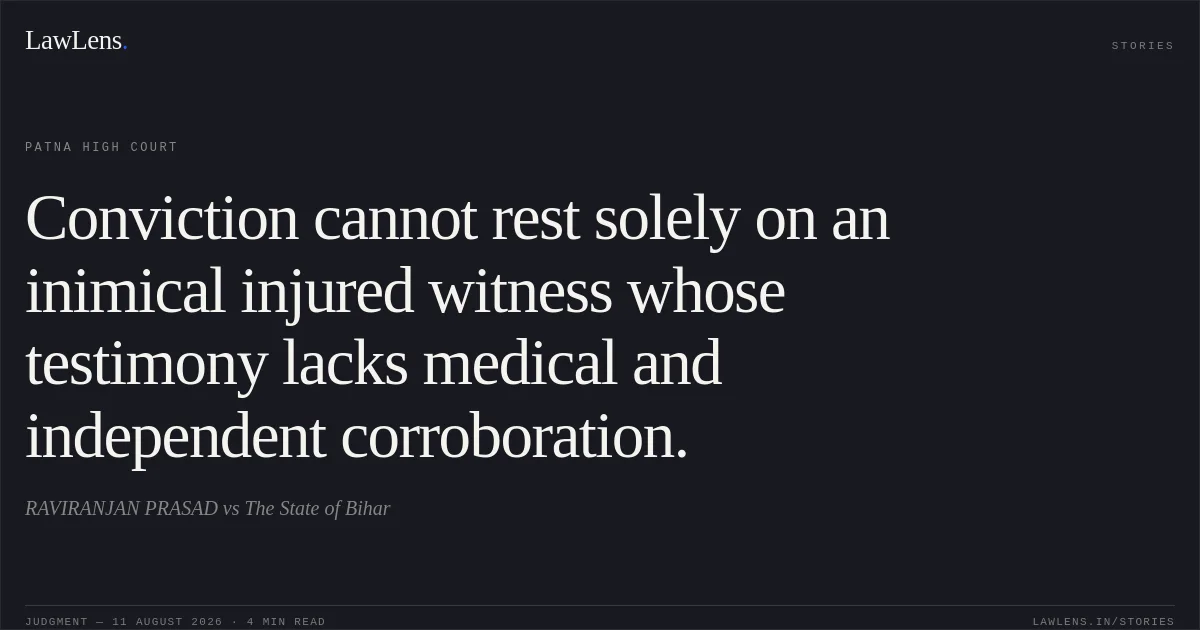
Source reference: paras. 11–14, 25–30; pp. 6–7, 12–14Whether the testimony of the injured witness, Vindhyachal Prasad, could safely sustain the appellants’ conviction despite inconsistencies, prior enmity, delayed FIR registration, and alleged suppression of the first version and counter-case.
Source reference: paras. 21–24, 31–38; pp. 9–18Whether the prosecution evidence was materially corroborated by the medical evidence and other independent circumstances.
Source reference: paras. 25– Thirty-eight; pp. 12–18Law Applied
The Court applied Sections 302, 323 and 341 IPC, along with the principle of common intention under Section 34 IPC, requiring the prosecution to establish the accused persons’ participation and the requisite common intention beyond reasonable doubt.
Source reference: paras. 21, 29–38; pp. 9–18It applied the criminal-law principle that the prosecution bears the burden of proving guilt beyond reasonable doubt and that material contradictions, unexplained delay in lodging the FIR, suppression of the earliest version, non-examination of material witnesses, and failure of medical evidence to support the alleged manner of assault may create reasonable doubt.
Source reference: paras. 21, 29–38; pp. 9–18The Court further applied the principle that the testimony of an injured witness is ordinarily entitled to weight but cannot be relied upon mechanically where the witness is shown to be inimical and his evidence is materially inconsistent or unsupported by objective evidence.
Source reference: paras. 21, 29–38; pp. 9–18No specific judicial precedent was cited in the judgment.
Source reference: no citationReasoning
The High Court found the prosecution case unsafe for several cumulative reasons.
Source reference: no citationFirst, although the fardbeyan was allegedly recorded on 1 January 2015, the FIR was registered four days later; the injured witness stated that he had already informed the police and affixed his thumb impression to an earlier written statement, which had not been produced.
Source reference: paras. 21, 33–35; pp. 9–17Second, the prosecution witnesses other than Vindhyachal Prasad were found, on the basis of PW-1’s own cross-examination, to have arrived after the assault and therefore were not eyewitnesses.
Source reference: para. 22; p. 10Third, the alleged farsa assault and repeated lathi blows were not corroborated by the medical evidence: the initial injury report recorded a swelling and stick mark, while the post-mortem described injuries caused by a hard and blunt object, without any farsa injury or evidence of multiple assaults.
Source reference: paras. 25–30; pp. 12–14Fourth, PW-1’s account of a prolonged assault and numerous injuries was inconsistent with his own simple single head injury and the medical record.
Source reference: paras. 31–32; pp. 14–15Finally, the prosecution failed to explain the counter-case lodged by the opposite side concerning injuries suffered during the same land dispute, supporting the possibility of a sudden free fight and suppression of material facts.
Source reference: paras. 23–24, 36–38; pp. 11–12, 16–18Consequently, the Court held that PW-1, being an interested and inimical witness whose evidence lacked sufficient corroboration, could not alone support a conviction for murder.
Source reference: para. 38; p. 18Holding
The High Court answered the issues in favour of the appellants and held that the prosecution had failed to prove the charges beyond reasonable doubt.
The judgment of conviction dated 19 December 2022 and order of sentence dated 20 December 2022 were set aside, and the appellants were acquitted by granting them the benefit of doubt.
Source reference: para. 39; p. 19Appellant no. 3, Vishwanath Prasad @ Bishwanath Prasad, was reported to have died during the pendency of the appeal.
Source reference: paras. 40–42; p. 19Appellants nos. 1, 2, 4 and 5 were directed to be released forthwith if not required in any other case.
Source reference: paras. 40–42; p. 19Acts & Sections Cited
8 provisions across 2 statutes referred to in this judgment. Each provision opens on LawLens.
Indian Penal Code, 18606
Code of Criminal Procedure, 19732
Original Court PDF
RAVIRANJAN PRASADvsThe State of Bihar
Click to open original judgment
Original judgment, available to read, download and summarize on LawLens.in