Facts
On 6 January 1993, an unlawful assembly allegedly attacked Gaflu and Bharat Singh at Hatta, District Damoh, using weapons including lathis, farsas and ballams. Gaflu subsequently died from his injuries. An FIR was registered under Sections 147, 148, 149 and 307 of the Indian Penal Code, 1860 (“IPC”), and a charge-sheet was filed against eleven accused persons.
Source reference: para. 1–2During trial, one accused died and five were acquitted. The appellant, Nepal Singh, and four others were convicted under Sections 148, 324/149 and 302/149 IPC. The High Court dismissed the convicts’ appeals and affirmed the convictions.
Source reference: para. 2–3The prosecution primarily relied on the testimonies of PW-6, an injured witness, PW-7, the deceased’s wife, and PW-8 and PW-9, together with the recovery of weapons.
Source reference: para. 6, 9Issues
Whether the prosecution proved beyond reasonable doubt that the appellant was one of the assailants involved in the assault resulting in Gaflu’s death.
Source reference: para. 5–6Whether the testimonies of the principal prosecution witnesses were sufficiently reliable to sustain the appellant’s convictions under Sections 148, 324/149 and 302/149 IPC.
Source reference: para. 6–9Whether the inconsistent treatment of similarly placed co-accused by the Trial Court, and the absence of adequate reasoning for distinguishing the acquitted accused, rendered the conviction unsustainable.
Source reference: para. 10Law Applied
The Court applied Sections 148, 324/149 and 302/149 IPC, concerning rioting armed with a deadly weapon, voluntarily causing hurt in prosecution of the common object of an unlawful assembly, and murder committed in prosecution of that common object, respectively.
Source reference: para. 2The prosecution was required to establish the appellant’s participation and the necessary common object through reliable and credible evidence. Material contradictions, omissions, embellishments and circumstances undermining the presence or perception of alleged eyewitnesses create reasonable doubt and cannot support a criminal conviction.
Source reference: para. 6–9Recovery of weapons, by itself, does not establish the accused’s connection with the offence where the weapons are ordinary articles commonly available in rural households.
Source reference: para. 9Where materially similar evidence and roles are attributed to all accused, the court must provide a rational basis for convicting some while acquitting others.
Source reference: para. 10Reasoning
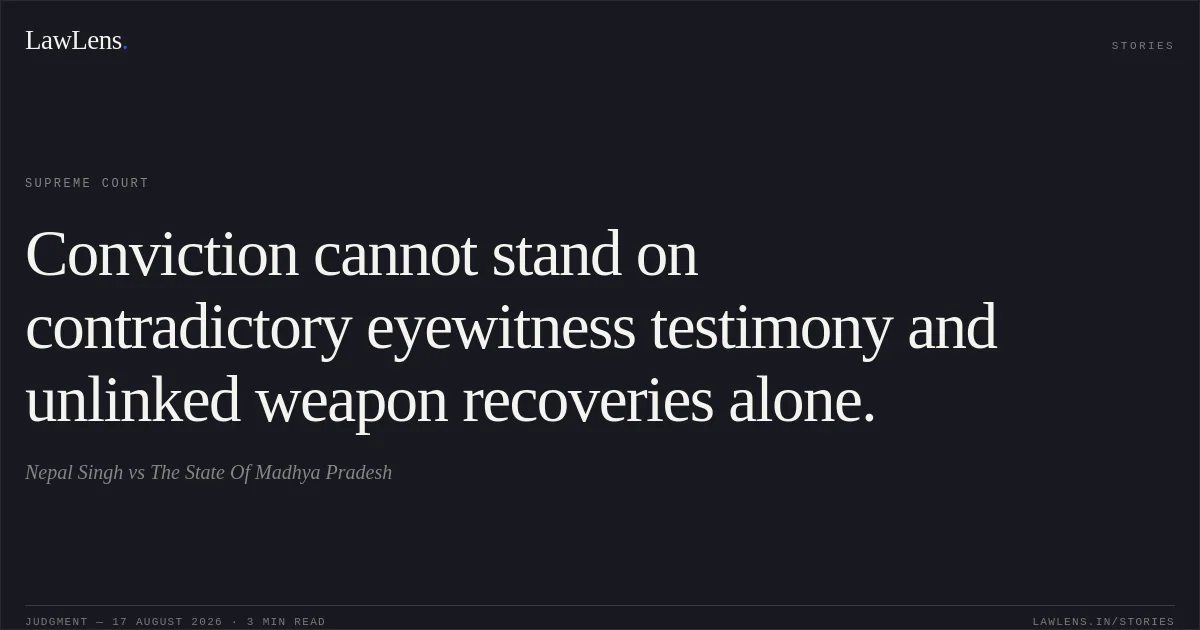
Although the death of Gaflu from the injuries was medically established, the Court found the evidence identifying the assailants unreliable.
Source reference: para. 4–6PW-6 gave contradictory and embellished evidence, claimed to have lost consciousness after the first blow, yet described the individual acts of the assailants, and admitted that he had not personally witnessed his father being struck with a farsa.
Source reference: para. 7PW-6 also acknowledged prior disputes and an earlier incident involving the complainant side, supporting the possibility of false implication.
Source reference: para. 7PW-7’s statement that she arrived only after hearing a commotion and found her husband already placed on a cot contradicted her examination-in-chief claim that she had witnessed the assault.
Source reference: para. 8The Court also found PW-8 and PW-9 unreliable and appearing to have been planted, while the weapon recoveries lacked independent evidentiary linkage to the appellant.
Source reference: para. 9Further, the Trial Court had acquitted several co-accused on the same evidentiary material and similar allegations, but the High Court did not explain why that reasoning should not equally benefit the convicted accused.
Source reference: para. 10Consequently, the prosecution failed to prove the appellant’s participation beyond reasonable doubt.
Source reference: no citationHolding
The Supreme Court allowed the appeals, set aside the appellant’s conviction, and quashed the High Court’s judgment dated 8 March 2018 in Criminal Appeal Nos. 1272 of 1995 and 1327 of 1995.
If the appellant was in custody, he was directed to be released forthwith; his bail bonds, if any, were cancelled, and pending applications were disposed of.
Source reference: para. 11Acts & Sections Cited
6 provisions across 1 statute referred to in this judgment. Each provision opens on LawLens.
Indian Penal Code, 18606
Original Court PDF
Nepal SinghvsThe State Of Madhya Pradesh
Click to open original judgment
Original judgment, available to read, download and summarize on LawLens.in