Facts
The complainant alleged that on July 18, 2011, his 14-year-old daughter was enticed away by the appellant under the pretext of an excursion.
Source reference: para. 3The victim stayed with the appellant in Surat for approximately 1.5 months, where she alleged she was subjected to sexual intercourse against her will.
Source reference: para. 9, 21Medical examination and radiological tests estimated the victim's age to be over 19 years.
Source reference: para. 11, 16The trial court, however, discarded the expert medical opinion, conducted its own "average" calculation based on physical characteristics and teeth (concluding she was 17), and convicted the appellant under Section 366 of the IPC despite acquitting him of kidnapping (Sec 363) and rape (Sec 376).
Source reference: para. 2, 31, 35Issues
1. Whether the trial court was justified in discarding expert medical evidence regarding the victim's age and substituting it with its own subjective assessment.
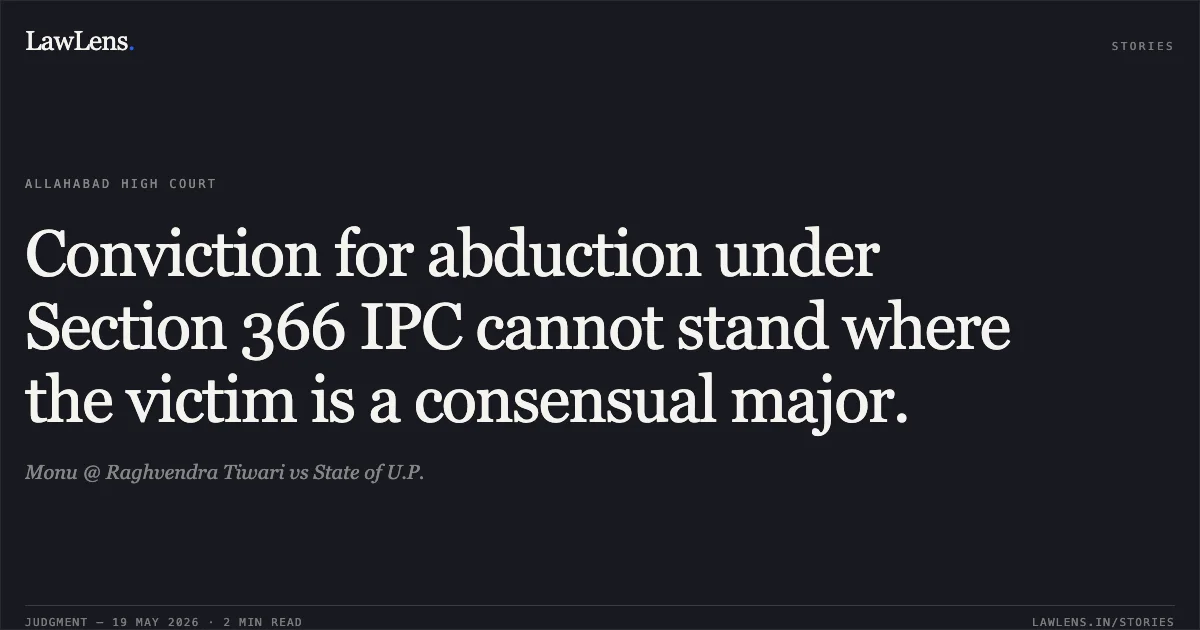
Source reference: para. 30, 322. Whether a conviction under Section 366 of the IPC (Abduction to compel marriage/intercourse) can be sustained when the court has found that the victim accompanied the accused voluntarily due to mutual love and affection.
Source reference: para. 38, 39Law Applied
The court applied Section 366 of the IPC, which mandates that kidnapping or abduction must be done with the intent to compel marriage or forced illicit intercourse.
Source reference: para. 36It further applied Section 362 of the IPC, defining "abduction" as the use of force or deceitful means to induce movement.
Source reference: para. 37The court applied the rule of evidence that while a court may give precedence to direct evidence over expert opinion under specific circumstances, it cannot act as an expert itself to replace scientific findings with arbitrary calculations.
Source reference: para. 33Finally, it applied the principle that where two views of medical age are possible, the conclusion favoring the accused must be accepted.
Source reference: para. 34Reasoning
The High Court found the trial court’s assessment of the victim's age to be "perverse" and "without any basis".
Source reference: para. 30, 32It noted that the trial court ignored the radiological and pathological reports confirming the victim was a major (over 19 years) and instead performed an arbitrary mathematical average of physical features.
Source reference: para. 31, 32The Court emphasized that the absence of a third molar is not conclusive proof of being a minor.
Source reference: para. 30Regarding the merits, the Court highlighted a logical contradiction in the trial court's judgment: the trial court found that the victim went with the appellant under a pre-planned arrangement due to "mutual love and affection" and without force.
Source reference: para. 35, 38Since the victim was a major and there was no evidence of force or deceit (essential for Section 362), the legal requirement for "abduction" remained unsatisfied.
Source reference: para. 39Consequently, if no abduction or kidnapping occurred, a conviction under Section 366 for "abduction to compel marriage" was legally untenable.
Source reference: para. 39Holding
The High Court allowed the appeal and set aside the conviction.
It held that the prosecution failed to establish the offense of abduction as defined under Section 362, thereby nullifying the charge under Section 366.
Source reference: para. 39, 40The appellant was acquitted of all charges, and his personal bonds were ordered to hold good under Section 437-A Cr.P.C.
Source reference: para. 40, 41Acts & Sections Cited
9 provisions across 2 statutes referred to in this judgment. Each provision opens on LawLens.
Code of Criminal Procedure, 19735
Indian Penal Code, 18604
Original Court PDF
Monu @ Raghvendra TiwarivsState of U.P.
Click to open original judgment
Original judgment, available to read, download and summarize on LawLens.in