Facts
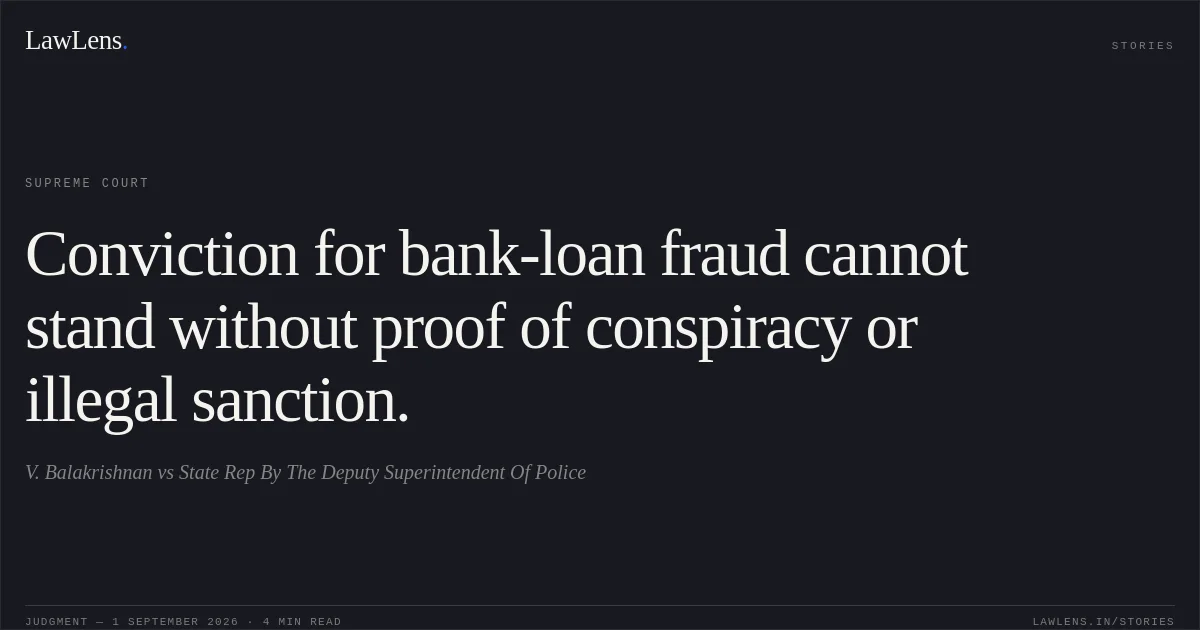
The appellant, A1, was Branch Manager of Indian Bank, Anna Nagar Branch, in 1991. The prosecution alleged that, in conspiracy with A2, a retired Indian Overseas Bank officer, A1 sanctioned loans to A4 and A5, who were allegedly domestic employees of A2, and that A2 appropriated the disbursed funds.
Source reference: pp. 2–3, paras. 4, 11A loan/overdraft facility of ₹13,50,000 was sanctioned in favour of A4, with an additional ₹3,30,000 allegedly disbursed hurriedly; the prosecution relied, inter alia, on A2’s signatures on the reverse of certain cheques.
Source reference: pp. 2–3, paras. 4, 11A loan of ₹10,00,000 was sanctioned to A5 for purchase of land, allegedly on the basis of an inflated valuation certificate issued by A3.
Source reference: p. 3, para. 5A2 and A4 died before framing of charges, A3 was bedridden and his trial was split up, and A5 was acquitted.
Source reference: p. 1; p. 2, para. 3The trial proceeded against A1 and A5, with A1 alone being convicted under Sections 420 read with 120B of the Indian Penal Code, 1860, and Sections 13(2) read with 13(1)(d) of the Prevention of Corruption Act, 1988.
Source reference: p. 1; p. 2, para. 3The prosecution examined 13 witnesses and relied on Exhibits P1–P86.
Source reference: pp. 3–5, paras. 6, 8The loan accounts were ultimately satisfied through recovery and auction of mortgaged properties, with substantial excess amounts remaining with the Bank.
Source reference: pp. 3–5, paras. 6, 8The High Court affirmed the conviction, leading to the present appeal.
Source reference: no citationIssues
Whether the prosecution proved beyond reasonable doubt that A1, as Branch Manager, dishonestly or fraudulently sanctioned the loans to A4 and A5 in conspiracy with A2, thereby committing offences under Sections 420 and 120B IPC.
Source reference: pp. 10–11, paras. 18–19Whether the evidence established that A1 abused his official position or acted corruptly so as to attract Sections 13(2) read with 13(1)(d) of the Prevention of Corruption Act, 1988.
Source reference: pp. 4–5, 10–11, paras. 8, 18–19Whether the prosecution sufficiently proved the alleged appropriation of the loan proceeds by A2, the overvaluation of the mortgaged properties, and the illegality of A1’s loan sanctions.
Source reference: pp. 6–11, paras. 11–19Law Applied
The Court applied Sections 420 and 120B IPC, requiring proof of dishonest or fraudulent inducement and criminal conspiracy, respectively, and Sections 13(2) read with 13(1)(d) of the Prevention of Corruption Act, 1988, requiring proof of criminal misconduct through abuse of official position or obtaining an improper advantage.
Source reference: pp. 10–11, paras. 18–19The prosecution was required to establish each incriminating circumstance and the accused’s guilt beyond reasonable doubt; suspicion, presumptions, or evidence merely showing irregularity or association could not substitute proof of conspiracy, dishonest intention, or corrupt abuse of office.
Source reference: pp. 10–11, paras. 18–19The Court also applied the evidentiary principle that disputed signatures and documentary transactions must be properly proved, and that unproved photocopies, unsupported valuation assumptions, and testimony lacking a demonstrated connection with the accused could not sustain a criminal conviction.
Source reference: pp. 6–10, paras. 12–18Reasoning
The Court held that the fact that A1 sanctioned the loans was established, but the sanctions were approved by the Regional Office, weakening the allegation that A1 independently or illegally caused the loans to be granted.
Source reference: pp. 4–5, 10–11, paras. 8–10, 19The alleged proof that A2 received the loan proceeds was inadequate because his signatures on the reverse of the cheques were not properly identified or compared with any contemporaneous admitted signatures, and relevant witnesses were not confronted with those signatures.
Source reference: pp. 6–7, paras. 11–12The evidence regarding leases, property transactions, and A2’s real-estate activities was either irrelevant, unsupported by title documents, based on photocopies, or did not implicate A1.
Source reference: pp. 7–9, paras. 13–16The alleged overvaluation was also not proved: the prosecution produced only one valuation certificate and no contemporaneous sale deeds or government market-value material showing the properties’ actual value when the loans were sanctioned in 1991–1992; reliance on their auction value nearly 20 years later was impermissible.
Source reference: p. 9, para. 18Since the mortgaged properties were auctioned and the Bank recovered the amounts due, the Court found no reliable evidence of cheating, conspiracy, or abuse of official position by A1.
Source reference: pp. 10–11, paras. 18–19Holding
The Supreme Court allowed the appeal and set aside the judgments of the Trial Court and the High Court convicting A1.
It granted A1 a clean acquittal of all allegations; if he was in custody, he was directed to be released forthwith unless required in another case, and any bail bonds were ordered to stand cancelled.
Source reference: p. 12, paras. 20–21Because the Bank had retained excess amounts realised from auction of the mortgaged properties, the Court impleaded the Branch Manager of Indian Bank, Anna Nagar Branch, directed submission of a report concerning the loan accounts, recovery, utilisation of auction proceeds, and production of the title deeds, and retained the case records to ensure proper disbursal of the excess funds to the lawful heirs.
Source reference: pp. 12–13, paras. 22–26Acts & Sections Cited
2 provisions across 2 statutes referred to in this judgment. Each provision opens on LawLens.
Indian Penal Code, 18601
Prevention of Corruption Act, 19881
Original Court PDF
V. BalakrishnanvsState Rep By The Deputy Superintendent Of Police
Click to open original judgment
Original judgment, available to read, download and summarize on LawLens.in