Facts
On 12.11.2018, Jyoti Devi sustained extensive burn injuries at her matrimonial home while allegedly preparing milk on a gas stove.
Source reference: p. 2–3, paras. 2–4Her initial statement, recorded at Civil Hospital, Sarkaghat in the presence of a doctor, stated that a sudden fireball caused by gas leakage had burnt her and that nobody had set her on fire.
Source reference: p. 2–3, paras. 2–4She was referred successively to hospitals at Ner Chowk, Shimla and Chandigarh, but died while being taken to PGI Chandigarh.
Source reference: p. 3, paras. 5–7Subsequently, her father lodged a report alleging that the appellant-husband had poured a liquid smelling of petrol or kerosene on her and set her ablaze; the FIR was registered under Sections 302, 498A and 306 IPC.
Source reference: p. 3–5, paras. 8–12After investigation, Sections 498A and 306 IPC were deleted for want of evidence, and the appellant was tried solely under Section 302 IPC.
Source reference: p. 5–6, paras. 14–18The Trial Court convicted him and sentenced him to imprisonment for life for the murder of his wife.
Source reference: no citationIssues
Whether the prosecution proved beyond reasonable doubt that the appellant intentionally caused the death of his wife by pouring a combustible liquid on her and setting her on fire, thereby committing an offence under Section 302 IPC?
Source reference: p. 20–22, paras. 57–60Whether the alleged oral disclosure made by the deceased to her parents during transit to PGI Chandigarh was reliable and sufficient to displace her contemporaneous medical statement attributing the burns to accidental gas leakage?
Source reference: p. 10–12, paras. 35–40Whether the medical, forensic, recovery and other circumstantial evidence corroborated the prosecution’s allegation of homicidal burning?
Source reference: p. 13–20, paras. 44–56Law Applied
The Court applied Section 302 of the Indian Penal Code, which requires the prosecution to establish the intentional causing of death constituting murder beyond reasonable doubt.
Source reference: p. 5–6, paras. 12, 16–17It applied the fundamental criminal-law principle that the burden rests on the prosecution and that any reasonable doubt regarding the credibility of material evidence must enure to the benefit of the accused.
Source reference: p. 20–21, paras. 57–60The Court treated the deceased’s statements as competing pieces of evidence and assessed their reliability in light of their timing, medical certification, consistency and surrounding circumstances.
Source reference: p. 10–12, paras. 35–40It further distinguished substantive evidence from corroborative or link evidence, holding that recovery and forensic material cannot cure deficiencies in the principal testimony on which the prosecution case rests.
Source reference: p. 20–21, paras. 57–59The Court also considered the evidentiary effect of the testimony of the deceased’s son, who was found competent and testified that the fire was accidental and that his father had done nothing wrong.
Source reference: p. 14–15, paras. 46–47Reasoning
The High Court found the prosecution’s principal case unreliable because the deceased’s first statement, recorded shortly after the incident in the presence of a doctor, attributed the burns to a gas-stove fireball and expressly stated that nobody had set her on fire.
Source reference: p. 2–3, paras. 3–4The later alleged oral disclosure to her parents was not independently corroborated: the medical employee accompanying the deceased in the ambulance was not examined, and the evidence did not satisfactorily establish whether the deceased, who was on oxygen, was capable of making the alleged disclosure.
Source reference: p. 10–11, paras. 36–38The father’s initial report itself contained alternative theories—that the deceased had committed suicide or that she had been killed by the appellant—and his later courtroom version included material improvements regarding the appellant’s conduct.
Source reference: p. 11–13, paras. 39–43The contemporaneous police record stated only that a fire had occurred, while the medical record recorded that the deceased had been brought by her husband and that the burns were attributed to gas leakage.
Source reference: p. 12–14, paras. 41–44The appellant’s own burn injuries were medically consistent with an attempt to extinguish the fire.
Source reference: p. 14, para. 45Most significantly, the deceased’s four-year-old son, examined after the Court found him competent, supported the accidental-fire version and was not declared hostile or confronted by the prosecution.
Source reference: p. 14–15, paras. 46–47The forensic evidence was inconclusive: kerosene was detected in a bottle and on some partially burnt clothes, but not in several other samples, including the appellant’s clothes and debris from the room; neither the medical examination, postmortem, inquest report nor police form recorded the smell of kerosene.
Source reference: p. 16–19, paras. 51–56Accordingly, the corroborative evidence did not establish homicidal burning, and the resulting reasonable doubt required acquittal.
Source reference: p. 20–22, paras. 57–60Holding
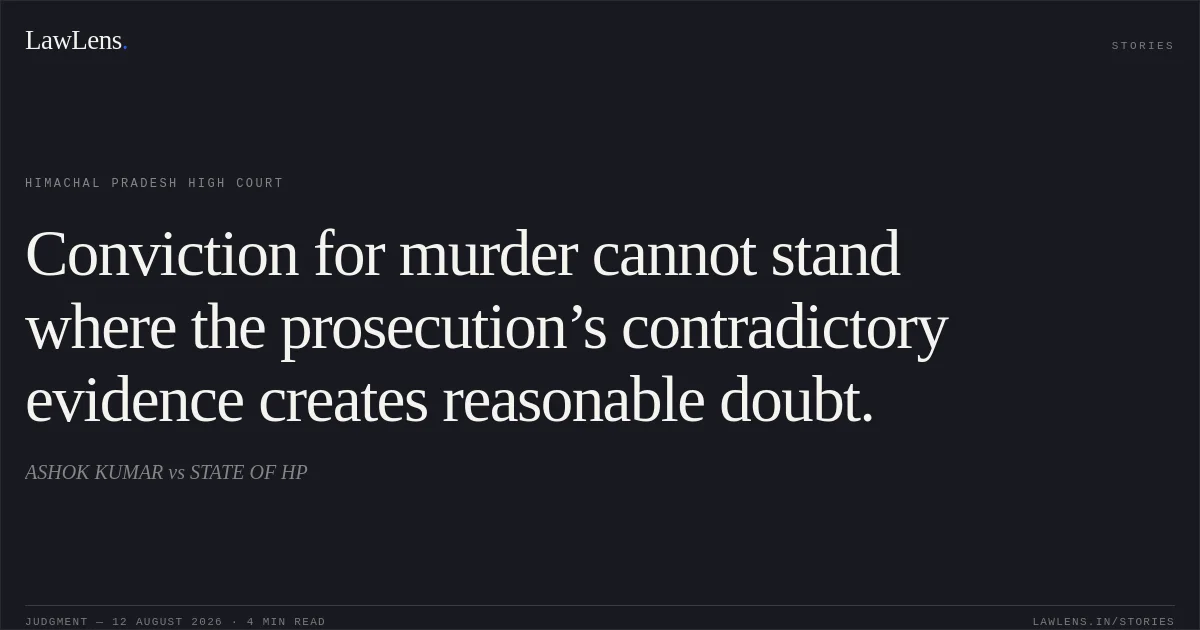
The High Court held that the prosecution failed to prove beyond reasonable doubt that Ashok Kumar murdered Jyoti Devi under Section 302 IPC.
The judgment of conviction and order of sentence dated 12.07.2024 were set aside, and the appellant was acquitted and directed to be released forthwith if not required in any other case.
Source reference: p. 22, paras. 61–62The Court directed that the case property be dealt with in accordance with law and that any deposited fine be refunded, subject to the limitation period for further proceedings.
Source reference: p. 22, paras. 63–64The appellant was further directed to furnish a bond of ₹50,000 with one surety under Section 481 BNSS, 2023, effective for six months and subject to his appearance before the Supreme Court if required in any further proceedings.
Source reference: p. 22–23, para. 65Acts & Sections Cited
5 provisions across 3 statutes referred to in this judgment. Each provision opens on LawLens.
Indian Penal Code, 18602
Code of Criminal Procedure, 19732
Bharatiya Nagarik Suraksha Sanhita, 20231
Original Court PDF
ASHOK KUMARvsSTATE OF HP
Click to open original judgment
Original judgment, available to read, download and summarize on LawLens.in