Facts
The appellant challenged the judgment dated 18.08.2017 of the Additional Sessions Judge, Seondha, District Datia, in S.T. No. 66/2016, by which he was convicted under Sections 376(2)(f) and 506 Part II of the Indian Penal Code and sentenced to life imprisonment and one year’s rigorous imprisonment, respectively, along with fines and default sentences.
Source reference: para. 1The prosecution alleged that on 19.02.2016 at about 9:00 p.m., the appellant, while intoxicated, entered the prosecutrix’s house when she was alone, raped her, and threatened her with death. Owing to fear, she left for her parents’ house the following morning, remained away for approximately two months, and later narrated the incident to a relative. She subsequently approached the police after learning that the appellant had been arrested, resulting in registration of the FIR and filing of the charge-sheet.
Source reference: para. 2In appeal, the appellant argued that the prosecution witnesses were interested and related to the prosecutrix, their statements contained material contradictions and improvements, the FIR was lodged after an unexplained delay of nearly two months, and there was prior hostility arising from property and other disputes.
Source reference: para. 3The State supported the conviction and contended that the appellant had not only committed the offence but had also threatened the prosecutrix to prevent her from reporting it.
Source reference: para. 4Issues
Whether the testimony of the prosecutrix, despite the delay in lodging the FIR, material contradictions, improvements, and alleged hostility between the parties, was sufficiently reliable to sustain conviction under Section 376(2)(f) IPC?
Source reference: paras. 6–11, 15Whether the prosecution had proved the charge under Section 506 Part II IPC beyond reasonable doubt?
Source reference: paras. 2, 8, 15–16Whether the appellant was entitled to acquittal on the ground that the prosecution evidence was unreliable and lacked independent corroboration?
Source reference: paras. 11, 15–16Law Applied
The Court applied Sections 376(2)(f) and 506 Part II IPC, requiring the prosecution to establish the alleged sexual assault and criminal intimidation beyond reasonable doubt.
Source reference: no citationIt relied on State of Punjab v. Gurmit Singh, 1996 (2) SCC 384, for the principle that the testimony of a prosecutrix may by itself support a conviction where it inspires confidence, and that minor discrepancies or the absence of corroboration should not ordinarily defeat a reliable prosecution case.
Source reference: para. 12However, relying on Krishna Kumar Malik v. State of Haryana, (2011) 7 SCC 130, the Court reiterated that the solitary testimony of the prosecutrix must be trustworthy, unblemished, and of sterling quality.
Source reference: para. 13It further applied Rai Sandeep @ Deepu v. State, NCT of Delhi, (2012) 8 SCC 21, which requires a “sterling witness” to give a consistent, natural, unassailable version that withstands cross-examination and coheres with the other material evidence.
Source reference: para. 14Where prior hostility is established, the evidence must be scrutinised with particular care, and conviction cannot rest on testimony that is materially inconsistent, contradicted, or uncorroborated.
Source reference: para. 15Reasoning
The Court found that the prosecutrix’s evidence did not satisfy the standard of a reliable or sterling witness.
Source reference: no citationAlthough she attributed the delay in reporting to fear, she had admittedly made no immediate disclosure to the prosecution witnesses and remained silent for nearly two months.
Source reference: para. 6Her account regarding the appellant’s alleged conduct at Daboh was inconsistent with her written complaint and with the testimony of P.W.2; material facts concerning the alleged assault and threats were also absent from earlier statements.
Source reference: para. 7The prosecutrix claimed that threats were made through Tinku Jatav’s mobile phone and that a recording existed, but no recording was produced, the Investigating Officer was not informed of it, and Tinku did not support that assertion.
Source reference: para. 8The Court further noted that the prosecution witnesses had strained relations or prior hostility with the appellant, while no independent corroboration was available.
Source reference: paras. 10–11The alleged criminal antecedents of the appellant were not established, and the fact that the prosecutrix’s locked house remained intact during her absence was considered inconsistent with the prosecution’s portrayal of the appellant as a habitual criminal intent on causing further harm.
Source reference: para. 9In view of the substantial contradictions, improvements, delayed reporting, hostile relationships, and absence of reliable corroboration, the Court held that the prosecution evidence did not inspire the confidence required for conviction under either provision.
Source reference: para. 15Holding
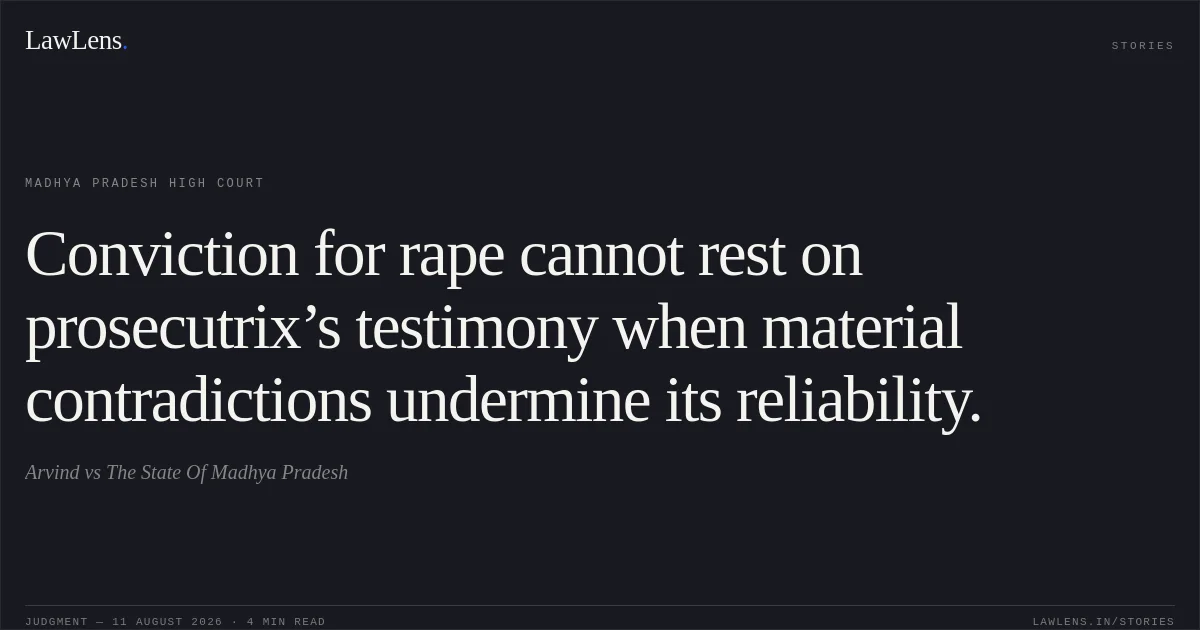
The High Court allowed the appeal and held that the prosecution had failed to prove the appellant’s guilt under Sections 376(2)(f) and 506 Part II IPC beyond reasonable doubt.
The conviction and sentences were set aside, and the appellant was acquitted.
Source reference: para. 17Since he was in custody, the Court directed that he be released forthwith unless required in any other case.
Source reference: para. 17Copies of the judgment were directed to be sent to the concerned jail authority and trial court, and any fine already deposited was ordered to be refunded to the appellant.
Source reference: paras. 18–19Acts & Sections Cited
2 provisions across 1 statute referred to in this judgment. Each provision opens on LawLens.
Indian Penal Code, 18602
Original Court PDF
ArvindvsThe State Of Madhya Pradesh
Click to open original judgment
Original judgment, available to read, download and summarize on LawLens.in