Facts
The appellant challenged his conviction under Section 376 of the Indian Penal Code and sentence of seven years’ rigorous imprisonment imposed by the 7th Additional Sessions Judge, Saran, Chapra, in Sessions Trial No. 254 of 2000, arising from Manjhi P.S. Case No. 25 of 1999.
Source reference: para. 1The prosecution alleged that on 6 March 1999, while the prosecutrix was carrying harvested mustard crops, the appellant intercepted, dragged and raped her in a wheat field after threatening and throttling her.
Source reference: para. 2The prosecution examined seven witnesses, including the prosecutrix, her parents, her brother, a doctor, a hostile independent witness and a formal witness; the investigating officer was not examined.
Source reference: para. 4, paras. 15–21The trial court convicted the appellant under Section 376 IPC, although the FIR had also invoked Section 307 IPC.
Source reference: paras. 3, 6, 10In appeal, the appellant alleged false implication arising from a dispute concerning alleged removal of crops from his field.
Source reference: paras. 8–12Issues
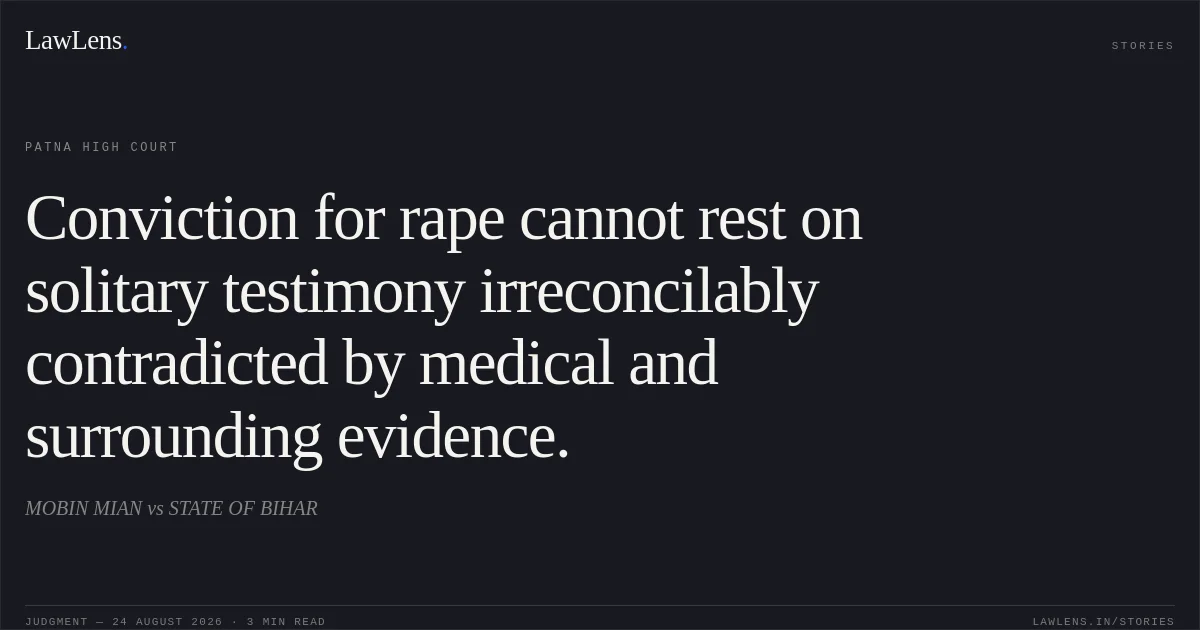
Whether the appellant’s conviction for rape could be sustained solely on the testimony of the prosecutrix when the independent witness had turned hostile and the remaining supporting witnesses were hearsay or related witnesses?
Source reference: paras. 22–23, 28–30Whether the medical evidence, which found bruises but no injury to the private parts, no spermatozoa and no evidence of recent intercourse, materially contradicted the prosecutrix’s testimony?
Source reference: paras. 18, 23, 30Whether the non-examination of the investigating officer and the defective formal proof of the medical injury report caused prejudice to the defence and weakened the prosecution case?
Source reference: paras. 24, 26–27Whether the prosecution proved the charge under Section 376 IPC beyond reasonable doubt?
Source reference: paras. 31–33Law Applied
The Court applied Section 376 IPC concerning rape and Section 374(2) Cr.P.C. governing appeals against conviction.
Source reference: para. 1It recognised that a conviction for rape may ordinarily rest on the sole testimony of the prosecutrix if that testimony is credible, natural and trustworthy; however, where the testimony is inconsistent, unsupported by medical evidence or rendered improbable by the surrounding circumstances, conviction cannot safely be based upon it, relying on Birka Shiva v. State of Telangana, 2025 SCC OnLine SC 1454.
Source reference: para. 28The Court also relied on Santosh Prasad v. State of Bihar, (2020) 3 SCC 443, for the principle that the prosecutrix’s solitary testimony is not to be accepted as gospel truth where corroborative circumstances are absent and the medical evidence does not support the allegation.
Source reference: para. 29Regarding investigation, Ravishwar Manjhi v. State of Jharkhand, (2008) 16 SCC 561, and Lahu Kamlakar Patil v. State of Maharashtra, (2013) 6 SCC 417, were applied for the principle that non-examination of the investigating officer assumes significance where it is necessary to establish the place of occurrence, fairness of investigation or material contradictions.
Source reference: para. 26The Court further held that a medical document could not safely be proved through a formal clerk who lacked medical expertise and had no proper basis to identify the maker’s handwriting or signature.
Source reference: para. 24Reasoning
The Court found that the prosecution case rested substantially on the prosecutrix’s uncorroborated testimony. The parents and brother were not eyewitnesses, while the only independent witness, P.W.-5, was declared hostile.
Source reference: paras. 15–17, 22Although the prosecutrix alleged forcible rape and throttling, the doctor found only bruises near the ear and neck, no injury or violence around the private parts, no foreign hair or spermatozoa, and expressly opined that there was no evidence of recent intercourse despite examining her the following morning.
Source reference: paras. 18, 23The injury report allegedly supporting suffocation was not proved by its maker and was only formally exhibited through a clerk.
Source reference: para. 24The investigating officer’s absence also prevented the defence from testing the place of occurrence, alleged physical evidence, seizure and prior statements of witnesses; no clothes, crop bag, trampling marks or other objective evidence were produced.
Source reference: paras. 26–27In light of the defence suggestion that the incident arose from a crop-related dispute and scuffle, the Court held that the surrounding circumstances required corroboration, which was lacking, and that the medical evidence materially conflicted with the prosecutrix’s account.
Source reference: para. 28, para. 30Holding
The Court answered the issues in favour of the appellant and held that the prosecution had failed to prove the charge under Section 376 IPC beyond reasonable doubt.
The judgment of conviction dated 2 December 2003 and order of sentence dated 8 December 2003 were set aside, and the appeal was allowed.
Source reference: paras. 32–33As the appellant was already on bail, he was discharged from the liability of his bail bonds.
Source reference: para. 32Acts & Sections Cited
4 provisions across 2 statutes referred to in this judgment. Each provision opens on LawLens.
Code of Criminal Procedure, 19732
Indian Penal Code, 18602
Original Court PDF
MOBIN MIANvsSTATE OF BIHAR
Click to open original judgment
Original judgment, available to read, download and summarize on LawLens.in