Facts
On 2 May 2010, the informant, Pappu Sao, and his father, Chintamani Sao, were crossing the G.T. Bye-Pass Road near Panchwati Nagar when a TVS Victor motorcycle bearing registration no. JH11C-4206 allegedly, driven rashly and negligently, hit Chintamani Sao. He was taken to Dumri Hospital and referred to PMCH, Dhanbad, but died on the way.
Source reference: p.4, para. 10On the informant’s written report, Dumri P.S. Case No. 13 of 2012 was registered under Sections 279 and 304A of the Indian Penal Code (“IPC”). Following investigation, a charge-sheet was filed against Binod Sao, and the trial court convicted him under Sections 279 and 304A IPC, sentencing him to six months’ rigorous imprisonment under Section 279 and eighteen months’ rigorous imprisonment with a fine of ₹2,000 under Section 304A, with the sentences to run concurrently. The appellate court dismissed his appeal on 27 July 2017. The accused thereafter preferred the present criminal revision.
Source reference: p.1, para. 2; p.2, para. 3Six prosecution witnesses were examined, while the defence led no evidence.
Source reference: p.2, paras. 4–5Issues
Whether the prosecution proved beyond reasonable doubt that the petitioner was driving the motorcycle rashly or negligently so as to attract liability under Sections 279 and 304A IPC?
Source reference: p.3, para. 7; p.5, para. 10Whether the evidence sufficiently established the petitioner’s identity as the driver of the offending motorcycle and connected his driving with the death of the deceased?
Source reference: p.3, para. 7; p.5, para. 10Whether the sentence imposed under Section 304A IPC warranted interference or modification in revision?
Source reference: p.6, para. 11Law Applied
The Court applied Section 279 IPC, which penalises driving or riding on a public way in a manner so rash or negligent as to endanger human life or likely cause hurt or injury, and Section 304A IPC, which criminalises causing death by a rash or negligent act not amounting to culpable homicide.
Source reference: no citationThe essential requirement for conviction under these provisions is proof of rash or negligent driving causally connected with the death or injury.
Source reference: no citationThe Court also applied the principles governing limited revisional interference with concurrent findings of fact, declining to disturb such findings where they are supported by reliable evidence and are not perverse.
Source reference: p.5, para. 10The petitioner’s reliance on Birju Ram v. State of Jharkhand & Anr., Cr. Revision No. 652 of 2018, decided on 28 August 2024, was held inapplicable on the facts of the present case.
Source reference: p.4, para. 7; p.5, para. 10Reasoning
The Court found that the informant, examined as P.W.-3, gave a consistent eyewitness account of the accident and specifically supported the allegation that the motorcycle was being driven rashly and negligently.
Source reference: p.4, para. 10P.Ws. 2 and 4 corroborated the prosecution version, and the medical evidence was treated as supporting the occurrence and its fatal consequence.
Source reference: p.4, para. 10The investigating officer described the place of occurrence and stated that the petitioner appeared in the case, obtained bail as the driver of the offending vehicle, and produced the vehicle’s registration certificate, driving licence and insurance documents. The motorcycle was registered in the petitioner’s name and was subsequently handed over to him after mechanical examination.
Source reference: p.5, para. 10On this evidence, the Court held that the petitioner’s identity and his connection with the vehicle were established, and that the prosecution proved that his driving resulted in the deceased being dashed and ultimately dying.
Source reference: p.5, para. 10The Court rejected the arguments that the petitioner was not named in the FIR, that the eyewitnesses had improved their testimony, and that the post-mortem report did not expressly record death from a vehicular accident, finding no basis to take a different view from the courts below.
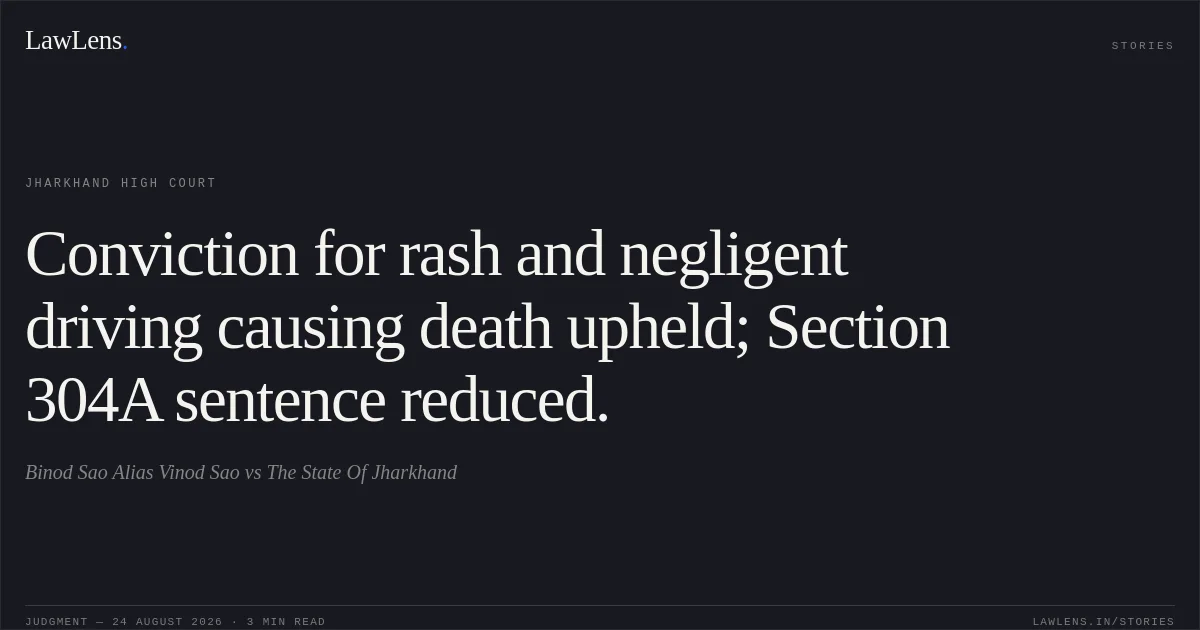
Source reference: pp.3–5, paras. 7, 9–10However, while affirming the conviction, the Court considered the sentence under Section 304A IPC excessive and reduced it from eighteen months to one year.
Source reference: p.6, para. 11Holding
The criminal revision was dismissed on merits, and the petitioner’s conviction under Sections 279 and 304A IPC was affirmed.
The sentence under Section 279 IPC—six months’ rigorous imprisonment—was maintained, while the sentence under Section 304A IPC was reduced to one year’s imprisonment; the sentences continued to run concurrently.
Source reference: pp.1, 6, paras. 2, 11–12The suspension of sentence granted during the revision was cancelled, and the petitioner was directed to surrender before the trial court within two months, failing which coercive steps could be taken for his arrest and detention.
Source reference: p.6, para. 13Acts & Sections Cited
1 provisions across 1 statute referred to in this judgment. Each provision opens on LawLens.
Indian Penal Code, 18601
Original Court PDF
Binod Sao Alias Vinod SaovsThe State Of Jharkhand
Click to open original judgment
Original judgment, available to read, download and summarize on LawLens.in