Facts
On 23.02.2014, the victim (PW1), a 13-year-old girl, was offered a lift to school by the accused, a van driver known to her.
Source reference: p.2, 8During the journey, the accused unzipped his pants, exposed his private parts, and performed a lewd act.
Source reference: p.8, para. 14Frightened, PW1 jumped from the moving vehicle, noted the registration number, and sought help from an acquaintance (PW3).
Source reference: p.8, 10The accused initially requested the victim’s father (PW2) not to report the matter, offering an apology, but was subsequently apprehended.
Source reference: p.11, para. 14.1The Trial Court (ASJ-01, North District, Rohini) convicted the accused on 19.12.2016 under Section 354 of the IPC and Section 12 of the POCSO Act, sentencing him to one-year rigorous imprisonment for each count, to run concurrently.
Source reference: p.1-2, 5-6The accused appealed on the grounds of lack of corroboration from hostile witnesses.
Source reference: p.6, para. 10Issues
1. Whether the conviction could be sustained based on the sole testimony of the victim when other material prosecution witnesses (PW3, PW4, and PW8) turned hostile.
Source reference: p.6, para. 10; p.7, para. 132. Whether the non-compliance with the mandatory hearing under Section 232 of the Cr.PC vitiated the trial proceedings.
Source reference: p.4, para. 73. Whether the acts of the accused satisfied the legal ingredients of "assault" under Section 351 IPC and "sexual harassment" under the POCSO Act.
Source reference: p.16-17, para. 20Law Applied
The Court primarily applied Section 354 of the IPC regarding the outraging of a woman's modesty and Section 12 of the POCSO Act regarding sexual harassment.
Source reference: p.16-17It relied on the definition of "assault" under Section 351 IPC, which includes gestures causing apprehension of criminal force.
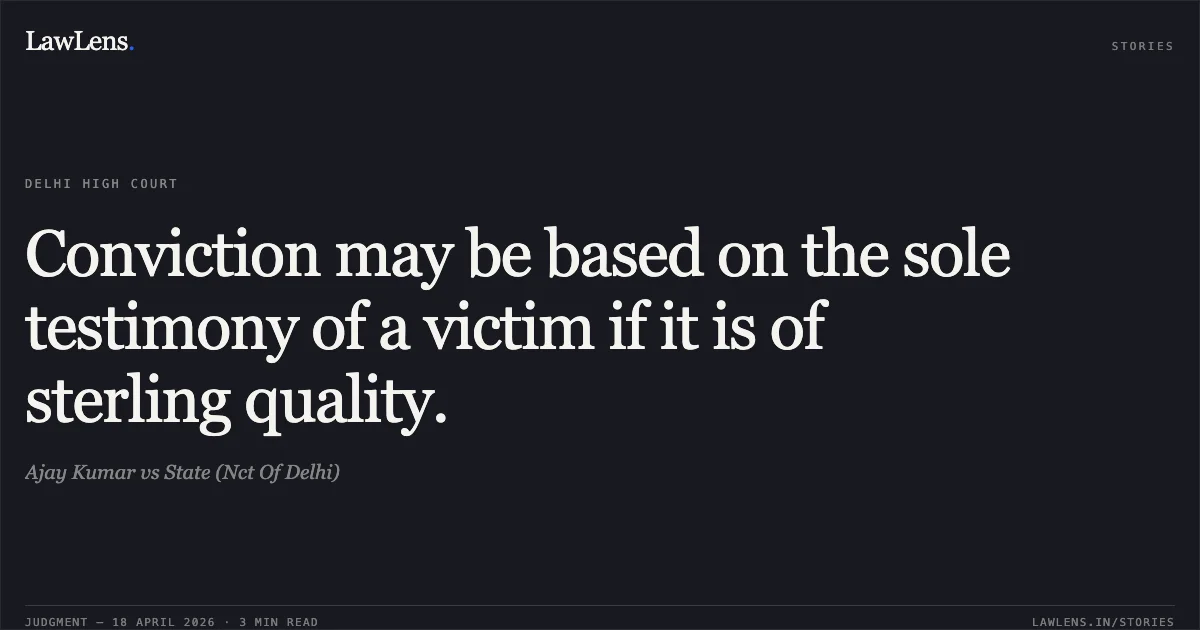
Source reference: p.16-17The Court followed the precedent in Rai Sandeep @ Deepu v. State (NCT of Delhi), establishing that conviction can be based on the sole testimony of a victim if it is of "sterling quality".
Source reference: p.18, para. 21Furthermore, it applied Section 162 Cr.PC and Section 145 of the Indian Evidence Act, 1872, asserting that police statements (Section 161 Cr.PC) can only be used to contradict witnesses, not to provide substantive evidence or corroboration.
Source reference: p.20, para. 23Reasoning
The Court found that PW1’s testimony was consistent across her First Information Statement, Section 164 statement, and court deposition, categorizing it as "sterling quality".
Source reference: p.18, para. 21The Court reasoned that the accused’s act of exposing his private parts was inherently "sexually coloured" and intended to outrage the victim's modesty, thus satisfying the requirements of Section 351 IPC and Section 12 POCSO.
Source reference: p.17, para. 20Regarding the hostile witnesses (PW3, PW4, and PW8), the Court noted that while they resiled from the specifics of the incident, their testimonies still corroborated that the victim was in a "distressed condition" immediately after the event, which lent credence to her version.
Source reference: p.19, para. 22The Court dismissed the challenge regarding Section 232 Cr.PC, holding that procedural omissions do not vitiate a trial unless substantial prejudice is shown, which the appellant failed to demonstrate.
Source reference: p.5, para. 7Minor discrepancies in the victim's account were viewed as natural for a child witness and indicative of a lack of tutoring.
Source reference: p.18-19, para. 21Holding
The High Court held that the prosecution successfully proved the charges beyond a reasonable doubt through the reliable and consistent testimony of the victim.
The Court affirmed that the hostility of secondary witnesses does not erode the credibility of a victim whose testimony is of sterling quality.
Source reference: p.19-20The appeal was dismissed, and the conviction and sentence under Section 354 IPC and Section 12 POCSO Act were upheld.
Source reference: p.21, para. 24-25Acts & Sections Cited
11 provisions across 3 statutes referred to in this judgment. Each provision opens on LawLens.
Code of Criminal Procedure, 19737
Indian Penal Code, 18602
Protection of Children from Sexual Offences Act, 20122
Original Court PDF
Ajay KumarvsState (Nct Of Delhi)
Click to open original judgment
Original judgment, available to read, download and summarize on LawLens.in