Facts
The appellant, a Lekhpal in the Consolidation Department, along with a Kanoongo, allegedly demanded a bribe of ₹400 from Virendra Singh to ensure a favorable outcome in a land dispute appeal pending before the Settlement Officer (Consolidation).
Source reference: para. 3Virendra’s son, Jai Vijai Singh, reported the matter to the Vigilance Department, which organized a trap party.
Source reference: para. 3On April 1, 1977, the appellant was caught red-handed at Chaurasiya Hotel accepting ₹300 in phenolphthalein-treated currency notes.
Source reference: paras. 5-6Following a chemical test of his hands and pocket, which turned pink, he was arrested.
Source reference: para. 6The Trial Court (Vth Additional Sessions Judge, Kanpur) convicted the appellant on October 9, 1985, while acquitting the co-accused Kanoongo due to insufficient evidence.
Source reference: paras. 2, 19The appellant challenged this conviction on grounds of non-examination of the primary complainant and lack of independent witnesses.
Source reference: paras. 21-22Issues
1. Whether the non-examination of the primary complainant (Virendra Singh) is fatal to the prosecution’s case given the availability of other eyewitnesses and trap evidence?
Source reference: para. 302. Whether the recovery of illegal gratification in a public place (hotel) without independent public witnesses renders the trap proceedings unreliable?
Source reference: paras. 32-333. Whether the prosecution proved the guilt of the appellant under the Prevention of Corruption Act beyond reasonable doubt?
Source reference: para. 37Law Applied
Section 161 of the Indian Penal Code, 1860 (IPC), which criminalizes public servants taking gratification other than legal remuneration.
Source reference: para. 2Section 5(2) of the Prevention of Corruption Act, 1947, regarding criminal misconduct by a public servant.
Source reference: para. 2The evidentiary standard applied was the "proof beyond reasonable doubt" principle in criminal jurisprudence.
Source reference: para. 24The court also implicitly applied the principle that the non-examination of a material witness is not fatal if their absence is explained (e.g., medical incapacity) and other corroborative ocular and forensic evidence exists.
Source reference: para. 30Reasoning
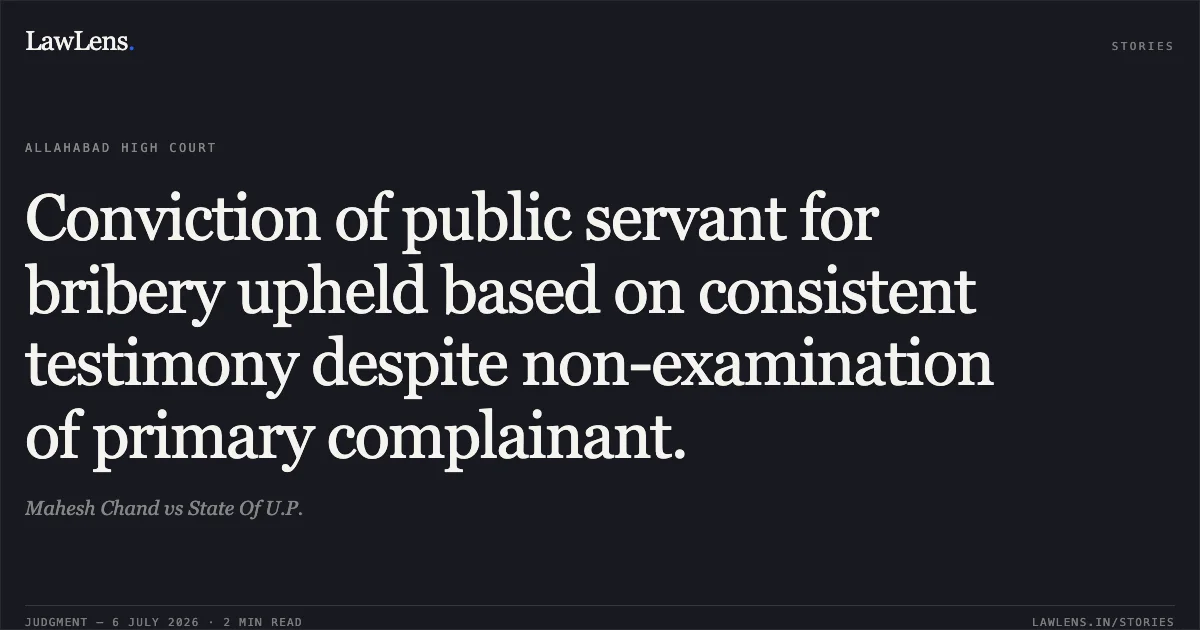
The Court rejected the appellant's contention regarding the non-examination of Virendra Singh, noting that P.W. 4 (his son) provided a valid medical explanation for his father's mental instability.
Source reference: para. 30The court held that since the trap was witnessed by P.W. 1 (Inspector), P.W. 2 (Constable), and P.W. 3 (Public Witness), the absence of the primary complainant did not weaken the case.
Source reference: para. 30Regarding the location of the trap, the court reasoned that the secrecy and planned nature of such operations are designed to prevent apprehension, and the appellant admitted his presence at the hotel.
Source reference: paras. 33-35The forensic evidence—the sodium carbonate solution turning red upon washing the appellant's hands—corroborated the testimony that he handled the marked notes.
Source reference: paras. 26, 28The court found no evidence of enmity or motive for the police to falsely implicate the appellant.
Source reference: para. 34Holding
The court held that the ocular evidence of the trap party combined with the forensic recovery of marked notes sufficiently proved the demand and acceptance of illegal gratification.
The High Court dismissed the appeal and affirmed the conviction and sentence of one year of rigorous imprisonment under Section 161 IPC and Section 5(2) of the Prevention of Corruption Act.
Source reference: paras. 37-38The appellant’s bail was cancelled, and he was directed to surrender before the Trial Court within four weeks to undergo the remaining sentence.
Source reference: para. 38Acts & Sections Cited
4 provisions across 2 statutes referred to in this judgment. Each provision opens on LawLens.
Code of Criminal Procedure, 19733
Indian Penal Code, 18601
Original Court PDF
Mahesh ChandvsState Of U.P.
Click to open original judgment
Original judgment, available to read, download and summarize on LawLens.in