Facts
The Appellant, a tuition teacher, was accused of committing rape on his 8-year-old student on September 29, 2018
Source reference: para. 4The victim (P.W. 7) returned home with blood-soaked clothing and identified the Appellant as the perpetrator
Source reference: para. 4-5Medical examination (P.W. 8) revealed physical injuries, contusions, and redness in the genital area
Source reference: para. 22, 30Forensic reports (P.W. 11) confirmed the presence of human blood and semen of group ‘A’ on the victim's clothing
Source reference: para. 21, 31The Trial Court convicted the Appellant under Section 376 IPC and Section 4 of the POCSO Act, sentencing him to 20 years of imprisonment (10 years rigorous, 10 years simple)
Source reference: para. 3, 35The Appellant challenged the conviction on grounds of lack of medical examination of the accused under Section 53A CrPC and disputed the victim's presence at the coaching center
Source reference: para. 14-17Issues
1. Whether the prosecution proved the foundational facts of penetrative sexual assault beyond reasonable doubt to trigger the reverse burden under Sections 29 and 30 of the POCSO Act.
Source reference: para. 122. Whether the non-medical examination of the accused under Section 53A CrPC is fatal to the prosecution's case when other evidence is available.
Source reference: para. 15, 223. Whether the sentence of 20 years imprisonment was legally sustainable given the statutory provisions of Section 4 POCSO Act existing at the time of the occurrence (2018).
Source reference: para. 24-25, 38Law Applied
The Court primarily applied Section 376 of the IPC and Section 4 of the POCSO Act (as it stood in 2018), which provided a minimum sentence of seven years for penetrative sexual assault
Source reference: para. 3, 36It relied on the "reverse burden" principles under Sections 29 and 30 of the POCSO Act, which presume guilt once foundational facts are established
Source reference: para. 12The court also invoked Section 134 of the Indian Evidence Act (now Section 139 of Bharatiya Sakshya Adhiniyam), establishing that the testimony of a single "sterling witness" (the victim) is sufficient for conviction
Source reference: para. 23, 33Furthermore, it observed the principle of non-retroactivity of criminal laws, noting that the 2019 amendment enhancing the minimum sentence to 20 years could not be applied to a 2018 offense
Source reference: para. 24, 38Reasoning
The Court upheld the conviction, characterizing the victim (P.W. 7) as a "wholly reliable" and "sterling" witness whose testimony remained consistent through her Section 164 CrPC statement and trial
Source reference: para. 23, 32-33The medical evidence (P.W. 8) showing injuries and the FSL report (P.W. 10 & 11) confirming semen on the victim's clothes provided strong corroboration
Source reference: para. 30-31Regarding the lack of medical examination of the accused (Section 53A CrPC), the Court held this was an investigatory lapse that did not vitiate the unimpeachable ocular and forensic evidence
Source reference: para. 22However, the Court found the sentence of 20 years to be erroneous; the Trial Court had mistakenly applied the 2019 Amendment (Act 25 of 2019), whereas the law in 2018 only mandated a seven-year minimum
Source reference: para. 24, 38Considering the Appellant's young age (approx. 18 years and 9 months at the time of the offense), the Court sought to balance retribution with rehabilitation
Source reference: para. 26, 39-40Holding
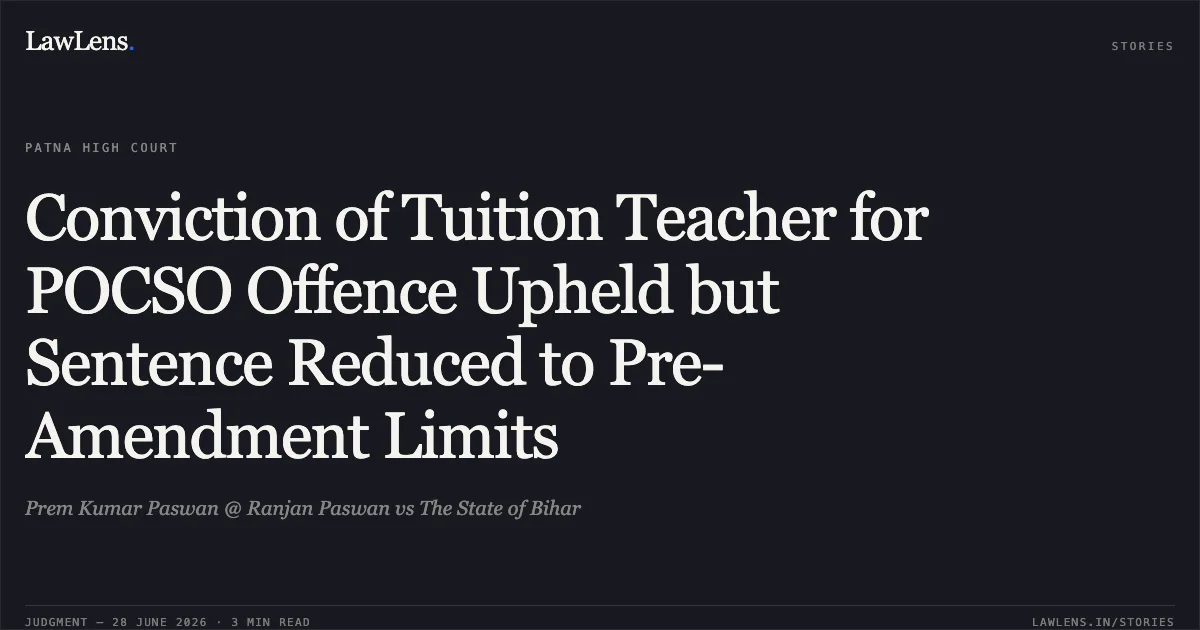
The Court dismissed the appeal against the conviction but allowed it in part regarding the sentence
It held that the 20-year sentence was not in accordance with the law existing at the time of the occurrence
Source reference: para. 38The sentence was modified to 12 years of imprisonment (10 years rigorous and 2 years simple), while the fine and default imprisonment remained unchanged
Source reference: para. 41-42The Court directed the fine to be paid to the victim
Source reference: para. 35, 41Acts & Sections Cited
9 provisions across 5 statutes referred to in this judgment. Each provision opens on LawLens.
Indian Penal Code, 18601
Protection of Children from Sexual Offences Act, 20124
Code of Criminal Procedure, 19732
Bharatiya Nagarik Suraksha Sanhita, 20231
Bharatiya Sakshya Adhiniyam, 20231
Original Court PDF
Prem Kumar Paswan @ Ranjan PaswanvsThe State of Bihar
Click to open original judgment
Original judgment, available to read, download and summarize on LawLens.in