Facts
The prosecution alleged that on July 22, 2014, the appellant and other co-accused intercepted the informant (PW-8) and his son, Anupam Anand. Under instructions from a co-accused, the appellant allegedly shot the son in the chest at point-blank range, leading to his death.
Source reference: p. 2-4The Trial Court convicted the appellant under Sections 302/34 of the IPC and Section 27 of the Arms Act based primarily on the testimony of a purported eye-witness, PW-1.
Source reference: p. 1, 4-5Notably, the informant (PW-8) did not support the prosecution's case during the trial but was not declared hostile.
Source reference: p. 6Issues
1. Whether the solitary testimony of PW-1 qualifies as "sterling" evidence sufficient to sustain a conviction for murder when the informant himself did not support the prosecution case.
Source reference: p. 62. Whether the investigation suffered from material lacunae and dereliction of duty that vitiated the prosecution’s case.
Source reference: p. 9-10Law Applied
Section 302 (Murder) and Section 34 (Common Intention) of the Indian Penal Code, and Section 27 of the Arms Act.
Source reference: p. 1The Court relied on the "sterling witness" doctrine as defined in Rai Sandeep @ Deepu v. State of NCT of Delhi (2012) and followed in Nirmal Premkumar v. State Rep. By Inspector of Police (2024), which mandates that a solitary witness's version must be of very high quality, unassailable, and consistent to warrant conviction without corroboration.
Source reference: p. 7-9Reasoning
The Court found the Trial Court’s reliance on PW-1 misplaced, noting that PW-1’s cross-examination created significant doubt as to whether he actually witnessed the shooting or arrived after the injury was inflicted.
Source reference: p. 6Since the informant (PW-8) failed to identify the appellant and was not declared hostile, his testimony remained on record, further weakening the prosecution's narrative.
Source reference: p. 6The Court highlighted severe investigative failures by the I.O. (PW-7), including the failure to verify ownership of the motorcycle and mobile phone found at the scene, and the failure to send the recovered empty cartridge to a Forensic Laboratory.
Source reference: p. 9-10These omissions constituted a "clear instance of dereliction of duty," depriving the court of the best evidence.
Source reference: p. 10Holding
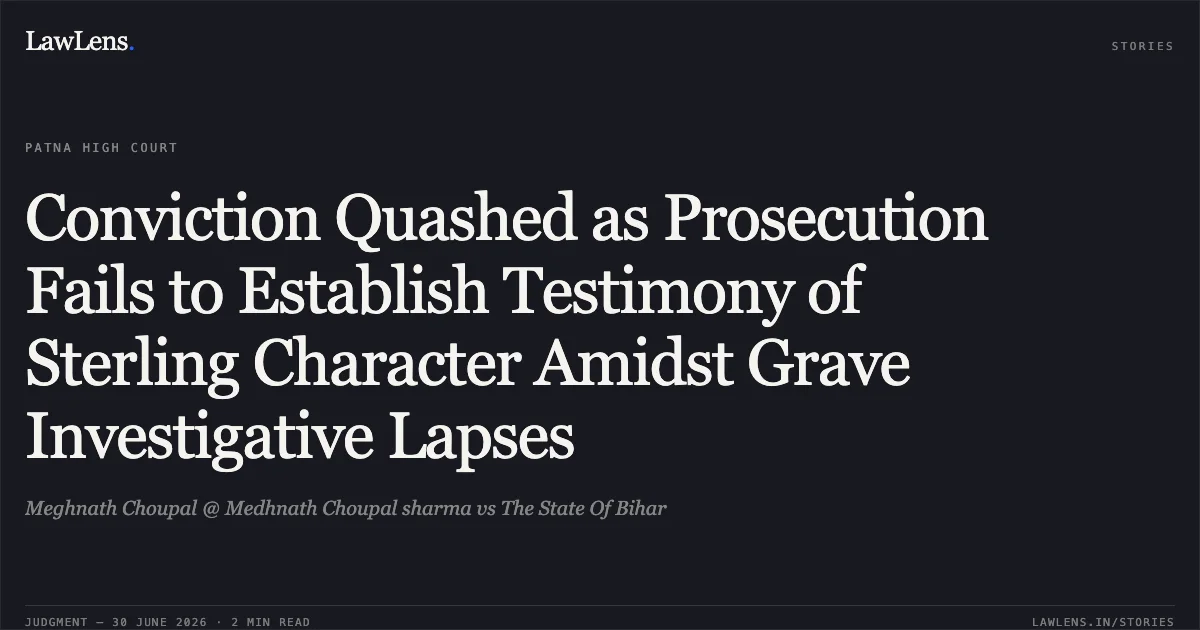
The Court held that the prosecution failed to prove the charge beyond a reasonable doubt due to the lack of "sterling" witnesses and lackadaisical investigation.
The High Court allowed the appeal, setting aside the judgment of conviction dated May 30, 2018, and the sentence of life imprisonment. Additionally, the Court directed the Director General of Police, Bihar, to initiate departmental proceedings against the Investigating Officer for gross negligence.
Source reference: p. 10-11Acts & Sections Cited
3 provisions across 2 statutes referred to in this judgment. Each provision opens on LawLens.
Indian Penal Code, 18602
Arms Act, 19591
Original Court PDF
Meghnath Choupal @ Medhnath Choupal sharmavsThe State Of Bihar
Click to open original judgment
Original judgment, available to read, download and summarize on LawLens.in