Facts
The informant, Birendra Prasad Gupta (a member of the CPI-ML), alleged that on September 6, 2000, while returning to his party office on a motorcycle, he was intercepted at Tikuliya Chowk by six to seven armed occupants of a Gypsy. He was forcibly abducted, tied, and assaulted.
Source reference: p. 3The accused allegedly engaged in firing and exploding bombs when intercepted by the Gopalpur Police, yet were eventually apprehended.
Source reference: p. 3Notably, two separate FIRs were registered for the same incident: Chanpatia P.S. Case No. 156 of 2000 (abduction) and Gopalpur P.S. Case No. 37 of 2000 (arms and explosives).
Source reference: p. 5The Trial Court convicted the six appellants under Sections 364/34 of the IPC, sentencing them to ten years of rigorous imprisonment.
Source reference: p. 2Issues
1. Whether the prosecution proved the guilt of the appellants beyond a reasonable doubt given the material contradictions in eye-witness testimonies.
Source reference: p. 82. Whether the failure to conduct a Test Identification Parade (TIP) and relying solely on dock identification for the first time during trial is legally sustainable.
Source reference: p. 63. Whether the previous acquittal of the appellants in the related case (Gopalpur P.S. Case No. 37 of 2000) for the same occurrence impacts the current conviction.
Source reference: p. 5Law Applied
The court applied Section 364 (kidnapping or abducting in order to murder) and Section 34 (common intention) of the Indian Penal Code.
Source reference: p. 2It emphasized the fundamental principle of criminal jurisprudence that the prosecution must prove its case "beyond reasonable doubt" rather than on a "preponderance of probabilities".
Source reference: p. 9The court relied on the precedent of Nazim and Others v. The State of Uttarakhand (2025 INSC 1184) regarding the procedural necessity of a Test Identification Parade (TIP) and the unreliability of dock identification for first-time witnesses.
Source reference: p. 6-7Reasoning
The Court observed that the prosecution's case was riddled with inconsistencies. P.W. 5 and P.W. 6 contradicted each other on the number of assailants (two versus six) and their identity.
Source reference: p. 6Critically, the informant alleged a brutal assault, yet no medical evidence or injury report supported this claim.
Source reference: p. 5The Court noted that despite the occurrence taking place in a public area, no independent witnesses were examined, and all P.W.s were highly interested parties.
Source reference: p. 7The Court also highlighted that the appellants had already been acquitted in the simultaneous trial arising from the same transaction (Exhibit F), making the contradictory findings in the present case legally fragile.
Source reference: p. 8Holding
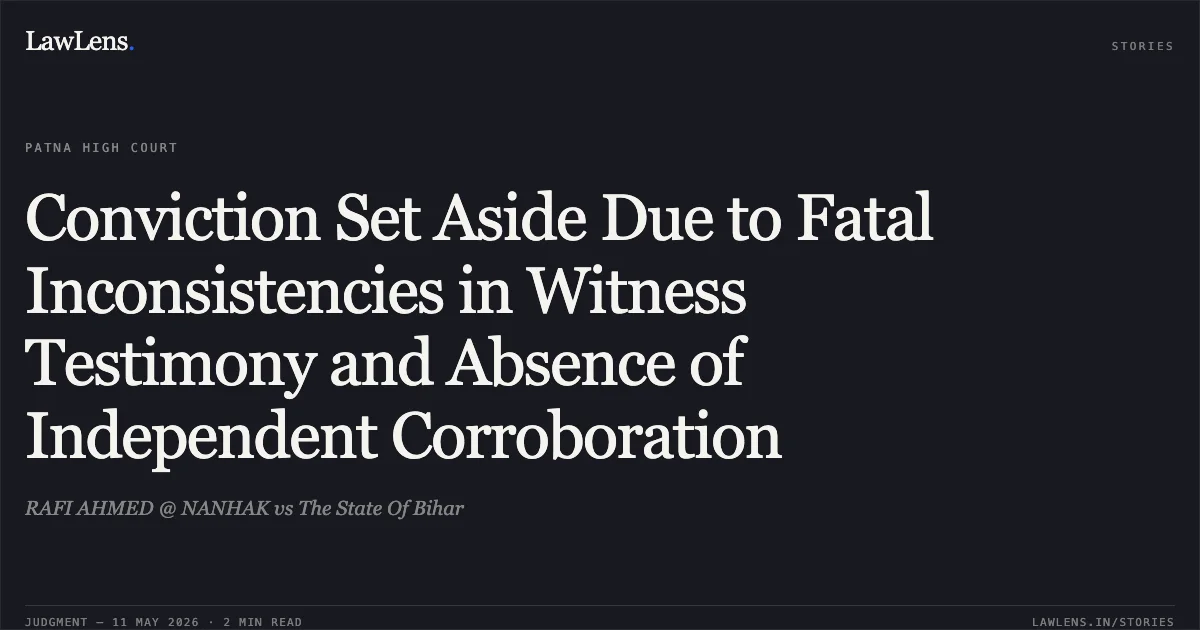
The Court held that the prosecution miserably failed to prove the charges beyond reasonable doubt due to unreliable oral evidence and procedural lapses.
The appeals were allowed, and the judgment of conviction dated January 14, 2016, was set aside. The appellants were acquitted of all charges and ordered to be discharged from their bail bonds.
Source reference: p. 9-10Acts & Sections Cited
13 provisions across 3 statutes referred to in this judgment. Each provision opens on LawLens.
Indian Penal Code, 18607
Arms Act, 19593
Original Court PDF
RAFI AHMED @ NANHAKvsThe State Of Bihar
Click to open original judgment
Original judgment, available to read, download and summarize on LawLens.in