Facts
The Appellants were convicted by a trial court for offenses including gang rape and murder of members of a nomadic (Banjara) community
Source reference: p. 2-3The prosecution alleged that in May 2002, 3-4 unknown persons attacked a temporary camp, fatally shooting a man who attempted to intervene while they abducted and raped a young girl
Source reference: p. 3-4The Appellants were not named in the initial FIR
Source reference: p. 12During the investigation, the police arrested several individuals in unrelated arms cases who allegedly confessed to this crime
Source reference: p. 36-37The trial court relied heavily on the victim's identification of the accused in the courtroom several years later and convicted seven individuals under the IPC and the SC/ST Act
Source reference: p. 8-10The Appellants challenged the conviction, citing lack of witness credibility, faulty identification procedures, and police enmity
Source reference: p. 12-16Issues
1. Whether the identification of the accused in court for the first time, without a prior Test Identification Parade (TIP), is sufficient to sustain a conviction
Source reference: p. 31-352. Whether the prosecution proved the essential ingredients of Section 3(2)(v) of the SC/ST Act regarding the motive of the crime
Source reference: p. 39-423. Whether the contradictions between ocular testimony and medical evidence, and discrepancies in forensic material (ghaghra vs. petticoat), vitiate the prosecution’s case
Source reference: p. 48-50Law Applied
Section 9 of the Indian Evidence Act regarding the relevance of facts for identification, emphasizing that a Test Identification Parade (TIP) is a vital rule of prudence to corroborate courtroom identification
Source reference: p. 31-34The Court cited Gireesan Nair v. State of Kerala, which holds that showing an accused to a witness in custody makes subsequent identification meaningless
Source reference: p. 33Section 3(2)(v) of the SC/ST Act, noting that for an offense to be made out, it must be proved the act was committed on the ground that the victim belonged to a protected caste
Source reference: p. 39-40Section 149 of the IPC regarding common object in unlawful assemblies, requiring proof that the offense was committed to accomplish a shared purpose
Source reference: p. 59-61Reasoning
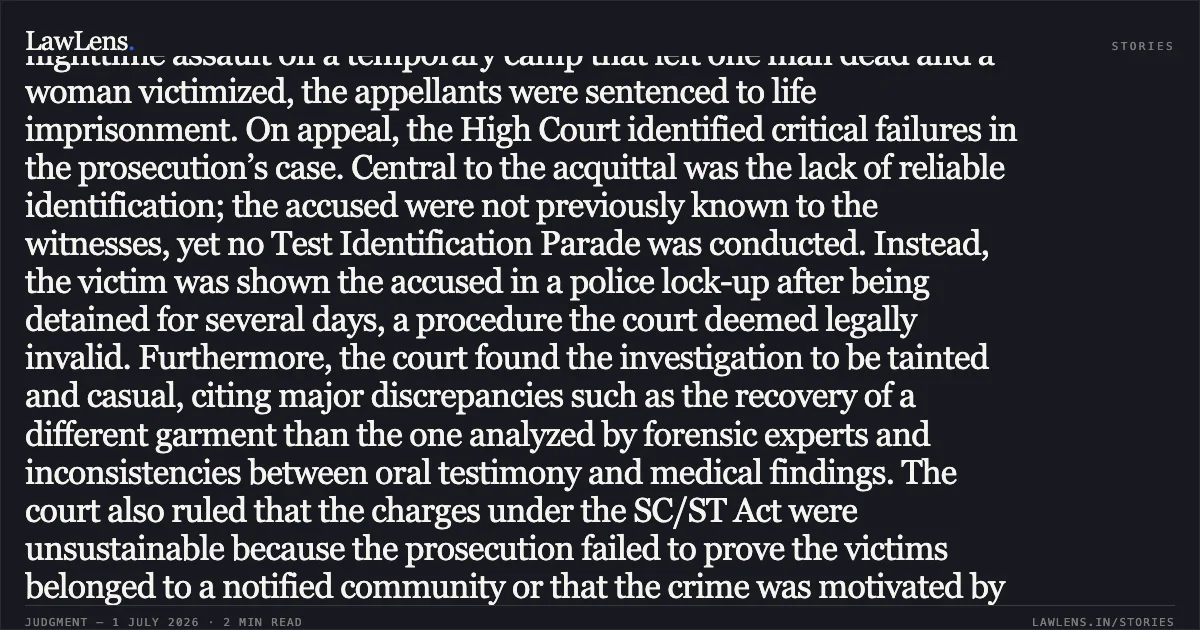
The Court found the identification process fundamentally flawed, noting the victim was kept in police custody for three days and shown the accused in a lock-up rather than through a formal TIP
Source reference: p. 35-38This lack of procedural integrity rendered the subsequent courtroom identification unreliable
Source reference: p. 54Regarding the SC/ST Act, the Court observed that since the accused and victims were previously unknown to each other, the crime could not have been motivated by the victim's caste
Source reference: p. 40-42Significant forensic discrepancies were highlighted: the police seized a "ghaghra" (skirt), but the forensic lab received and tested a "petticoat," and medical reports failed to find injuries consistent with the victim's testimony of struggle
Source reference: p. 49-50The Court noted that the trial court ignored the testimony of a neutral defense witness (D.W. 1) who was present during the FIR filing and confirmed the assailants were different individuals
Source reference: p. 54-55Holding
The prosecution failed to prove the involvement of the Appellants beyond reasonable doubt due to a tainted investigation, failed identification protocols, and material inconsistencies
The High Court allowed the appeals and set aside the judgment dated 03.02.2011. The Appellants were acquitted of all charges and ordered to be released forthwith if not wanted in other cases
Source reference: p. 64Acts & Sections Cited
23 provisions across 5 statutes referred to in this judgment. Each provision opens on LawLens.
Indian Penal Code, 1860
Code of Criminal Procedure, 19736
Scheduled Castes and the Scheduled Tribes (Prevention of Atrocities) Act, 19892
Arms Act, 19592
Bharatiya Nagarik Suraksha Sanhita, 20231
Original Court PDF
Anwar Ali And Ors.vsState Of U.P.
Click to open original judgment
Original judgment, available to read, download and summarize on LawLens.in